Wednesday, March 29, 2006


Denmark Invites Muslim Leaders to Talk
Danish Foreign Minister Per Stig Moller is expected to receive the Muslim delegation.
By Nidal Abu Arif, IOL Correspondent
COPENHAGEN,


Danish Foreign Minister Per Stig Moller is expected to receive the Muslim delegation.

March 26, 2006 (IslamOnline.net) – The Danish foreign ministry has invited leading Muslim figures for a meeting in Copenhagen within weeks to address the cartoons crisis for the first time since the September publication of the drawings that lampooned Prophet Muhammad (peace and blessings be upon him), a leading Danish daily revealed Sunday, March 26.
The invitation was sent to Secretary General of the Muslim World League Abdullah bin Abdulmohsen Alturki before the Manama conference, Politiken quoted as saying Thomas Christensen, head of the Middle East Section at the Danish Foreign Ministry.
He was referring to the two-day International Conference for Defending the Prophet, which wrapped up in the Bahraini capital Thursday, March 23.
Brining together up to 300 Muslim scholars worldwide, the gathering announced the establishment of an international organization and a fund for defending the Prophet.
A similar invitation has been further extended to the Washington-based International Committee for the Support of the Final Prophet (ICSFP).
ICSFP Spokesman Ali Jumaa confirmed that his committee received an invitation from the Danish Foreign Ministry to attend the Copenhagen meeting.
He told Politiken that the committee delegation will group a host of prominent Muslims figures from all over the world.
The Committee was one of the Muslim bodies, which co-championed the Manama conference.
Twelve cartoons, including one showing the Prophet with a bomb-shaped turban, were first published by the Danish daily Jyllands-Posten in September and reprinted by European newspapers on claims of freedom of expression.
The drawings, considered blasphemous under Islam, have triggered massive and sometimes violent demonstrations across the Muslim world.
Dialogue
Christensen said the Danish government has opted for a constructive dialogue with the Muslim world.
"We wanted to express our keenness on entering into a dialogue with the Muslim world," he was quoted by the daily as saying.
"There are many misconceptions about Denmark in Muslim countries, so it is useful to put our heads together," added the Danish diplomat.
Asked on the issues high on the agenda, Christensen said the economic boycott will be possibly tackled.
The drawings have triggered a massive Muslim economic boycott of Danish products, costing the strong economy of the Scandinavian country hundreds of millions of dollars in less than one month.
Muslim scholars, however, hailed the positive stance taken by Danish dairy company Arla Foods, which strongly condemned the publication of the cartoons.
The paper said the meeting is expected to raise the Danish State Prosecutor's decision not to drop a case filed by Muslims against the Posten.
State Prosecutor Henning Fode argued that the mass-circulation daily did not violate the Danish freedom of expression laws by commissioning and printing the cartoons.
Danish Muslims are planning now to take the publication of cartoons to the United Nations after Fode's snub.
It is the first time that Denmark sends an official invitation to Muslim figures for a dialogue since the spark of the cartoons crisis.
At the very outset of the standoff, Prime Minister Fogh Rasmussen refused to meet a delegation of ambassadors of Muslim countries in Denmark.
Rasmussen has said he regretted the hurt caused to Muslims but refuses to apologize on behalf of the paper.
The editor of Jyllands-Posten has apologized for offending Muslims but defended the paper's right to publish the cartoons.
The Muslim world insists on a clear-cut apology for the "publication" of the odious cartoons and is pressing for a UN resolution criminalizing blasphemy.
Nike makes sportswear for Muslim refugees
DADAAB, Kenya, March 25 (UPI) -- Muslim girls at a refugee camp in Kenya are learning to play volleyball, wearing uniforms specially designed by Nike to meet Islamic standards.
Oliver Delarue of the United Nations High Commission for Refugees told the BBC the uniforms have been "very liberating." He described them as long pants with a top resembling a traditional jilbab, or long tunic, on top -- and said the girls chose the most traditional of the four possibilities Nike designers presented.
"It still allows them to move more freely, as they are made of a very modern type of fabric," he said.
Nike, the U.S. sportswear and shoe giant, has been working for the past four years on educational projects in the camps, which house 127,000 refugees from Somalia.
Adar Osman Horar, a female community leader in the Dadaab camp, said sports gives the girls "a break from their daily life" and encourages them to get an education.

© Copyright 2006 United Press International, Inc. All Rights Reserved

Muslim Scouts do their duty
Home News Tribune Online 03/26/06By
DEBORAH LYNN BLUMBERG
STAFF WRITERdblumberg@thnt.com

SOUTH BRUNSWICK — The boys of Troop 114 hike, canoe and help fix trails at Scout camp in northwestern New Jersey. They earn patches, sing songs and hoist tents in the woods.
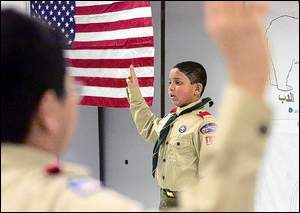
Basith Fahumy leads Troop 114 in the Boy Scout Oath at the beginning of a meeting at the Noor-Ul-Iman School in South Brunswick.

"The coolest thing is the camping and all the activities we do," said Scout Atif Salahudeen, 12, of Lawrenceville. "We're independent for a while."
But unlike most other Boy Scouts, Atif and his fellow 35 troop members take time out during camp to pray five times a day. In the mess hall they dine on halal food, and during weekly troop meetings at the Noor-Ul-Iman School off Route 1 they recite the Pledge of Allegiance and the Boy Scout Oath after a prayer to Allah.
"In the context of the troop we're able to have our own culture," said Saffet Catovic, chair of the troop committee at the Noor-Ul-Iman School.
As members of the first, official all-Muslim Boy Scout troop in New Jersey, the boys mesh their religious beliefs with the values of the Boy Scouts of America, learning first aid, outdoor survival techniques, citizenship skills and earning patches on Islam.
Aly Aziz, 70, a Noor-Ul-Iman board member who was once a Boy Scout in Alexandria, Egypt, founded the troop four years ago. Since then, the school also has chartered a Daisy and Junior Girl Scout troop.
"Being a part of an all-Muslim unit gives a certain level of comfort," said Catovic, adding that pupils are at ease performing daily prayers at Scouting events because they're part of a larger group.
That experience, along with the understanding of the Boy Scouts' regional governing body, the Central New Jersey Council, has helped boys to feel more accepted as Muslim Americans, Catovic said, and more open about their religion.
"The council gave us a lot of support," said Catovic. "They said belief in God is central to Scouting, and if some parts of Scouting are against your religious beliefs you don't have to honor that."
As of 2004, 112 Islamic Boy Scout, Cub Scout, and Venturing Crew groups were chartered in the United States. In 2002, 94 troops were registered; in 2003, 107.
Since Troop 114's inception in 2002, members have held a food drive at the end of Ramadan and organized a mosque prayer service to commemorate the Boy Scouts' 95th anniversary. Catovic led the sermon dressed in a Scout uniform. During Christmas, troop members collected 150 toys from the Noor-Ul-Iman School and distributed the gifts to needy children in Newark.
Alan Rowe, a Boy Scouts of America district director who helped organizers establish the troop, said the boys' presence at Scouting events has inspired cultural dialogue and questions about Islam.
"I think it's wonderful the way they run their Scout meetings," Rowe said about troop leaders. "The 12th point of the Scout law is to be reverent, and they follow that very well."
At a recent troop meeting, Atif and other young Scouts learned rescue breathing and how to approach an unconscious victim with Scoutmaster Ahmadesmael El-Moslimany. The boys, many still in after-school activity clothes — karate and other sports uniforms — bounced in their seats and shouted out answers: "Check for breathing!" and "Do the Heimlich!"
Across the school building, senior Scouts learned about the Religious Emblem, a patch on Islam earned after passing a written test and an oral exam administered by the Islamic Society of Central New Jersey's imam.
"The most important part is to continue to live as Muslims have ordained," Catovic said as he flipped through a copy of the Quran and the Boy Scout Handbook. "And these days, we also have to be able to explain our religion very clearly."
Scouts also must complete religious activities and hours of community service to earn the emblem. Boy Scout troops affiliated with other religions have similar patches: Presbyterians have the "God and Me" emblem and Jews the Maccabee emblem.
Catovic's son, Ibraheem, 15, earned the religious patch last year after writing essays about how he would describe God and what he thought were the effects of prayer.
"I was a little nervous, but I got it," Ibraheem said. "I felt good because it tells you you're on the right track in terms of religion."
Atif, a first-year Boy Scout who said he loves to canoe, recently earned the Do a Good Turn Daily patch through volunteer work both in the community and in the mosque.
"I helped with a turkey drive to give turkeys to poor families and helped clean the mosque," Atif said.
Aziz, who once attended international jamborees in Lebanon and Syria and sailed with fellow Scouts in the Mediterranean, said Scouting helped him become more disciplined and build confidence. He wanted Noor-Ul-Iman pupils to have that same experience.
"Scouting really prepares the youngsters to face any situation," Aziz said. "It makes them independent, more tolerant and more appreciative."
Aziz now teaches troop members how to swim and gives lectures on leadership and drug awareness. The troop participates in all activities required by the Boy Scouts of America in addition to religious events.
"The people at Boy Scouts of America respect our religion," Aziz said. "They're quite understanding."
To close each meeting, the boys of Troop 114 gather in a circle, shake hands and wish each other "salam," peace in Arabic. At a recent meeting, members displayed posters depicting the symbols of the troop's five patrols. Each symbol — a falcon, bronco, panther, bear and lion — is mentioned in the Quran or Hadith, sayings and practices of the Prophet Muhammad, Catovic said.
Looking on, Catovic spoke about the benefits of Scouting, which he says helps boys to grow into responsible, confident men. Scouting also gives members the chance to commune with nature.
"You're not mesmerized by the lights and can actually see the stars," Catovic said. "You're getting back to your origins. You're closer to God."
Deborah Lynn Blumberg:
(732) 565-7264;
dblumberg@thnt.com

Sunday, March 26, 2006

Malaysia set to be hub for Islamic finance education
By Zaidi Isham Ismailbt@nstp.com.my
March 25 2006

MALAYSIA, which aspires to become an Islamic finance, banking, takaful (insurance) and halal hub, has added another sector under the list - Islamic finance education.
Bank Negara has launched the country's first International Centre for Education in Islamic Finance (Inceif) aimed at attracting the world's best minds to beef up their knowledge in Islamic finance.For now, the temporary campus will be at Menara Tun Razak Kuala Lumpur until a new site is identified by the central bank.Bank Negara Malaysia has also set up a RM500 million endowment fund to ensure Inceif's operations and services are benchmarked against the world's best standards.Bank Negara assistant governor Datuk Mohd Razif Abdul Kadir said Inceif is Malaysia's way of offering to the world Islamic finance education."We want to start competing with other hubs in Islamic finance education such as Hong Kong, New York and several West Asian countries," Mohd Razif told the press in Kuala Lumpur yesterday.To date 500 students, of which half are foreigners, have made plans to enrol in Inceif for the certified Islamic finance professional certificates.Successful graduates can expect to become exemplary professionals and will be much sought after in the global employment market in Islamic financial services industry.Duration of its education programmes and courses range between one and nine years and are mostly aimed at working professionals with emphasis on electronic or e-learning.Bank Negara governor Tan Sri Dr Zeti Akhtar Aziz is also Inceif chairman and council members include Royal Professor Ungku A. Aziz, Islamic Financial Services Board secretary general Professor Dr Rifaat Ahmed Abdel Karim and Ambank Group chairman Tan Sri Azman Hashim.

Muslim comics use laughter to tackle discrimination, fear
Azhar Usman says when he walks down the street, he gets dirty looks.
"People are looking like I was responsible for 9/11," the comedian told the crowd recently in the Chicago suburb of Tinley Park, Ill. "Me 9/11? 7-Eleven, maybe.

The 30-year-old Usman, who calls himself "a very patriotic American Muslim" in his act, is one of several emerging Muslim comics who are touring in an attempt to break down stereotypes, encourage critical thinking, create an identity and, most importantly, get people to laugh.
"The standup is quintessentially an American art form and is a form of political protest," said Usman, who grew up in suburban Skokie, Ill. "There's a history of the underdog using standup comedy to speak truth to power. People take notice and are transformed by the experience."
Humor is a good way to deal with issues, said Daniel Capper, associate professor of religion at the University of Southern Mississippi.
"I think it's a very healthy approach for Muslims to take," Capper said. "It's not easy to be a Muslim in America today. Religions everywhere teach the value of being joyful and laughter is a way of being joyful."
Mikal Uqdah of Hattiesburg said the Prophet Mohammed had a humorous side.
"I don't see any problem with it," Uqdah said, adding that it should not be sacriligious. "I am sensitive to the feelings of other people."
Not many subjects are off limits for Usman - a former lawyer who became a full-time comic about two years ago. He jokes about terrorism, the war in Iraq, President Bush, airport security and the Patriot Act. His own religion and fellow Muslims are not exempt.
"Just about anything is fair game, just as long as it's done tastefully and artfully," he said. "I have some boundaries, based on religion. I won't do any sacrilegious material, make fun of God or the prophet."
Usman seeks the advice of Muslim scholars when he has doubts over material.
Though most of the response is positive, Usman knows some Muslims disapprove of his mixture of comedy and religion. He tackles not just how Americans see Muslims but how Muslims in America see themselves.
"It's equally my obligation as a comedian to point out what is wrong with us and get us talking about our problems as it is pointing out what's wrong (with) the way, for example, the government is treating us," Usman said.
Although he performs solo, Usman also travels as part of the Allah Made Me Funny tour with two fellow Muslim comedians.
They began touring in 2004, thinking they'd be a success if they played 30 cities in three years. Instead, they toured 50 cities in one year, performing not just at Muslim community centers but comedy clubs across the United States and internationally.
Tour creator Preacher Moss, a longtime comic who has written for popular comedians including George Lopez and Damon Wayans, says the tour has a twofold message.
"On the outside our goal is trying to build bridges with non-Muslims, but on the inside it's to build bridges between ourselves," said Moss, 39. "When you get people to smile about what they're fearful about, it's powerful. And when you finish laughing, you think about what you're laughing about."
Using laughter to tackle discrimination and fear is not new. Minorities in America have often used standup to open people's eyes.
"Humor is a good way, as it always has been, of drawing people in, exploiting the stereotype and finding a common ground," said John Lowe, a Louisiana State University English professor who's working on a book about humor in American ethnic communities.
Maysoon Zayid, a New York-based standup, helped create the Arab American Comedy Festival hoping to break down stereotypes and showcase Arab talent.
The show has played the last three years in New York.
"This is an effort to really change the image of Arabs in America, which are often considered religious zealot-terrorists," said Zayid, 30.
Along with comedy clubs and Muslim community events, these comics also are using technology as a platform to bring their messages to a bigger audience.
Usman is developing a podcast about a fictional character named Tinku Patel - an Indian Muslim who comes to America to make a movie. Patel interviews celebrities and average Americans, asking them their thoughts on race and politics.
Matt Suneulli, the podcast's co-creator who also works as a producer for MTV, said he's hoping the podcast becomes popular enough to parlay into a television show.
But for Usman and his colleagues, being a comic isn't just a way to make money or gain fame. They've become role models for other U.S. Muslims who are looking for ways to merge their Muslim and American identities.
"To me this is not just about standing on stage telling jokes," Usman said. "There's a lot riding on this."
Originally published March 25, 2006
Muslim women raise voices worldwide
Mar. 25, 2006. 01:00 AM
RAHEEL RAZA
OPINION

During the height of the Danish cartoon controversy, Canadian media interviewed male Muslim leaders exclusively, without bothering to seek out leaders among Muslim women. It's a given that Muslim leaders are men, preferably with beards.
Haideh Moghissi, a sociology professor at York University, says that rigid, unforgiving and sexist voices are considered valid voices by Western media. When a Muslim woman speaks out or assumes a leadership role, she's called militant.
Yet the struggle for sexual equality and leadership among Muslim women is gaining strength around the world.
Harvard University recently held a seminar titled "Emerging Forms of Muslim Women's Leadership."
Among the panellists was Sarah Eltantawi, a young Muslim doctoral candidate at the university and a media commentator on American-Muslim Affairs and Middle East policy who writes on counterterrorism for Upfront and The New York Times.
She spoke about the importance of a dialogue of civilizations as someone who has been part of U.S.-Islam dialogue in Qatar.
The dialogue continued at The Union Theological Seminary at Columbia University in New York where a diverse panel of Muslim women to spoke about leadership.
Among them were Aisha al-Adawiya, an African American Muslim who founded the advocacy organization Women in Islam Inc., and Shqipe Malushi, a Sufi poet and writer from Kosovo and Nureen Qureshi, a young TV anchor and head hunter for IT from Mississauga. These women are movers and shakers working at the grassroots level, creating dialogue and safe spaces for other Muslim women.
They believe that if men won't allow Muslim women their rights, then Islam will; all they have to do is reclaim what was originally given to them by the Prophet Muhammad.
This populist women's movement in Islam also has traction in Europe. At an early celebration of International Women's Day, the International Federation of Women Against Fundamentalism and for Equality (WAFE ) held a conference in Paris.
Formed after 9/11, WAFE asserts that fundamentalism in all faiths has emerged as the biggest challenge for humanity. The battle for sexual equality and emancipation can't be separated from the fight against extremism, its members say.
The conference, titled "Women's leadership: Indispensable to the struggle against fundamentalism," was supported by 15 European organizations.
Discussions ranged from fundamentalism as it exists in many faiths today to the challenges of female leadership, but the main focus was rise of fundamentalism in the Muslim world.
The international solidarity network Women Living Under Muslim Laws has identified anti-female policies as one of the warning signs of rising fundamentalism.
Whether it's abortion bans in U.S., opposition head scarves in Europe or forced veiling by the Taliban, whether its limiting women's freedom of movement or their rights to education and work under dictatorial regimes, the leaders of these movements are always men, and the victims are always women.
The women, however, are insistent on making their voices heard.
The speakers at the Paris gathering were from a variety of religions and countries — United States, Canada, Australia, France, Britain, Germany, Belgium, Switzerland, Italy, the Netherlands, Greece, India and Iraq as well as representatives of the National Council of the Resistance of Iran — and included members of parliament from several European countries. They were all of the view that religious fanatics exist in every faith and that women have been exploited by religious leaders for centuries.
In her opening remarks, Dame Elizabeth Sydney, chair of the International Federation Against Fundamentalism and for Equality, said, "Gender equality brings great many benefits ... it introduces an enormous amount of talent and energy into society. Under the fundamentalist regime, women are violently prevented from using their abilities. But the release of 50 per cent of human talent will raise standards for all of us."
In a video message, Maryam Rajavi of the Iranian Resistance said that Islamic fundamentalism is the biggest threat to the equality movement and therefore finding a way to confront the imminent danger of religious fascism ruling Iran is an urgent imperative.
Asked how to defeat Islamic fundamentalism and misogyny, Rajavi responded: "You have to eliminate the male-dominated culture as an inhumane culture, through women leadership. Accordingly, the establishment of democracy without the active role of women in society's leadership is impossible or at best retractable."
Adding their insights were Prof. Carole Fontaine of Boston's Andover Newton Theological School who called "fundamentalist patriarchy" a disease; Sushma Dilip-Pankule, representative of the International League of Women For Peace and Freedom in India, who pointed out the major role fundamentalism plays in female infanticide, dowry deaths, child marriage and sati, all of which continue despite government restrictions; Anissa Boumedienne, a lawyer, writer, and wife of the late Algerian President Houari Boumedienne strongly promoted education for women; Swiss Parliamentary Deputy Salika Wenger, who said that it's popular for politicians to discuss fundamentalism without doing anything to fight it; and Hoda Shaker Maarouf Al-Naimi, a professor of political science in Iraq, who elaborated on "the suffering of Iraqi women in an atmosphere of fundamentalist domination and in the absence of tolerance for diverse viewpoints."
Canadian Muslim women's voices were also heard this past weekend at a conference at Michigan State University titled "Islam and Gender: Social Change and Cultural Diversity in Muslim Communities."
Among the presenters was Jasmin Zine, an assistant professor of sociology at Wilfred Laurier University. She spoke about identity issues and the education of Muslim girls in Canada, both in Islamic and public schools
Western media would do well to keep these women's names on file for the next time they need a Muslim spokesperson to comment on current events.
Muslims forced off plane
HAYWARD — A Muslim father and son from Hayward, California filed a complaint with the U.S. Department of Transportation last week, accusing airline attendants of booting them off a flight because of their appearance.
Fazal Khan, 59, and his son, Mohammed Khan, 28, boarded a United Airlines flight from Los Angeles to Oakland on Jan. 31 wearing traditional South Asian tunics, white skullcaps and loose trousers. Both men also have long beards.
Before takeoff, attendants asked the Khans to vacate their seats and escorted them back to the terminal, said their lawyer, Shirin Sinnar of the Lawyers' Committee for Civil Rights in San Francisco.
"They were essentially told, "You can't take this flight because the flight attendant is uncomfortable," Sinnar said.
The plane was operated by SkyWest Airlines, a regional feeder airline that serves as a carrier for some flights booked with the United Express service of United Airlines.
United Airlines spokesman Jeff Green said his company was "fully investigating" the allegations this week. Utah-based SkyWest is responsible for staff on the aircraft, he said.
SkyWest spokeswoman Sabrena Suite said that the regional airline also is looking into the complaint, adding "there is no room or excuse for discrimination" at SkyWest.
Sinnar said the Khans do not know of anything, other than their attire, that could have agitated the female flight attendant, who apparently expressed concern to the terminal crew about their presence.
An airline customer service representative walked onto the plane and asked the Khans to bring their carry-on handbags with them and return to the airport terminal, Sinnar said.
After escorting them out, the representative was "sympathetic" but said they could not return because the flight attendant was not comfortable with them on board, Sinnar said. With their check-in luggage still in the aircraft's cargo hold, the Khans were booked on a separate flight going to San Francisco International Airport a few hours later.
"The strange thing is no one took the bags off the first flight," Sinnar said. "If there was any thought they were a security risk, certainly their bags should have been removed."
Canada jails Muslims for security reasons
By Reuel S. Amdur -- The Arab American News:

Currently, four Muslim immigrants are being held in Canadian jails pending deportation, and a fifth is subject to strict bail conditions. The five were arrested under provisions of the Immigration and Refugee Act, providing for issuance of security certificates.
Under provisions of the Act, non-citizens may be held in detention without bail or charge on the basis of secret evidence available neither to the accused nor his lawyer. All five of the men are alleged to have terrorist connections and all claim innocence. They all express fear of torture or worse if returned to their home countries.
One judge, James Hugessen, stated the distaste that he and other judges have for the law: "I can tell you because we talked about it. We hate it. We do not like this process of having only one party and looking at the materials produced by only one party and having to try to figure out for ourselves what is wrong with the case. . . and having to try for ourselves to see how the witnesses . . . . ought to be cross-examined."
Hassan Almrei, a Syrian, has been in custody since 2001, accused of being an al Qaeda agent involved in forgery. Pictures of Osama bin Laden were found on his computer, but he says that he downloaded the pictures with articles from Al Jazeera and the BBC. He went on a hunger strike to get improved conditions in jail, and the prison guards supported his complaints. Almrei fought with the muhajadeen against the Russians in Afghanistan.
Mohammad Mahjoub, held since 2000, is accused of membership in Vanguards of Conquest, affiliated with the Egyptian Islamic Jihad. He admits working for bin Laden on a farm in Sudan. Another Egyptian, Mahmoud Jaballah, principal of a Toronto Islamic school, is accused of being a senior operative of the Al-Jihad organization as well. He claims to have been imprisoned and tortured in Egypt but never convicted of anything.
Mohamed Harkat, an Algerian refugee, in jail since 2002, stands accused of memership in the Groupe Islamique Armé, described as a violent organization bent on setting up an Islamic state. It is also alleged that he was in Afghanistan, took part in the resistance in 1991, and was involved with al Qaeda lieutenant Abu Zubayda. He denied these allegations, saying that he was never in Afghanistan, being in Pakistan at the time. Federal Court Judge Eleanor Dawson, who examined the secret evidence, did not believe his denials.
The only one of the five out on bail is Adil Charkaoui. The Canadian Security Intelligence Service (CSIS) accused him of being an acquaintance of al Qaeda members and of connections to the Moroccan Islamic Combatant Group, blamed for attacks in Spain and Morocco. His bail conditions include a curfew and an electronic monitoring bracelet. He is also restricted as to his contacts and as to computer usage.
Amnesty International charges that "individuals detained purusant to a security certificate are effectively denied their right to prepare a defense and mount a meaningful challenge to the lawfulness of their detention." AI further calls attendtion to the fact that "international law provides absolute protection against being returned to torture."
Some critics have argued that, if secret evidence is necessary, then the court should be aided by an advocate for the person detained to examine the evidence and question witnesses, a kind of second lawyer for the accused who does not share the information with the actual lawyer or the client. There is no provision in the law to provide such protection.
In other Canada news, The Canadian Council on American-Islamic Relations (CAIR-CAN) this week called on law enforcement authorities to treat an attack on Muslim students at the University of Toronto (UT) as a hate crime and to bring the strongest possible criminal charges. CAIR-CAN is also calling on the university to take concrete steps to address racial hate and Islamophobia on campus.
Several witnesses told CAIR-CAN that a man attempted to run down four Muslim students with his car on the university campus on Sunday after yelling racial slurs at them. One of the students was reportedly hit by the car and taken to a nearby hospital by paramedics. The alleged attacker sped away.
"The University of Toronto has been known for its tolerance and accommodation of religious needs. Now the university must take a strong stand to show that all forms of hate and racism, including Islamophobia, will not be tolerated on its campus," said Riad Saloojee, CAIR-CAN's executive director. He added that the university must take action to ensure the safety of its Muslim students.
In a prior complaint, a female Muslim student at the university told CAIR-CAN she was pushed and called a terrorist on March 7. Earlier complaints received by CAIR-CAN concerned at least two different flyers promoting Islamophobia that were distributed at both York University and the University of Toronto.
The victim of the March 7 incident told CAIR-CAN that she believed a "Know Radical Islam" weeklong event organized by a student group at the university in February may have also contributed to the recent rise of Islamophobia on campus.
Last week, CAIR-CAN sent a letter to David Naylor, president of the University of Toronto, asking that the university take a strong stand against hate. CAIR-CAN reiterated that request this weekend.
CAIR, America's largest Muslim civil liberties group, has 32 offices and chapters nationwide and in Canada. Its mission is to enhance understanding of Islam, encourage dialogue, protect civil liberties, empower American Muslims, and build coalitions that promote justice and mutual understanding.

Friday, March 24, 2006

It's Jummah


Inshallah we will take advantage of as many blessings as possible today. Enjoy Jummah. Salaam Wa Laikum.
Quebec orders prayer site for Muslims

Mar. 23, 2006. 01:00 AM

MONTREAL—The Quebec Human Rights Commission says a university-affiliated institution should try to find reasonable accommodation where its Muslim students can pray.
Some students at the Ecole de technologie supérieure, affiliated with the Université du Québec, complained they had to pray in the stairwell.
The students want the school to build a separate prayer room because they are tired of kneeling on prayer mats.
A commission spokesman says the college has a responsibility to offer reasonable prayer accommodation to the Muslim students but is not obliged to offer space that is exclusive to them.
Marc-André Dowd, the commission's interim president, said a multi-faith chapel or classrooms are possibilities.
The school's "secular format doesn't exempt it from its obligation to reasonably accommodate its Muslim students," he told a news conference.
The complaint was launched on behalf of 113 students.
The commission also ruled that pictograph signs prohibiting the washing of feet in the school's sinks wasn't discriminatory against Muslims, who must perform the ritual. Witnesses testified that it's acceptable for a person to simply pass his wet hands over his feet.
Canadian Press

Bernama.comMalaysian National News AgencyMuslims Almost Totally Dependent On Others, Says Mahathir
Business
March 23, 2006 12:55 PM
By Umi Hani Sharani


KUALA LUMPUR, March 23 (Bernama) -- Muslims do not seem to have faith in their ability or qualifications, as they are almost totally dependent upon others for almost all their needs in life, says former premier Tun Dr Mahathir Mohamad.Currently, the chairman of the Islamic Development Bank (IDB) 1440H Vision Commission, Mahathir said that even in the extraction of the wealth and resources that Allah has blessed the Muslims with, they were still dependent on others."We hire other people to do everything for us," he said in his address prior to the launch of the report containing details of the vision, here Thursday."The whole Muslim Ummah of 1.5 billion is one huge consumer society, procuring all our needs from outside our community, including our defense and security requirements."We produce practically nothing on our own, we can do almost nothing for ourselves, we cannot even manage our wealth," he added.Mahathir said the Islamic world today was full of paradoxes and contradictions. In spite of a number of Muslim nations being extremely wealthy, there is not a single one of them that can be classified as developed by any criteria."Certainly there is no Muslim world power as there was for much of the past 1,300 years....lagging behind in modern knowledge, financial and technological skills and in many instances, effective governments," he lamented.In addition to poverty, ignorance and instability have become such common features in the Muslim world that the detractors assume that these are the natural consequences of following the teachings of Islam, Mahathir said.He said that it is a historical fact that Muslims were at one time the most advanced people in all fields of human endeavours.At the time when the European Christians were wallowing in the Dark Ages and the Jews were wondering rootless all over the world, the Muslims were the biggest traders, the producers of goods, the strategists, navigators and defenders of their faith, he said.Christians and Jews lived freely under the success of the Muslims, while many people embraced the religion so that much of the world became Muslim, he said.Muslims were respected and no one dared to to desecrate the Quran or insult the prophet and his teachings, he said.However, the great Islamic civilization went into decline when the learned Muslims interpreted knowledge acquisition as enjoined by the Quran, to mean acquiring only the knowledge of the religion, rejecting other knowledge as un-Islamic.Followng this, the Muslims gave up the study of science, mathematics, medicine and other so-called worldly disciplines.Instead, they spent much time debating on Islamic teachings and interpretations, on Islamic jurisprudence and Islamic practices, which led to a break-up of the Ummah and the founding of the numerous sects, cults and schools, Mahathir said.Such have been the differences between them that they often kill and war against each other."To this day, they are blowing up each other's mosques to the delight of their detractors," Mahathir added.While the Muslims rejected their worldly knowledge, the Europeans gained from the early studies and researches of the Muslim scholars, achieved their Renaissance and went on to develop their countries and gain wealth, knowledge and military power, he said."We cannot be proud of the decline of the (Muslim) civilization and the sad state of the Muslims today. Nor can we believe that this is what Islam would lead us to when we follow its teachings," said Mahathir.He said Islam promises "hassanah" or good life in this world and in the next for those who accept the faith and the teachings and practice them.If Muslims do not enjoy hassanah in the world of today, it cannot be because of Islamic teachings, he pointed out."It must be because we are not practicing the injunctions of our religion or that we have misinterpreted them. The fault lies with us and it is incumbent upon us to identify what that we do is wrong and to correct them," he advised.

-- BERNAMA
Muslim students cheered by human rights ruling
Three-year dispute; Engineering school must accommodate those who wish to pray

ANDY RIGA
The Gazette
Thursday, March 23, 2006
Muslim leaders were cautiously optimistic yesterday after the Quebec Human Rights Commission told a Montreal engineering school it must allow Muslim students to pray in dignity, though it is not obliged to provide them their own special prayer space.
In 2003, 113 Muslim students filed a human rights complaint against the Ecole de technologie superieure after it blocked Muslim students, who must pray five times daily, from doing so in school hallways and stairwells.
"These students have a right to pray and the school has the responsibility, the duty, to accommodate them," commission president Marc-Andre Dowd told reporters. Students should not have to decide between school and their religion, he added.
After controversy erupted, ETS relented, letting students pray in stairwells and hallways, but more needs to be done to accommodate them, Dowd said.
Citing the Quebec charter of rights, the commission ruled ETS must ensure students can "pray, on a regular basis, in conditions that respect their right to the safeguard of their dignity." ETS could, for example, let them use an empty classroom or a gymnasium, Dowd said.
The school argued that as a secular institution it is not obliged to give students prayer space. But the commission said ETS's secular status does not relieve it of its duty to accommodate the Muslim students.
Dowd said ETS is not obliged to set aside a special room for them, a request of some but not all ETS Muslim students. Compelling ETS to have such a room would cause "undue hardship, as it could lead to similar demands from students of other denominations," he said.
The commission gave the school, part of the Universite du Quebec network, 60 days to solve the problem. If the commission is not satisfied with ETS's response, it may take the case to the Quebec Human Rights Tribunal, a judicial body with the power to order the school to act.
The commission said ETS did not discriminate when it refused to fund a Muslim student group and posted a pictogram near sinks barring foot-washing, a pre-prayer practice of some Muslims.
The panel also said it did not have enough evidence to rule on a complaint about an ETS administrator quoted in a newspaper saying students who didn't like ETS policy could go elsewhere.
The complaint was filed by the Centre for Research-Action on Race Relations and the Muslim Council of Montreal. Council president Salam Elmenyawi said the groups are studying the decision and will comment today.
Elmenyawi said the decision appears to answer the key demand - that students' "religious beliefs be reasonably accommodated in a dignified way." In the long run, that may mean a space shared with other groups, he added, noting Muslim students never said they wanted their own space.
He said he is disappointed the decision took three years and that the commission didn't deal with a demand for compensation for ETS's "disrespectful" treatment of Muslim students.
ETS spokesperson Denis Morin said empty classrooms are already available for Muslims who want to pray. "When they aren't being used, any student can use them - they're not locked," he said.
Morin said ETS will study the decision and will comment on Monday.
A group of Muslim students filed a similar human-rights complaint against McGill University in December after the school took away its prayer space. That case is pending.
Nafay Choudhury, president of McGill's Muslim Students' Association, said he hopes the ETS decision persuades McGill to offer students a quiet, clean prayer space.
McGill spokesperson Jennifer Robinson said the school is reviewing the ETS decision.

ariga@thegazette.canwest.com
© The Gazette (Montreal) 2006

Thursday, March 23, 2006

Uganda: Mufti Calls for Girls' Education

(Kampala)
March 22, 2006Posted to the web March 22, 2006
Nathan EtenguKampala
The Uganda Muslim supreme Council (UMSC) is to support the education of Muslim girls destabilised by the insurgency in northern Uganda and insecurity in Karamoja.
The Mufti, Sheikh Shaban Ramathan Mubajje, said on Saturday that the UMSC executive had asked its education department to identify Muslim girls and support their education.
He said some had dropped out due to lack of school fees.
Mubajje said UMSC would liaise with the district khadis to identify and recommend the girls for sponsorship.
He said Islam supported the education of girls and that the first verse in the Koran (read in the name of the Lord) was the first revelation that prophet Mohammed received, which made it obligatory for all Muslims to seek knowledge even if it was somewhere in China.
"Any nation that cannot educate its people cannot claim to be an advanced nation. Contrary to the myth and colonial legacy that Islam did not support the education of girls, in Islam seeking knowledge is obligatory," he said.

Mubaje was on Saturday addressing students, staff and parents of Hamdan Girls High School, Mbale, during a thanksgiving ceremony to celebrate the school's performance during the 2005 O'level and A'level examinations.
He said the success of the school was one of the fruits of his leadership that united all the Muslims in the country and enabled them to identify and focus on education as the cornerstone for development.
He said the unity of the Muslims in the country had also enabled the Islamic University in Uganda (IUIU) to advance to higher levels.
Designer targets Muslim market with prayer-friendly jeans

They're high around the waist, wide around the leg and have lots of pockets for holding watches, bracelets, glasses and other knick-knacks.
A new line of jeans designed by a small company in northern Italy caters to Muslims seeking to stay comfortable while they pray.
"As far as we know we're the first, at least in Italy," said Luca Corradi, who designed Al Quds jeans.
The bagginess is to ensure the wearer avoids stiffness while bending down repeatedly during prayers. The pockets are for holding all the accessories Muslims have to take off while they worship. And the jeans have green seams -- because green is the sacred colour of Islam.
aPs="boxR";
var boxRAC = fnTdo('a'+'ai',300,250,ai,'j',nc);
Al Quds representatives said a year of research and testing went into the product, with models being asked to try different versions of the jeans while they prayed.
Abdel Hamid Shaari, president of the Islamic Cultural Institute in Milan, said low-priced jeans specifically designed to keep Muslims comfortable could open up a big market in countries with large Muslim populations.
"This could be a good idea, thinking of the comfort," said Mr. Shaari, who used to be a production manager for Italy's Carrera jeans.
Mr. Shaari, who is originally from Libya, said Muslims in Tunisia and other North African countries generally wear established brands of jeans or imitations. He said "normal jeans indeed can be slightly stiff to pray and kneel in."
Al Quds -- the Arabic name for Jerusalem -- has produced an initial 9,500 pairs that it sold to the French retailer Carrefour SA. The retailer has sold an initial batch of about 50 pairs of jeans at a low promotional price of $22.53 (U.S.) in Italy, company officials said. Mr. Corradi said the regular price would be $30.44. AP
A Birth-Based Recipe for Australia Becoming a Muslim Nation
By Chad GroeningMarch 22, 2006


(AgapePress) - A pro-family organization dedicated to ending the overpopulation myth says falling birth rates in Australia could dramatically change the long-term future of that country.
Recently an Australian-based Muslim imam bragged that with that nation's low birth rates, the continent could become Muslim-dominated with the next 50 years. Muslims currently make up between 1.5 and 3 percent of the Australian population, and average a birth rate of 2.7 children per woman -- considerably higher than the nationwide average of 1.7. While those statistics somewhat mirror the increasing Muslim population in Europe, Joseph D'Agostino of the
Population Research Institute says Australia is not yet Europe.
"The danger that Europe is facing is all these unassimilated Muslims who could easily be in the majority in some of these countries in 50 years or so," says D'Agostino. "Australia's situation is the immigrants could be in the majority in 50 years or so, but most of those people will not be Muslim."
But PRI's vice president for communications says while most Australian immigrants come from non-Islamic countries like China, the immigration patterns could change. He sees that as the only way the imam's prediction could come to pass.
"[Nearby] countries like Malaysia and Indonesia, which are [predominantly] Muslim, still have relatively high birth rates -- and those countries could, in the future, become greater sources of immigrants for Australia, which is going to need laborers," he observes. According to D'Agostino, countries from which Australia receives many of its immigrants now have very low birth rates, resulting in a labor shortage in those countries over the next couple of decades.
"So the immigration from those countries may really drop," he says. "And therefore, if the immigration patterns change, it is possible for Australia to become a Muslim nation much faster."
In a recent column for
Human Events Online, D'Agostino says that regardless how "Islamic" Australia should become, the character of the country will change due to factors such as high rates of immigration and low birth rates among the native population. "Those who value Australia's Western, English, ordered, and Christian-influenced culture should be concerned," he writes. "Unfortunately, Australians aren't concerned enough to produce their future generations."

Chad Groening, a regular contributor to AgapePress, is a reporter for American Family Radio News, which can be heard online.

Filmmakers focus on Muslim college experience
By Kellie Bramlet
Tribune Staff

Milwaukee should get ready for its close-up — shooting for "Generation Jazba," an independent film about Muslim college students in Milwaukee, is tentatively scheduled to begin in May of 2007.
Writer and director Brooke Maroldi and producer Allyson Bahr said they plan to show the movie at prominent independent film festivals including Tribeca, Sundance and Toronto, among others. In order to help reach this goal they are a holding a fundraiser tonight, where promotional material for the movie will also be shot, according to a press release.
Based on a story by Qudsia Sethi, the film follows the lives of a group of Muslim college students living in Milwaukee as they struggle to find their place in a world between their Muslim roots and American society.
Their goal is "to portray a minority in a way that's realistic and fair and give people a lot to think about," Maroldi said.
Maroldi said they chose Milwaukee for the backdrop of this story for a number of reasons.
"We're here. We work here," she said.
Maroldi and Bahr said that through their film, they hope to present a new image of Milwaukee.
"Milwaukee has been kind of badly portrayed in the past. It's almost embarrassing," Maroldi said. "I think this is going to show a view of Milwaukee that a lot of people across the country have never seen."
Bahr said that the movie will give Milwaukee a "sexy and sophisticated look," because it shows college students gathering against a backdrop of nightclubs, coffee shops and the lakefront.
"We just want to make art in Milwaukee. We love the city," she said.
Both Bahr and Maroldi said the city plays a prominent role in the film, almost like a character.
"With such a small Muslim population here, the movie really is relevant to Milwaukee," Bahr said.
"In the city there's so much segregation," Maroldi said. "We're trying to show that (Muslims) are pretty much like everybody else."
Hammam Hasan, senior in the College of Engineering and leader of Marquette's Muslim Student Association, said he can definitely relate to the characters in this film after hearing a plot synopsis and some details concerning the movie.
Hasan was raised in Philadelphia, but moved to Palestine with his family when he was 8 years old because his parents wanted him to learn about his culture and roots, he said. Hasan said he moved to Milwaukee in 2001 to avoid violence and find better opportunities, attending high school and eventually Marquette.
"I hope that (the movie) justly describes the situation," he said. Hassan also said he hopes that the film focuses on the positive and avoids stereotypes, because the news media often fail to do so.
"There are a lot of things about Middle Eastern tradition that people in the U.S. do not understand," he said. "Having to put up with both ends of the world is not easy at all."
Although the film is about Muslim students, Bohr said its themes are really universal and that college students everywhere should be able to relate to it.
The movie is about "how you carve yourself into this world and become a person," she said. "And I think that all college students can relate to that."
Currently, Maroldi and Bahr, along with their newly-formed production company Jazba Productions, are working on fundraising for the film. They said they hope to raise $50,000 before asking for funds from investors and then moving on to the pre-production phase, which is tentatively scheduled for February. The fundraiser will be held this evening at the Hi-Hat Garage, 1709 N. Arlington Place, at 5 p.m. and admission is $7.

This article was published in The Marquette Tribune on Thursday, March 23, 2006.
Muslim camp lease signed
Published: 03/22/2006 5:34 PM

By: Frank Gluck - The Gazette


NORTH LIBERTY, IA - An organization planning a Muslim youth camp on the shores of Coralville Lake has signed a lease of up to 25 years with the federal government, the U.S. Army Corps of Engineers announced this afternoon.Muslim Youth Camps of America (MYCA) now has full rights to be on the land and, once it works out details with county and state regulators, can begin building at any time.The organization has up to five years to begin building before the Corps of Engineers would reconsider the lease. If, after five years, MYCA shows it is progressing in a "satisfactory" fashion, a 20-year lease would be offered.Plans for the $934,000 facility call for lodging up to 60 campers ages 10 to 17 -- 40 in cabins and 20 in tents -- plus staffers during summer, and up to 40 per night in the off-season.The proposal has been a controversial one. Many neighbors have complained that the development would overwhelm the rural Johnson County roads leading to the facility and that the proposed buildings would mar the scenic nature of the spot.A minority of other camp opponents have tried to block construction by evoking the specter of terrorism.The plans were downsized from the original proposal, which detailed a $2 million facility for 136 campers. The Corps asked Muslim Youth Camps of America in 2003 to cut that scale in half after concerns about safety that neighbors raised.The Johnson County Supervisors had given their informal approval, without needing to vote, in late December for the lease agreement.County planning officials said the camp's operators had adhered to restrictions the county imposed, dealing with the county's planning and zoning, building code, public health and engineering departments.

For more on this story check Thursday's Gazette and GazetteOnline.com

PM: Muslim world needs to develop entrepreneurial skills

KUALKA LUMPUR: Prime Minister Datuk Seri Abdullah Ahmad Badawi said on Thursday that the Muslim world must develop entrepreneurial skills and managerial expertise.
Speaking at the 'Third Islamic Development Bank (IDB) 1440H Vision Commission Meeting and launching the IDB 1440H Vision Document' here, he said, "The Muslim World is not lacking in assets.
"It possesses an abandunt supply of resources for wealth creation. In terms of numbers, the 1.3 billion Muslims represent at least 20% of the world's manpower."

Prime Minister Datuk Seri Abdullah Ahamd Badawi shaking hands with one of the delegates at the third Islamic Development Bank 1440H Vision Commission meeting on arrival at the welcoming dinner at Mandarin Oriental Hotel Wednesday night. Also present was IDB president Dr Ahmed Mohammed Ali (right). "Muslim countries occupy strategic gheographical positions, being located in the centgral region of the earth which are the most fertile and resource rich in the world.
"If there is any deficiency it is more in the area of entrepreneur skills and managerial expertise.
"These we must develop ...," the Prime Minister, who is also the Chairman of the Organisation of Islamic Conference (OIC) said.
For the full text of the speech, click
here.
Law lords back school over ban on Islamic gown
By Joshua Rozenberg,
Legal Editor(Filed: 23/03/2006)

A schoolgirl who was refused permission to wear a
full-length Islamic gown in class was not deprived of the right to manifest her religion, five law lords ruled yesterday.
The House of Lords
allowed an appeal by Denbigh High School, in Luton, against a unanimous ruling by the Court of Appeal last March in favour of Shabina Begum, 17.

Shabina Begum: 'Quite happy that it's all over'
Lord Bingham said it would be "irresponsible" for any court to overrule the school's judgment "on a matter as sensitive as this".
The power to devise a school uniform had been given to the school staff and governors for the "compelling reason" that they were best placed to exercise it, the senior law lord said, and he saw no reason to disturb their decision.
School rules permitted the shalwar kameez, loose trousers under a smock-like dress worn by some Muslim, Hindu and Sikh girls.
But Shabina was sent home when, aged 13, she arrived wearing a jilbab, a long coat-like garment that "concealed, to a greater extent than the shalwar kameez, the contours of the female body".
The school "had taken immense pains to devise a uniform policy that respected Muslim beliefs but did so in an inclusive, unthreatening and uncompetitive way," Lord Bingham continued. "The rules laid down were as far from being mindless as uniform rules could ever be. The school had enjoyed a period of harmony and success to which the uniform policy was thought to contribute."
Cherie Booth, QC, for Shabina, had argued that the school's actions had deprived the girl of the right to manifest her religion under Article Nine of the Human Rights Convention.
But, Lord Hoffmann said yesterday: "Article Nine does not require that one should be allowed to manifest one's religion at any time and place of one's own choosing. Common civility also has a place in the religious life."
Shabina could have changed schools when she discovered that the uniform she had worn for the past two years created a problem for her. "That might not have been entirely convenient for her, particularly when her sister was remaining at Denbigh High, but people sometimes have to suffer some inconvenience for their beliefs," Lord Hoffmann said.
"Instead, she and her brother decided that it was the school's problem. They sought a confrontation and claimed that she had a right to attend the school of her own choosing in the clothes she chose to wear."
Lady Hale pointed out that the school had respected cultural and religious diversity by allowing girls to wear a skirt, trousers, or the shalwar kameez, with or without a headscarf. This was a "thoughtful and proportionate response", as shown by the fact that girls were worried that they would come under pressure to wear the jilbab if it had been permitted.
The law lords also dismissed the second of Miss Booth's arguments - that Shabina had been denied the right to education, guaranteed by Article Two of the first protocol, or supplement, to the Human Rights Convention.
"That article confers no right to go to any particular school," said Lord Hoffmann. "It is infringed only if the claimant is unable to obtain education from the system as a whole."
The law lords agreed that the two-year interruption in Shabina's education was the result of "her failure to secure prompt admission to another school where her religious convictions could be accommodated".
And in a related case taken by Miss Booth on behalf of the Children's Legal Centre, the law lords decided that Abdul Ali, now 18, had not been deprived of his right to education either. As a 13-year-old he had been excluded from Lord Grey School in Bletchley after being questioned by the police about a suspected arson incident - although charges were later dropped.
Speaking in the House of Lords lobby immediately after the ruling, Shabina said: "I am upset about the judgment, but I'm quite glad that I can move on now, and that I did make a stand and speak out against this. I am quite happy that it's all over."
She said she felt that at least she had made a lot of people question the issues. The loss of schooling was not her fault, as there were no places available in alternative schools.
law@telegraph.co.uk

Tuesday, March 21, 2006

Islamic Televangelist Risks Popularity
By NADIA ABOU El-MAGD,
Associated Press Writer12:14 PM PST, March 20, 2006

CAIRO, Egypt -- Islamic televangelist Amr Khaled is young, smiling, teaches love and mercy, and is so popular he's credited with inspiring thousands of women to take the veil. Now he's putting his popularity on the line by trying a new role, as a bridge between Islam and the West at a time when many are talking about a clash of civilizations.
In the process, Khaled is telling the faithful something they're not used to hearing from clerics -- that Muslims aren't blameless in the tensions, that the West is not always bad and that dialogue is better than confrontation. "A young Muslim goes to Europe with a forged visa, takes unemployment insurance there, then goes on TV and says, 'We're going to expel you from Britain, take your land, money and women,'" Khaled said recently on his weekly program on the Saudi satellite TV channel Iqraa, trying to explain the mistrust of Muslims in Europe. "It's a rare example, but it exists." The 38-year-old Egyptian raised a storm of controversy when he attended a March 9 conference of European and Muslim leaders in Denmark, which has been the focus of anger across the Islamic world over cartoons of the Prophet Muhammad first published in a Danish paper. Some in the Arab world saw his attendance as a surrender and branded him a traitor and an opportunist. This week, Khaled is headed to a gathering of Islamic clerics in Bahrain that begins Wednesday, aimed at considering the next step in the response to the prophet cartoons. The conference is organized by one of Khaled's most vocal critics, hard-line Sheik Youssef el-Qaradawi. Many Muslims saw the caricatures -- one of which depicted Muhammad wearing a turban shaped like a bomb -- as an intentional insult and reacted with a wave of protests. In the West, the outrage was seen as an attack on freedom of speech and only deepened anti-Muslim sentiment. For Khaled, the controversy underlined the need for a new approach by Muslims, one of reform and dialogue with the rest of the world. "For the past three years, with youth across the Islamic world, we've been working for a faith-based renaissance in this region, which will not take place by clashes but by coexistence," he said in an interview with The Associated Press in Cairo. Khaled is not the only Muslim religious leader promoting dialogue. But he has become one of the most outspoken. And he brings the fan base of a pop star: young people, women and members of the middle and well-to-do classes. He built his popularity over more than 10 years of preaching in a style far from traditional clerics in their beards and robes, whose sermons often emphasize the demands of Islam and the threat of damnation and hellfire. By contrast, Khaled is known for his stylish suits and broad smile. In his sermons, he avoids politics and stresses God's mercy, seeking to show how one can be a good Muslim while still enjoying the activities of modern life. That message instantly appealed to the young -- particularly the well-off, looking for a version of Islam that suited their lifestyles. Educated as an accountant, not a cleric, Khaled began preaching as a hobby in social clubs, but then vaulted to television. Thousands packed mosques where he preached. "He is a very simple, moderate, humble man, easygoing. He makes you feel like you are his sister," said Zeinab el-Sherif, 32, a wealthy, veiled Egyptian businesswoman who has been a fan of Khaled's for a decade. "He is so tolerant and friendly, he makes you feel good about your religion and yourself," she said. The Egyptian government, apparently nervous over his popularity, pushed Khaled out in 2002, banning him from giving sermons at Egyptian mosques. He moved to London with his wife and son Ali to pursue a doctorate in Islamic studies. His thesis: "Islam and coexisting with the other." The time in London "has resulted in a mixture of maturity and seeing the other better and readiness to coexist," he told the AP. "It also made clear the common values as well as the differences that can't be overcome." Khaled's program on the Iqraa channel continued, and now Egypt -- perhaps seeking to encourage a moderate Islamic voice -- has been more welcoming, allowing him to hold a large conference in Cairo last month. He is back in Egypt for good. Many clerics criticized Khaled in the past, particularly for his lack of religious training. The controversy heated up with his campaign for dialogue, which represents a new foray into the realm of politics. Egyptian newspapers have been sharply divided over his visit to Copenhagen. But Khaled's supporters appear to be sticking by him. "I loved the idea of the Denmark conference, and I don't know any of Amr Khaled's admirers who don't," said Riham el-Demerdash, 35, a veiled mother of three in Cairo. "Those who are against the conference are those who don't like Amr in the first place -- or are clerics who are jealous."

Britain Wants Muslim Businesses?

Britain Aims to Become Europe's Most 'Islam-Friendly' Economy
By Kevin McCandlessCNSNews.com
Correspondent

March 20, 2006London (CNSNews.com) - As more and more British banks offer special services to Muslims, the government says its wants to make the United Kingdom the most Islam-friendly economy in Europe.Treasury officials said they wanted to create a "level playing field" for banks selling financial products that comply with Islamic law (shari'a.)In addition to providing for the 1.8 million Muslims who live in Britain, Treasury spokesman Tom Youldon said the government would continue to promote the country as a center of Islamic finance for Muslims based abroad.According to government estimates, global assets controlled by Islamic banks stand at around $500 billion and are growing at a rate of 10-15 percent a year."Shari'a-compliant" finance forbids any form of interest - called "usury" in the Koran. Although a Muslim cannot earn interest, Islamic institutions can pay investors a share of profits, as earning a profit is not prohibited.All partners in a business venture must share risk equally and Muslims cannot invest in businesses dealing in alcohol, gambling or pornography.To get around these restrictions when selling mortgages, for example, a bank will buy a property and then rent it back to its customer for a set number of years.Currently, the Islamic Bank of Britain is the only fully Islamic retail bank here, but several British banks have begun to offer a line of shari'a-compliant products in the last year or so.Humayon Dar, an economist specializing in Islamic finance, said most British Muslims wanted Islamic banking, but only if it came with the convenience they were used to getting from other banks.He said he personally favored Western banks offering shari'a-compliant services over the creation of small Islamic institutions.Ashraf Piranie, financial director at the Islamic Bank of Britain, said many laws relating to purchasing and leasing commercial property were unfair to Muslim business owners.They were either forced to pay a higher rate of tax when using shari'a-compliant business arrangements or to compromise their religion.Piranie said his bank had been in talks with the government and predicted tax rules would be adjusted once Chancellor Gordon Brown unveils the government's 2006 budget on Wednesday."Thankfully the Treasury has been very keen to understand the issues facing the development of Islamic financial products," he said.While analysts agree that the core of Islamic banking will probably remain in the Middle East, many argue that London is a natural magnet for such activity.Rodney Wilson, a professor of economics at the University of Durham, said that since the city is already a major financial center, many Middle Eastern bankers were already comfortable with doing business there.One problem Islamic financing in the West faced was the shortage of people knowledgeable in shari'a who were able to help structure complex deals, he said.Another was that while a particular scholar may be qualified in terms of religion, his English may not be good enough to understand complicated contracts.Hamid Yunis, a lawyer with the London firm of Taylor Wessing, said Islamic financing was flexible enough to tackle projects of almost any size.Last year, his firm helped an international consortium buy a $250 million office complex in the heart of London in a shari'a-compliant deal that used a form of Islamic bonds as equity."In Islam, there's a saying that in matters of [business] dealings, everything is possible - unless it's prohibited," he said.

What will the Afghan Government Do?

Afghan on trial for Christianity An Afghan man is being tried in a court in the capital, Kabul, for converting from Islam to Christianity.

Abdul Rahman is charged with rejecting Islam and could face the death sentence under Sharia law unless he recants.
He converted 16 years ago as an aid worker helping refugees in Pakistan. His estranged family denounced him in a custody dispute over his two children.
It is thought to be Afghanistan's first such trial, reflecting tensions between conservative clerics and reformists.
Conservatives still dominate the Afghan judiciary four years after the Taleban were overthrown.
The BBC's Mike Donkin in Kabul says reformists, like the government under President Hamid Karzai, want a more liberal, secular legal system but under the present constitution it is hard for them to intervene.
'Tolerance'
Afghanistan's post-Taleban constitution is based on Sharia law, and prosecutors in the case says this means Abdul Rahman, whose trial began last Thursday, should be put to death.
We will ask him if he has changed his mind. If so we will forgive him Trial judge Ansarullah Mawlazezadah
When he was arrested last month he was found to be carrying a bible and charged with rejecting Islam which is punishable by death in Afghanistan.
Trial judge Ansarullah Mawlazezadah told the BBC that Mr Rahman, 41, would be asked to reconsider his conversion, which he made while working for a Christian aid group in Pakistan.
"We will invite him again because the religion of Islam is one of tolerance. We will ask him if he has changed his mind. If so we will forgive him," the judge told the BBC on Monday.
But if he refused to reconvert, then his mental state would be considered first before he was dealt with under Sharia law, the judge added.
He said he expected the case to take about two months to be heard.
Precedent
The Afghan Human Rights Commission has called for a better balance in the judiciary, with fewer judges advocating Sharia law and more judges with a wider legal background.
Several journalists have been prosecuted under blasphemy laws in post-Taleban Afghanistan.
The editor of a women's rights magazine was convicted of insulting Islam and sentenced to death last year - but was later released after an apology and heavy international pressure.
Mr Karzai's office says the president will not intervene in the case.
Observers say executing a converted Christian would be a significant precedent as a conservative interpretation of Sharia law in Afghanistan.
But it would also outrage Western nations which put Mr Karzai in power and are pouring billions of dollars into supporting the country.


Story from BBC NEWS:http://news.bbc.co.uk/go/pr/fr/-/1/hi/world/south_asia/4823874.stmPublished: 2006/03/20 13:15:27 GMT© BBC MMVI

Islam Awareness Week at the University of Virginia


Inside Islam
As Islam Awareness Week begins, Muslim students reflect on life at the University
Jenna Wandres
Cavalier Daily Staff Writer


Sam Stollar Cavalier Daily
Students who attended the Islam Awareness Week kick-off event heard from Imam Siraj Wahajj, who spoke on the recent cartoon controversies depicting the Prophet Muhammad.
When most Americans hear the word "Islam," chances are good that they immediately think of several strong images and phrases. Perhaps they picture an arid desert village crawling with soldiers. Maybe they hear words like "jihad," "fundamentalist" or "terrorism." Maybe they see a replay of a plane crashing into a skyscraper in a plume of smoke and flames.
While the media has popularized these perceptions of Islam, the organizers of Islam Awareness Week feel these stereotypes couldn't be more untrue for the majority of Muslims. While the center of military conflict regarding these issues is in the Middle East, there is a different front of the conflict, some Muslim students feel, which is present right here at the University: the struggle of American Muslims to embrace their faith in the midst of a Western culture that misunderstands them.
­­­
Misunderstood
Islam is the third-largest religion in the United States, and its number of American adherents is growing faster than any other religion. This trend is evident in the University community as well, according to third-year College student Umair Javed, president of the Muslim Student Association. Javed estimates the number of Muslims at the University to be in the low hundreds.
"We're not a very large group, but we are growing every year," he said. "We work to build a support structure for Muslim students by doing things like trying to find rooms around Grounds where Muslims can do their five daily prayers and trying to bring Halaal food to dining halls."
The MSA also recently formed a Muslim Alumni Association, through which Islamic graduates ofthe University can network with present students to share resources, advice and fellowship. Some Muslims at the University, however, are also faced with issues that are not as tangible to solve.
Hassan Tahmir, a fourth-year Commerce student, discussed the difficulties of being a religious Muslim while immersed in a secular society that he feels misunderstands him.
"Islam is a very peaceful religion, based strongly on trust and community," he said. "A lot of times, people see and hear about terrorists and other Islamic groups and make the assumption that all Muslims believe the same thing. Just as Baptists, Methodists and Mormons are all considered Christians, there are different groups that hold different Islamic beliefs."
First-year College student Nazia Chowdhury expressed her frustration with the misconceptions surrounding jihad, an Arabic term literally translated as "striving in the way of God."
"Jihad can be anything from inwardly trying to become a better person to an [armed] struggle fought in defense of Islam," she said. "People, especially the American media, don't understand that in order for true armed jihad to be established, there is a long process with lots of different rules and standards that must apply."
According to a recent MSA project, misconceptions such as these about Islam are fairly common among University students. The project, a documentary, addressed the question, "what is the perception of Islam amongst U.Va. students?"
According to Javed, the results of the project were grim.
"Overall, we found that non-Muslim students don't have a basic knowledge of what Islam is," Javed said. "U.Va. students did have an impressive knowledge of the politics surrounding Islam and had strong opinions about what Muslim countries should be doing, but they had no knowledge of the religion itself."
Tahir said this lack of knowledge is usually the root of anti-Muslim sentiment.
"People don't understand Islam, and they can't understand the Islamic people without understanding their religion," he said.
Since the attacks of Sept. 11, Muslim communities in America have faced a diverse realm of reactions. Waves of hate crimes, harassment and assaults on Islamic people and businesses spiked drastically in late 2001 and have been intermittent since then around the United States.
However, the University community has generally responded in a calmer manner.
"After Sept. 11, people began asking a lot of questions about Islam, with a desire to learn and see it as a peaceful religion," Javed said. "More and more people are seeking to learn about our faith and practices, in order to understand what is going on in the world with an unbiased perspective."
To combat this general ignorance, the MSA has set March 20 through March 30 aside as "Islam Awareness Week," with a theme of "The Many Faces of Islam." This week is meant to show another side of Islam than is usually portrayed in the media and to let the Muslim voice be heard around Grounds.
"We want the student body to hear about controversial issues directly from Muslims," Javed explained. "We want everybody to realize that Islam is broader than what they hear in class and encompasses all areas of life."
Chowdhury said she thinks this week will be a good opportunity for the University community to learn about Islam but, mostly, to recognize that Muslims are a peaceful, God-centered group.
"Our God is the same God as the Christian God and the Jewish God," she said. "Many of us say, 'In'sh'Allah' almost every time we have a conversation, which means, 'If God wills it."
A tight-knit community
"Before I came to U.Va., I wasn't sure what to expect," Chowdhury said. "I wasn't sure if I would be able to fit in and find all the resources I would need. I was scared I would have to be stuck on a crazy vegetarian diet or something."
While the transition from home to college can be difficult for many Muslim students, it is made a lot easier by an extensive support network of both peers and the Charlottesville community.
"Once I got here and I realized how many resources are available to Muslims, I haven't had a very hard time adjusting at all," Chowdhury said.
Tahmir expressed similar sentiments about his experiences at the University, especially during the month of Ramadan.
"During Ramadan, [Muslims] fast during the daylight hours," he said. "It's a month that is intended for us to grow closer to God, but in the process, we are able to grow closer to each other, too."
During Ramadan, the MSA sponsors events such as community fast-breaking after sunset, as well as an IHOP breakfast at 4 a.m.
As a community, Javed said they strive to take advantage of available resources as much as possible. In addition to hosting events with religious studies professors Abdulaziz Sachedina and Timothy Gianotti as key speakers, the Muslim community also gives back to Charlottesville by participating in Habitat for Humanity builds and tutoring young Muslim students at local public schools.
"One of the things we're trying to do is integrate the Muslim identity into the University," Javed said. "And one of the best things about ... U.Va. is that we have the opportunity to work with and learn together with so many different groups."

Islam in Italian Public Schools

I believe that one of the signs of the end of time is that Rome will embrace Islam. I may be wrong ( If I am, please post the correct information so that we all may be properly informed), but this article sounds as though it could be the beginning.

Italian Schools Might Teach Islam
ROME, MARCH 21, 2006 (Zenit.org).- Cardinal Camillo Ruini, president of the Italian bishops' conference, acknowledged the possibility that Islam might be taught in this country's public schools. The cardinal made that point when he opened a session of a bishops' commission on Monday. After recalling that the Church has authority in "relations with the Italian state in regard to the teaching of Catholicism but not in regard to other religions," the cardinal noted that "the right to religious freedom is true for all and, in principle, the teaching of the Islamic religion does not seem impossible." "However, there must be some fundamental conditions, applicable to all teaching in Italian public schools: specifically, there must be no opposition to the contents of our Constitution, for example, in the matter of civil rights, beginning with religious liberty, the equality of man and woman, and marriage," stressed Cardinal Ruini. "To date, a representative entity of Islam has been lacking, empowered to establish an agreement in this regard with the Italian state," he said. "It is also necessary to ensure that the teaching of the Islamic religion does not give room in fact to a socially dangerous indoctrination."

Prince Charles Speaks on Islam

For a long time I have wondered if Prince Charles is a Muslim or not. He appears to be quite knowledgeable in the deen, even more so than some of us that openly profess adherence. You never know. He could be like John Esposito, knowledgeable about the deen but still a Christian. Nevertheless, may we all be guided on the straight path. Here is the article about his speech at Al Azhar University.


Charles mends fences over Islam cartoons
By Caroline Davies in Cairo(Filed: 22/03/2006)

For the Prince of Wales, whose passion for all things Islamic is firmly on record, there can be few greater accolades than the opportunity to address some of the Arab world's most eminent scholars.At Cairo's venerated Al-Azhar University - the oldest seat of religious and secular study in the world - he took full advantage yesterday, delivering a 30-minute speech on inter-faith tolerance entitled Unity in Faith.
Before an audience that included Egypt's top cleric the Grand Sheik of Al-Azhar, Mohammed Sayed Tantawi, and 800 students and teachers, he seized the opportunity to criticise the Danish cartoons that satirised the Prophet Mohammed and provoked violent protests across the Muslim world.
"The recent ghastly strife and anger over the Danish cartoons show the danger that comes of our failure to listen and to respect what is precious and sacred to others," said the prince.
"In my view, the true mark of a civilised society is the respect it pays to minorities and to strangers."
He continued: "I look forward to a world in which we share a vision that acknowledges our differences with respect and understanding, that recognises what others hold sacred, and to a world in which we see that we cannot and must not abuse our great traditions and their teachings as a weapon in the service of selfish worldly power."
It was a mammoth speech, running to eight typed pages. The Duchess of Cornwall perched a pair of wire-rimmed reading glasses on her nose, for the first time in public, to read the English version.
In respect of Islamic culture she had slipped off her duck-egg blue suede shoes to reveal pink-laquered toenails.
In the knowledge that the eyes of the Sunni Muslim world's most auspicious scholars would be upon her, she had chosen an ensemble of pale-blue silk and chiffon tunic top and white trousers, a Western interpretion of the shalwar kameez and designed by Robinson Valentine.
Earlier, the royal couple joined 30 students at a class in English on Islamic studies at the mosque adjoining the university.
The highlight of the visit was the presentation of an honorary doctorate to the prince in recognition of his conciliatory stance since the September 11 attacks.
Yesterday's visit coincided with the Duchess being named "Spouse of the Year" by The Oldie magazine for her "strength and conviction " in the public gaze, attributes which have undoubtedly helped her bear constant comparison to Diana, who was also famously photographed at the mosque.
Accepting the award long-distance and with good humour, she dispatched a tongue-in-cheek message via her friend, the author Jilly Cooper.
"Unfortunately, at the time this award launch takes place I shall be carrying out some overseas spousing duties," she said.

Friday, March 10, 2006

Community Development

I am only recently getting over the flu. That is why I have been remiss with posting new information. Nevertheless, Alhamdullah I'm back. As you will come to find out over time, I like to progress and to help others do the same. One thing that I feel is missing from the ummah here in North America is the unity of Muslims outside of the masjid. Our deen is a way of life that extends beyond salaat and the masjid.
I think that we need to insulate ourselves from the flucuation of public perceptions of Islam and Muslims. I believe that a good way to provide this insulation is to establish and support Muslim businesses. I realize that there are many Muslim owned businesses across this country, but we need more. It doesn't matter if you start the next Microsoft or Google, or if you transition a hobby that you are good at into a homebased business. Even if you are currently employed, you should still consider starting a business. The goal is to be as self-sufficient as possible.
We should focus on three things (business wise) . The first is to insure that it is a halal means of earn an income. The next is to employee other Muslims, particularly recent immigrants and high school/college students (This will give valuable experience to the next generation of Muslims in our community). We need to look to other Muslim businesses to do business with first (this will keep money within our ummah longer). We need to diversify the types of businesses that we open. Doing so will allow us as a community to adequately support our individual local communities. There are other professions than computer programmers, engineers, doctors, falafel shop owners, and car dealers. All of those professions are needed, but we also need more lawyers, nurses, teachers (not professors), cleaning services, dry cleaners, and etc. All the services and products that we consume from non-Muslims, we should work to provide for ourselves. With that said, Muslim businesses should not take the support of local Muslims for granted by charging above average prices.


I will step off of my soapbox now and provide you with some information to started.


www.sba.gov/starting_business

www.entrepreneur.com

www.inc.com/guides/start_biz/

For existing businesses, please send in your ummah can procure from your business. We have to be aware that your business exists before we can take advantage of your products or services.


INTERESTING VIDEO FOR THOSE NEW TO ISLAM OR WANTING INFORMATION ON ISLAM


Wednesday, March 01, 2006

First Day Extras

Here are more useful resources. I know that the links to the Home country webpages are not up yet. I made all of what you see in one night. This is defintely a work in progress. Inshallah, I will have all of the HCWP linked soon. I do some of the code by hand (old school) so it takes a little longer, but it looks the way that I want. What I would like from you is feedback. I intend to continueously add and improve this project. Please leave comments to let me know what you would like to see or how I may be able to improve this site.


FREE MUSLIM MARRIAGE SERVICE

QURAN TRANSLATION DOWNLOAD FOR FREE
Quran translation in zip format
Quran translation in exe format

FREE COLLEGE SCHOLARSHIPS FOR QUALIFYING MUSLIMS
List of Islamic institutes which may give free room and board for their foreign students(Al-Azhar is # 1 :-)

FREE ARABIC NETSCAPE BROWSER
Sinbad Arabic viewer

QURAN TRANSLATIONS VIEW ON LINE
http://www.geocities.com/Athens/Agora/4229/tQ.html

FREE COPY OF THE QURAN
http://convertstoislam.org/Free-Quran.htm

RECEIVE DAILY AYAT TRANSLATION FOR FREE
http://www.muslimsonline.com/~ayat

FREE MUSLIM E-MAIL
http://www.muslimsonline.com/webemail.html

FREE MUSLIM WEB PAGE SPACE
http://www.muslimsonline.com/freehosting.html
http://www.muslims.net/

FREE MUSLIM CLINICS
http://www.geocities.com/CapitolHill/Lobby/2294/
MUSLIM STUDENT ASSOCIATION FREE ITEMS
Basic Planning for Small Islamic Organizations
Quranic Ayahs of the Week (WithFonts) (Zip file, contains MS Word documents) file which has manybeautifully prepared bezels of Quranic Wisdom for you toprint, Xerox, and post around your campus.
How to Organize Your MSA Log BookDo you wish you could see exactly what other groups aredoing, and learn from them? Then download this file anddo a Project Log Book for your organization, and encourage othergroups to do them, too! (41K Zip file contains 3 MS Word documents)
Guidelines for Establishing Islamic Study Circles (Halaqas) Downloadthis 79K (Zip file, contains many MS Word documents)
Guidelines for Establishing an MSA Library (coming soon)
Summary Notes on a Time Management Workshop (Zip File )
How to Teach the Quran To Children (Zip File of 7 KB)
FREE MUSLIM YELLOW PAGES DIRECTORY
http://www.muslim-yellowpages.com/index.html
FREE MUSLIM GREETING CARDS
http://www.inminds.com/cardcentre.html
http://www.muslimdirectory.co.uk/
http://www.sakhrsoft.com/lpostcards/greeting.html
http://www.islamicart.com/vcards/
http://www.123greetings.com/events/miladudnabi/
FREE MUSLIM MARRIAGE SITE
to the Free Islamic Marriage Page
FREE ISLAMIC RADIO AND SPEECHES ON-LINE
Quran Al Kareem radio station
Hear Qur'an in Arabic
Hear Qur'an translation in English
Hear Qur'an translation in Urdu
Online Islamic audio lessons
Islamic Radio (what CNN hides, now Learn the Full Story)
Voice of Islam
Ahmed Dedaat (hear is great speeches)
Dr. Jamal Badawi (additional great speeches)
Tunisia Radio in French and Arabic
Egyptian Radio
Hear the News in (Arabic), (Urdu), (Hindi), (Persian) news broadcasts.
FREE ISLAMIC GATEWAY CD
http://ummah.net/igcd.html
FREE ISLAMIC PICTURES
http://members.xoom.com/Sumair/page22.html
http://users.aol.com/hineaf/files/free.htm
FREE ISLAMIC ARABIC FONTS
http://www.ummah.net/islamloads/apps3.htm
FREE ISLAMIC PRAYER TIME PROGRAMS
http://www.ummah.net/islamloads/apps1.htm
FREE ISLAMIC MOON CALCULATOR
http://www.ummah.net/islamloads/apps2.htm
FREE MUSLIM SCREEN SAVER
Beautiful Hajj screen saver here
Other Free Islamic Screen savers here
ISLAMIC / ARABIC NEWSPAPERS VIEW FOR FREE
Al Shaab in Egypt
The Truth in the USA
Al Ayyam: Online Arabic Newspaper from Bahrain.
Asharq Al Awsat: Middle East Newspaper (in Arabic)
Islamic Republic news agency in Iran
Harbinger Column
Islamic Voice (India)
Middle East Times
Renaissance Islamic Journal
DAWN, Karachi http://www.dawn.com/
The NATION, Lahore http://www.nation.com.pk/
The NEWS, Karachi & Islamabad http://www.jang.com.pk/thenews/
MUSLIM TELEVISION STATIONS AND VIDEOVIEW ON-LINE FOR FREE
Saudi TV
Free Islamic Video Library a great selection
Dawah in the Park from England
Al Ayam TV Broadcast
Bahrain Radio AND TV
Oman Radio AND TV Broadcast
Pakistan Television
Al-Manar Television
Jordan TV
More Arab TV stations online
ARABIC MP3 MUSIC
Om Kalthoum (one of the greatest Arabic Muslim singers)
non-ISLAMIC, but USEFUL and FREE
Free International Telephone links Call to most Countries Free (no more Phone Bills)
Free Internet Provider Links get online absolutely FREE (no more Internet Bills)
Submit url to All Search Engines Free Easy one step url submission to Top search engines (promote Islamic sites on the web) especially mine :-)
MORE FREE ISLAMIC RESOURCES PAGESSimilar sites offering a wide variety of resources to spread Islam:
http://www.al-sunnah.com/free.htm
http://www.beconvinced.com/downloads.htm
http://209.1.224.14/Athens/Olympus/1458/islam005.htm
http://www.sioindia.com/links/bazar/downloads.htm
http://www.dawatul-islam.org/links.html
http://islamicweb.com/free.htm
http://websolution.net/islamicweb/free.htm


Freestuff