Saturday, July 29, 2006


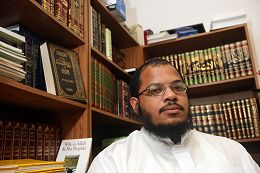
American imam leading diverse Muslim community

By JIM HAUG
Staff Writer

DAYTONA BEACH -- For much of its 30-year history, the Muslim community here has relied on foreign-born religious leaders.

This summer, Muslims have begun listening to the sermons of a 29-year-old who likes to play video games and root for the Washington Redskins.

With an American birthplace, Ron Smith is not subjected to the same worries of Muslim immigrants in this anxious age after 9-11. "If they deport me, they'll have to send me back to New Jersey," joked Smith about his home state.

Criteria for imams -- Islamic religious leaders -- are not formalized, but the Islamic Center of Daytona Beach has usually chosen imams on the basis of their religious knowledge and ability to speak Arabic and English.

The main Friday sermon is given in both languages.

Trying to hire an imam suitable to both Arabic- and English-speaking audiences has always been a tricky balance, said Idris Muhammad, a trustee of the local mosque.

The English of foreign-born imams has not always been as good as their Arabic or else they have spoken in unfamiliar Arabic dialects, Muhammad said.

As a consequence, "part of the community has felt left out at times," he said. "It's like a Northerner going to a Southern barbecue."

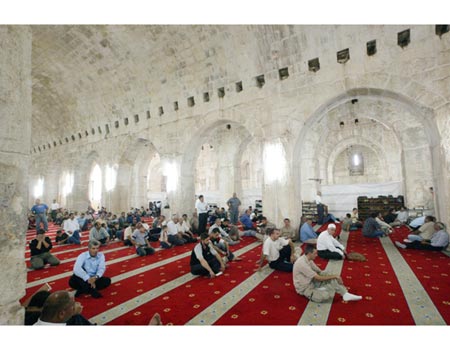
The local Muslim community is extremely diverse with members coming from the Middle East, the Balkan states and the South Pacific. The mosque on Keech Street attracts about 300 people on Fridays, Muslims' main day of worship.

But on major holidays, the mosque will get as many as 600 to 800 people. "The food is always exotic," Muhammad said.

Born to a Puerto Rican mother, a Catholic, and a Baptist African-American father, Smith is well suited as a community bridge builder.

As a lighter skin black, "I could easily pass for a Moroccan," Smith said.

Smith is also good with languages, speaking both Spanish and Arabic, along with English. When he meets an Arab, he said, "I prefer to speak Arabic."

He fit so well in Saudi Arabia that he said he never felt any of the usual hostility directed toward Americans. After six years of study, Smith graduated this year from the Islamic University of Medina in Saudi Arabia with degrees in Arabic and Islamic scholarship.

"That's definitely prestigious," said Phillip Lucas, a professor of religious studies at Stetson University. "It's fairly unusual to have someone from the U.S. with a degree from Saudi Arabia."

But Smith said, "It's all who you know."

After getting out of the Army, he was working as a "quality assurance manager" for a call center in Daytona Beach in 1999.

He met some Muslims at the Islamic Center with contacts in Saudi Arabia. Winning a full scholarship to university there was not part of a master plan by the mosque to get a new imam, Smith said.

Instead, he said it was part of his dedication to a religion that turned his life around.

Smith became a Muslim at age 14 after a teenage cousin was stabbed to death. "I thought if I don't get my act together soon, I could end up the same way," Smith said. Religion wasn't a regular part of his life before.

Muslim street vendors in Atlantic City and a world religion class in high school first exposed him to Islam. One day, he decided to walk into a mosque to find about Islam for himself.

"I actually began to see changes in my life," Smith said. "I became serious about school, became more respectful to my grandmother."

Smith has four children, ages 2-8, with his wife, Conseulo. The family endured six tough years in Saudi Arabia. The cultural differences "smacked you in the face," he said.

His wife was not allowed to drive and had to cover herself completely in public. Smith had to haul drinking water to their third floor apartment.

He does not think his new job will be easy. Imams are on call 24-hours a day, expected to respond to family emergencies and settle domestic disputes.

But Smith is glad to be back in America. The family is saving up for a Disney World vacation.

jim.haug@news-jrnl.com

Did You Know?

An imam is a learned and pious Muslim who generally acts as a leader of the local Muslim community.

· Imams give advice about Islamic law and customs, as well as leading the community prayers.

· An imam is not a priest. There are no rites which only he can perform, but imams usually conduct marriages and funerals.

· Sometimes an imam will also perform the functions of a muezzin (the one who calls people to prayer) as well as the khatib, who preaches the Friday sermon.

-- Compiled by News Researcher Karen Duffy

SOURCES: Religions of the World, The Everything World's Religion Book, www.bbc.co.uk

Local Muslim Culture

Men and women have separate entrances to the Islamic Center of Daytona Beach. A glass partition separates the sexes during prayer services.

· Because Muslims consider fornication to be a major sin, separating the sexes is considered to be like preventive medicine, Imam Ron Smith said.

· Because this is Daytona Beach, how do modestly dressed Muslim women learn how to swim? Usually in the backyard pools of private homes, Smith said. Organizing swimming classes for Muslim children could be a future role for the imam, he said.

Muslim group sues town over effort to build mosque

By JEFFREY GOLD
Associated Press Writer

July 18, 2006, 5:07 PM EDT

NEWARK, N.J. -- A Muslim group has sued a northern New Jersey town, charging that the municipality is discriminating against them by trying to seize its land after stalling its efforts to construct a mosque.

The federal lawsuit by the Albanian Associated Fund accused Wayne of violating religious protections in the U.S. and New Jersey constitutions, as well as a 2000 federal law designed to protect religious institutions against discrimination in land use applications.

Wayne Mayor Scott T. Rumana denied the township was trying to keep a mosque out, saying the land was needed for open space and that the township has suggested other sites.

"You've got an environmentally sensitive piece of property you are dealing with," Rumana said, adding it has steep slopes and lots of rock. "It's a pristine open parcel," he said.

He said the township notified the group in spring of its intention to use condemnation proceedings in light of a state court ruling last summer that allowed property to be taken to preserve open space.

The lawsuit, filed Monday in U.S. District Court in Newark, asks that eminent domain proceedings be put on hold so that the Muslim group's arguments can be evaluated by the court.

The Albanian Associated Fund in 2001 bought the property, which is in an area zoned for houses of worship, and submitted a development plan in 2002, according to the Becket Fund for Religious Liberty, a Washington-based law firm that filed the lawsuit for the Muslim group.

"Just when it seems that there were no more hoops to jump through, the township of Wayne said that they needed to preserve the land for _ quote _ open space," said Becket legal counsel Jared N. Leland.

"AAF is not asking for special consideration," said one of their lawyers, Roman P. Storzer. "This group is entitled to the same protections of the law as any church or synagogue."

The lawsuit charged that the unreasonable delay before eminent domain proceedings began cost the Muslim group three and a half years and hundreds of thousands of dollars.

On the Net:

Becket Fund: http://www.becketfund.org/

Copyright 2006 Newsday Inc.

Tuesday, July 18, 2006


2006: More Jews converting to Islam New record: 70 Israeli citizens expected to convert to Islam this year – more than twice the number in previous years. Most are cases of Jewish, Christian women marrying Muslim men

Nurit Palter

According to statistics from the Population Administration, 2006 will be a record year for Israeli Jews joining the Muslim religion. In the past few years, the number of conversions to Islam was relatively stable at 35 per year, but over 70 conversions were expected this year. In 2003, 40 Jews converted to Islam; in 2004 the number dropped to 27; and last year it stood at 33.
But the trend took a drastic turn this year, and Interior Ministry data showed that in the first half of 2006 alone 42 conversions were recorded, and a comparable number is expected throughout the second half of the year.
The process of converting to Islam is carried out at the Muslim religious court which operates according to Islamic law. In contrast to Jewish conversions, which last months and often years, to become Muslim one must only convince the court that one’s intentions are sincere and declare faith in Allah.
Most are Jewish and Christian women who convert after choosing to marry Muslim men. The number of men who convert to Islam is far lower, but has also seen a rise.
“Jews say they decided to convert after deepening their knowledge of Islam. Many are disappointed in Judaism,” a senior member of the Islamic court said.
In the past, the Religious Affairs and Interior Ministries made it very difficult for Jews to convert to Islam. “They are giving me the runaround, sending me back and forth from office to office. They made me see a psychiatrist, to ‘make sure I wasn’t brainwashed.’ They did everything so that I would despair and return to Judaism,” one convert related.
The data revealed that the reverse phenomenon of Muslims converting to Judaism is significantly lower. In the first half of this year, there were only seven conversions to Judaism.
Statistics that reached Israel’s leading daily Yedioth Ahronoth showed that Judaism continues to constitute a greater attractive force for Christians. In 2003, 437 Christians converted to Judaism, in 2004 – 884, and in 2005 – 733. Since the beginning of 2006, 210 Christians converted to Judaism.
Yedioth reporter Paiz Abbas countered that according to data recorded by the Islamic appeals court, the numbers do not indicate an increase in the number of converts. Further, data show that the greatest number of converts during 2005 were from Jerusalem with 46, followed by Yaffo with 28, then Haifa and Akre with 25 and Nazereth with 22.


Latino Muslims seek answers
Group meets in Hayward to discuss how to reconcile two cultures


By Martin Ricard,
STAFF WRITER
Inside Bay Area

HAYWARD — On a sunny afternoon, a dozen people file into the teaching room at Zaytuna Institute, a Muslim teaching center in downtown Hayward.
But they have not showed up to learn about the Prophet Muhammad, Islam or the Arabic language. They are gathered to enjoy fellowship with one another and discuss what it means to be a Latino Muslim in the Bay Area.
Murabit Benavidez, a lanky Mexican-American wearing a long gray tunic, said he has been pondering the duality since college, but most recently since he returned from studying in Syria. He grew up in Fremont immersed in Latino culture but, lately, he has been trying to reconcile the two cultures since he converted to Islam seven years ago.
"Am I still a Chicano?" he asked. "We have this Islamic identity and, being Latino, we have this Catholic background. I'm not Christian anymore, but am I still Latino? We're redefining what Latino is."
A small group of Latino Muslims — mostly college students and young professionals coming from Silicon Valley — have been meeting recently at Zaytuna to support one another in their new conversion and educate one another on their Latino connections to Islamic culture.
For those such as Benavidez' brother, Justin, who have fully embraced both cultures, Islamic culture always has been a part of Latino identity but has not always been recognized.
"You can find a lot of simifrom Metro 1
larities within the two cultures. Take the language, for example," said Justin, 32, who cited a passage in Carlos Fuentes' "The Buried Mirror," which says that one-quarter of all Spanish words are of Arab origin.
For others, who have not yet found that balance, it has been like making a spiritual jump into their new identities.
"We're kind of breaking that paradigm," he said. "And this is like laying the groundwork, making history as we go along. It's part of the journey."
Latino Muslim groups have been sprouting up all over the country, attempting to find cultural balance in their lives — in some instances, choosing religion over cultural roots. But this fledgling group says its identity will be focused on finding connections with Islamic Spain, which until the 15th century was ruled by Muslims but has since influenced other civilizations, especially those in Latin America, Benavidez said.
There are an estimated
40,000 to 70,000 Latino Muslims in the U.S. and about
1,000 reside in Southern California. There are no statistics available for the Bay Area.
The group has identified about 100 Latino Muslims in the Bay Area and has been meeting under a generic name. But Justin Benavidez said they hope to become a nonprofit and will change the name.
Until last week, they were meeting at Muhajireen Masjid, a local mosque mainly made up of Afghan immigrant congregants.
But renovations on the building have caused the group to search for a new meeting place. Thus, Zaytuna.
Walter Gomez, 29, whose roots are in El Salvador, said Zaytuna has been a perfect fit, not only for its intellectual focus but also for its adherence to the core values of Islam which, in essence, takes on the culture of the place it goes.
The word "zaytuna" — Arabic for olive tree — also has meaning for Gomez as well. It is a reference to aceituna or aceite, both mean oil in Spanish, and the light of God, a well-known and highly-interpreted passage in the Koran.
The Sunday gatherings bring from two to 20 people, Gomez said, and the group even hopes to attract non-Muslims.
"For us, it's not about the numbers," he said. "Just coming together."
On Sunday, Justin Benavidez was ending his lecture on how, toward the end of Islamic rule in Spain, many Spanish leaders believed their past with Muslims prevented the country from becoming as great as other European powers. Now, he said, Spain is beginning to reclaim and embrace that past.
Through the group's gatherings, he hopes to see all Latino Muslims in the Bay Area fully immersed in a quest to forge a new identity that embraces both their Latino and Muslim cultures — but also one that sheds the labeling by the outside world that often perpetuates a chasm between both cultures.
"It's important for us to have a link to something," he said in an interview. "We have a history, and we can trace it through Spain."
Martin Ricard is a general assignment reporter who can be reached at (510) 293-2480 or
mricard@dailyreviewonline.com.

FBI Investigates Online Video Of Destruction Of Muslim Holy Book

posted July 11, 2006

FBI officials said they are looking into an online video showing two men shooting a Quran and then tossing the Muslim holy book down outside a mosque in Chattanooga.The video was posted June 17 on MySpace.com and is titled "kill the koran." One scene shows the two men taking turns shooting the Quran with a military rifle and then tossing it onto the sidewalk outside the Islamic Center at 1410 Cemetery Ave.The location is just off Central Avenue near the National Cemetery.The Council on American-Islamic Relations of Washington, D.C., asked federal officials to investigate.


Could France go Muslim?
Islam and secularism on the rise as Christianity fades


01:00 AM EDT on Saturday, July 15, 2006
BY TOM HUNDLEYChicago Tribune

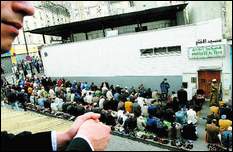
PARIS -- Al Fath Mosque is in a scruffy immigrant neighborhood not far from the neon-lit kitsch of Pigalle. On Friday afternoons the mosque is jammed, and the overflow of worshipers -- all men -- spills into the streets.
Tourists who stumble on the scene reflexively reach for their cameras, struck by this unusual public manifestation of religiosity in a country where Christian belief has become passe.
In France and in almost every other European country, Christianity appears to be in a free fall. Although up to 88 percent of the French identify themselves as Roman Catholic, only about 5 percent go to church on most Sundays; 60 percent say they "never" or "practically never" go.
But Islam is a thriving force. The 12 million to 15 million Muslims who live in Europe make up less than 5 percent of the total population, but the vitality of their faith has led some experts to predict that Islam will become the continent's dominant faith.
Princeton University historian Bernard Lewis, the dean of American Middle East scholars, flatly predicts that Europe will be Islamic by the end of this century "at the very latest."
George Weigel, a leading American theologian, frets about "a Europe in which the muezzin summons the faithful to prayer from the central loggia of St. Peter's in Rome, while Notre Dame has been transformed into Hagia Sophia on the Seine -- a great Christian church become an Islamic museum."
Lewis and Weigel represent a trend among American thinkers who say they fear Europe's doom if it does not re-Christianize, and soon. Most European experts believe those fears are exaggerated.
France, with Europe's largest Muslim population, surely will be a test case.
LITTLE ARGUMENT EXISTS about the severity of the crisis facing the Catholic Church in France. In contrast with the vigorous (and masculine) face that French Muslims present to the world, a typical Sunday Mass almost anywhere in France will feature an elderly priest preaching to a dwindling congregation of mostly elderly women.
"Mass is boring," said Odon Vallet, a religion professor at the Sorbonne. "The ceremony isn't very beautiful; the music is bad; the sermon is uninteresting. Mass is for people who have nothing else to do on a Sunday -- no sports, no hobbies, no shopping, no entertainment."
Islam, meanwhile, is France's fastest-growing religion. But this is mainly a result of immigration patterns, not conversions. Most of the 4.5 million Muslims who make up about 7 percent of the French population are immigrants or the descendants of immigrants from former French colonies in North Africa and sub-Saharan Africa.
Global Islam is eager for converts. But in Europe, the situation is nuanced. According to Olivier Roy, a leading French scholar on Islam, Muslims in Europe would be happy for Christians to convert, while Christians merely want Muslims to become more secular.
Despite the overflow at Al Fath, surveys suggest that the percentage of Muslims attending Friday prayers is not much higher than that of French Catholics who go to Sunday Mass.
The image of jampacked mosques is a "trompe l'oeil," said Roy, the Islamic scholar. "You have many millions of square meters of churches in France, but only a few thousand square meters of mosques."
And even though the conversation in France these days is about the alleged difficulties of integrating and assimilating the Muslim community, Roy said French Muslims are becoming "Europeanized" in more ways than many suppose.
Birth rates among Muslims in Europe appear to be falling into line with a general decline across Europe, he said, and a majority of French Muslims describe themselves as secular or non-practicing. According to one survey, 64 percent said they did not practice.
WHILE PRESIDENT BUSH proudly declares America "a nation of prayer," French President Jacques Chirac praises the virtues of French secularism. France developed a distinctly French notion of church-state separation more than a century ago in an attempt to curb the influence of the Catholic Church. Known as "laicite," it allows all faiths equal status and ensures that all are equally divorced from the functions of the state.
In recent months, laicite became the focus of renewed debate when it was used to justify a ban on Muslim head scarves and other conspicuous religious symbols in public schools, and later to explain French opposition to the inclusion of any reference to Europe's Christian roots in the preamble of the new European constitution.
"France is a lay state, and as such she does not have a habit of calling for insertions of a religious nature into constitutional texts," Chirac explained.
Significantly, the European Union constitution, stripped of all Christian references, was emphatically rejected by French voters.
Last year, when Cardinal Joseph Ratzinger was elected pope and took the name Benedict, the patron saint of Europe, it was seen as a sign that he would refocus the church's energies on rebuilding the faith in Europe. The Vatican was heartened when a million young people turned out last August for World Youth Day in Cologne, Germany, and heard the new pope urge them to rediscover Europe's Christian roots.
Some experts also are encouraged on Christianity's behalf if only because things can't get much worse.
"If you are the type of person who buys stocks and bonds, I'd buy Christianity," said the Sorbonne's Vallet. "The price now is very low, so I think it has to go up."
Other analysts believe Europe's future is neither Christianity nor Islam, but secularism. A pragmatic reading of the numbers suggests that not only will Christianity never regain its dominant cultural role, but also that churchgoers will be forced to recast themselves as minority groups or subcultures.
"Who truly thinks that Benedict XVI is the future of Europe?" asked Roy. "Secularism is the future."


Local Muslims aim to educate public

Monday, July 10, 2006 -
Bangor Daily News


ORONO - The tossing of a frozen pig's head into a Lewiston mosque last week has upset Muslims in northern Maine, the founder of the Islamic Center of Maine reports, even though the modest mosque on Route 2 has never been the target of vandals."After the initial shock," Mahmoud El-Begearmi of Bangor said Saturday, "the discussion centered around how can we help. We seem to be the oldest group in the state, and the other mosques all look up to us for help."El-Begearmi, who has lived in Maine for 26 years, advised leaders at the Lewiston-Auburn Islamic Center to make a concerted effort to educate the community about the tenets of their faith and to invite the public to visit the mosque and attend services. That's the same advice that was offered last week by a Washington-based Council on American-Islamic Relations, a group dedicated to protecting the civil rights of Muslims living in the United States.El-Begearmi, a native of Egypt, knows how demanding a task that can be. The retired University of Maine Cooperative Extension program educator spent every weekend after the Sept. 11, 2001, terrorist attacks traveling around the state dispelling what he saw as the myths and misunderstandings about Islam."We consistently advise Muslims the same way," he said Saturday. "The more you open up to the community that you are a part of, the better off this religion will be."The incident, which has drawn international media attention, happened Monday night, July 3, at the Lisbon Street storefront used as a mosque as about 40 men bowed down according to their prayer ritual. After the pig's head rolled in, the men raced outside to look for the perpetrator.Muslims are prohibited from eating pork, and the council contends the act was an insult to Muslims.Brent Matthews, 33, of Lewiston has been charged with the misdemeanor crime of desecrating a church. The Lewiston Police Department referred the case to the Androscoggin County district attorney as well as the state attorney general.Matthews allegedly told police that it was supposed to be "a big joke," Lt. Don Mailhot said.FBI agents have been conferring with police to determine whether federal hate-crime laws were violated, according to Lewiston police.Matthews, who is free on $200 bail, faces up to a year in jail and a fine of up to $2,000 if convicted of the criminal charge. The former Lewiston city employee could be in more trouble if the state decides to prosecute him under Maine's civil rights statute. If found guilty in the civil procedure, he could be fined $5,000 and ordered to stay away from the mosque and the city's Muslim community.Thom Harnett, assistant state attorney general for civil rights, said prosecutors have been fielding many phone calls about the incident."I think there's a great level of upset and not just the Muslim community," he said.Once state prosecutors get the police report, Harnett said, he will try to decide quickly whether to prosecute. "The goal is to make the community feel safe," he said last week.Although he is always aware that he is part of a religious minority in Maine, El-Begearmi said Saturday that he does not feel that he's a target because he is a Muslim.El-Begearmi is recognized throughout the state as a longtime lay leader of the state's growing Muslim population. He helped organize Muslims for weekly prayers at UMaine when he moved to the state in 1980. For more than a decade, the group planned and raised funds to build its own mosque on land near the Route 2 entrance to the university. When the mosque opened in February 2002, the public was invited to see what it looked like inside."We had an open house," El-Begearmi said. "We had people look inside, and they saw there was nothing unusual here. That kept the imaginations of people from going wild."The most common question he's asked isn't about the tenets of Islam but why the building sits at an angle on the lot."I explain that the entire building is directed to Mecca, the direction that we pray," he said. "We felt we could use the building more efficiently if we didn't have to pray at an angle."He advises other Muslims in the state in the post-Sept. 11 world to keep their guard up."You can't assume that every person by nature is hateful," El-Begearmi said. "When people ask me if I've encountered discrimination, I say not really, but every once in a while I run into an idiot - someone who is misinformed."The best way to prevent more incidents such as the one in Lewiston is to dispel the misinformation, he said.Fast factsThe five major teachings, or pillars, of Islam are:. Shahada, belief in and recitation of the profession of faith, "There is no God but Allah, and Mohammed is the prophet of Allah.". Salat, prayer offered while facing Mecca five times a day - at sunrise, midday, midafternoon, sunset and before going to bed.. Sawm, fasting during Ramadan, the month when the Quran was revealed to Mohammed.. Zakat, contributing financially to the Muslim community, similar to tithing in some Christian denominations.. Hajj, the pilgrimage to Mecca at least once in each Muslim's lifetime, if physically and financially possible.
http://www.bangordailynews.com/

Friday, July 07, 2006

Our Lord! Bestow on us endurance and make our foothold sure and give us help against those who reject faith. (2:250)
HAPPY JUMMAH

THIS SCARES ME!!!

This is an article that I came across and I decided to post it as a warning. Many Muslims are reluctant to address or acknowledge sexual issues, especially with the youth. I am by no means an expert, but I believe that this can contribute to the confusions that could allow someone to think that there can ever be such a thing as an homosexual Muslim. To the best of my knowledge homosexuality transgresses the bounds Islam and is without a doubt HARAAM!!! There are worst things than homosexuality like shirk, but that in no means minimalizes the graveness of the act. We should all say a dua for those that believe that they are homosexual Muslims so that they may become properly guided on the "Straight Path". We should also say a dua to protect our hearts and homes from such misguidance. Feel free to leave feedback after reading the article.

Homosexual and 'passionate about Islam'
Britain's gay Muslims struggle with sexuality, religion, and discrimination

By Jennifer Carlile
Reporter
MSNBC
Updated: 7:41 a.m. MT July 6, 2006

LONDON — "Oh my god, I'm a sinner," Ubaid said he once thought of himself.
"I kept praying and wishing I weren't gay, hoping it was a phase, and that if I kept praying I'd be saved," he said.
Ubaid, who asked that his last name not be used, was born in London to a close-knit and devoutly Muslim Pakistani family.
"I have always been passionate about Islam," the 30-year-old said, explaining how he struggled to resolve his religion with his sexuality.
Several years after deciding not to enter into a marriage arranged by his parents, he is now secretary of Imaan, the United Kingdom's only gay, lesbian, bisexual, transgender Muslim group.
Imaan's members feel like they are targets of both a wider society that discriminates against Muslims, and a Muslim community that sees homosexuality as a Western disease.
"Now we're dealing with Islamaphobia within the gay community, and Muslims who say gays can't be Muslims," Ubaid said.
Despite discrimination, Ubaid has found away to forge his own path and has reconciled his attraction to men with his love of Islam.
'Not acceptable'Imaan, which means faith in Arabic, has around 300 members, most of whom have not told their families that they are gay.
While members vary in how rigidly they keep to Islamic practices like praying five times a day and eating halal food, Ubaid said Imaan is for people who believe that they can be gay and Muslim. If they were raised in a Muslim family but have renounced the religion, Imaan probably would not appeal to them.
The group was started in 1998 as a branch of the U.S. gay Muslim group, Al-Fatiha, after its American members visited London. It serves as a support network, and is a meeting place for people to pray together and celebrate Islamic holidays.
Imaan hosts conferences that deal with such topics as culture, Islamaphobia, non-Muslim partners, HIV and Islam, relatives of gay Muslims, and trans-sexual Muslims. And some members take part in gay pride events.
On July 1, around 25 Imaan members rode atop a float in the EuroPride 06 parade in London. With banners reading "Gay Muslims unveiled" and flags of the United Kingdom and from across the Islamic world, they waved cheerfully at the crowd.
While they didn't hide themselves in rainbow burkhas as they did the previous year, most were still reluctant to give their names or be photographed for fear of reprisals.
Although the group's membership is on the rise, gay Muslims are not accepted by the wider Islamic communities of any country.
In fact, Iqbal Sacranie, who served as the Muslim Council of Britain’s general secretary until this June, told the BBC in January that homosexuality is “not acceptable,” and that Britain’s introduction of Civil Partnerships did “not augur well” for building the foundations of society.
In 2001, a fatwa was issued against Al-Fatiha, the U.S. gay Muslim umbrella group by al-Muhajiroun, an international organization that seeks the establishment of an Islamic caliphate.
Marriage plans"I tried not to be a sinner all my life, and then I thought, here I am, I'm going to go to hell," Ubaid said of when he came to terms with his homosexuality.
"Looking back, I've always been gay, but I didn't realize it until my mid or late teens.
"I'd never had a girlfriend or been attracted to the opposite sex. But, as sex is never talked about (in Muslim circles), it never really occurred to me until I got out of high school."
Ubaid, who has always prayed regularly at the mosque, fasts for Ramadan, and does not drink alcohol, began dating men.
"But, the prospect of marriage kept coming up and my family wanted me to get married," he said.
"I decided that I would get married for their sake," he said, adding that he considered dating men on the side.
"However, when Al-Fatiha (the American Muslim group) came along and I met gay Muslims who'd been married, I realized I just couldn't do it.
"Up to that time, I'd only been thinking of myself, my family, my culture. But, then I started taking into consideration that I'd be destroying someone else's life, making a wife miserable, and possibly the children miserable if I did that," he said.
Coming outUbaid began rejecting his parents’ overtures for him to get married. They couldn't understand his resistance and he failed to give them a reason.
If they found out he was gay, "I thought they might lose it, might kick me out of the house, and although my parents have never physically hurt me I thought they might, or I'd be sent to Pakistan and forced into marriage."
After hiding his homosexuality for so long, it came to the surface in an instant.
"They found a (gay) magazine in my bag in my room and they questioned me about it," he said.
"And I came out. I didn't bother to hide it. I said, 'I am gay and this is who I am.'"
Ubaid said his family do not accept his homosexuality and continue to ask him about marriage, but "they still keep me under their wing, and still love and nurture me as they always did before."
'Educating both sides'Ubaid insisted that his words not be misused to slander Islam as a repressive or hostile religion as he feels very strongly about most aspects of the faith. However, he said he hoped that the Islamic world would become more open to discussions on sexuality and more accepting of those who are not heterosexual.
"Judaism and Christianity have moved on over the years and allow dialogue to take place, but sex isn't talked about full stop (in the Islamic world)," he said, adding that non-Muslim gay men often ask him why he'd be part of a religion that doesn't accept him, and noting a rise in Islamaphobia within the gay community.
"It's a case of educating both sides," he said.
"If the Quran teaches you that everything God created is beautiful, then why would he create a type of person who's always oppressed?"
"We're all equal in the eyes of God."
© 2006 MSNBC Interactive

Muslim group decries desecration of mosque

LEWISTON, Maine -- An Islamic civil liberties group is decrying an episode in Lewiston in which a man threw a pig's head into a mosque.
The Washington-based Council on American-Islamic Relations is calling for stepped up outreach by Maine's Muslim community to educate people about their faith to promote greater understanding.
The incident happened Monday night at the Lewiston-Auburn Islamic Center. Police arrested 33-year-old Brent Matthews of Lewiston, who told police it was a "joke." He's charged with the misdemeanor crime of desecrating a church.
Muslims are prohibited from eating pork, and the Council on American-Islamic Relations says bigots often use pork products to attack or insult Muslims.
Spokesman Ibrahim Hooper says outreach is important. He says anti-Islam prejudice decreases when people get to know ordinary Muslims.
(Copyright 2006 by The Associated Press. All Rights Reserved.)

Muslim soldier's family condemn 'terrorist' claims

· He was doing worthwhile job, brother responds
· Parents not told of mission 'to avoid undue worry'Riazatt Butt and Sandra LavilleWednesday

July 5, 2006

GuardianThe family of the first British Muslim soldier to be killed in the "war on terror" were forced to hit back yesterday against extremist claims that he was a "home-grown terrorist".
Within hours of news of the death of Lance Corporal Jabron Hashmi, 24, in the Helmand province of Afghanistan, a website run by the extremist group al-Ghurabaa posted a picture of the young soldier surrounded by flames.
The group condemned L/Cpl Hashmi, who was in the Intelligence Corps, as a home-grown terrorist for serving with the British army in Afghanistan, adding: "Unlike members of al-Qaida, he took a salary for his terror."
In Birmingham, near the Hashmi family's home in Bordesley Green, some young Muslim men also spoke out.
"I don't see how any Muslim can be in the British army, not with all the shit that's happening in Muslim countries. It doesn't make sense. It's not right. There's no space for Muslims in the army," said a 25-year-old who would only give his name as Saleem. "Of course it's a tragedy and I feel for them [his family]. But what was he doing over there? He was an Asian dude fighting a white man's war. Basically, we can't be like the goreh [white people] and they can't be like us."
But in the front room of the family home in Bordesley Green yesterday there was no doubting the pride in which L/Cpl Hashmi's relatives held him.
Pictures of the young serviceman, born in Peshawar, 40 minutes from the Afghan border with Pakistan, in full regalia took pride of place on the sideboard, by a rolled prayer mat and copies of the Qur'an.
Well-wishers have flocked to the terrace house since news broke that L/Cpl Hashmi had been killed in a Taliban attack on his base in Sangin, in Helmand province, on Saturday. He died alongside Corporal Peter Thorpe, 27, from Barrow in Furness, Cumbria.
L/Cpl Hashmi's brother, Zeeshan, said: "My brother went in [to Afghanistan] in a peacekeeping role.He was doing a job that was worthwhile."
He condemned those Muslims who were criticising the young soldier.
"These Muslim brothers who are willing to carry out suicide bombings and sell drugs to fellow Muslims, they still think they have the ability to criticise people who want to do things differently," he said. "With the anniversary of the July 7 bombings approaching, it is important to try and break down the barriers in society. You can be proud to be Muslim and British - the two don't have to be separate."
Mr Hashmi, who has also served in the army, revealed that his brother kept the news he was going to Afghanistan from his mother, to stop her from worrying.
"As far as my mother and father were aware, Jabron was in Germany," said Mr Hashmi. "They knew he was in the armed forces, but we told them he was doing a language course. All of us brothers and sisters knew, but we felt there was no need to worry our parents unduly."
L/Cpl Hashmi was one of about 300 Muslims in the British armed forces. Inayat Bunglawala, spokesman for the Muslim Council of Britain, said whatever measures the armed forces took, the numbers of Muslim recruits would remain low while Britain was engaged in conflicts such as those in Iraq and Afghanistan.
But he added: "It would be entirely wrong ... to smear him [Hashmi] as being a supporter of the war. When you are a soldier, you have no choice about where you are sent."
In Afghanistan yesterday 12 members of the Taliban were killed in clashes near Kandahar in the south. In another incident, five Afghan labourers working at a US military base in the east were killed on their way home, police said.
More than 60 foreign troops have been killed in Afghanistan since January and yesterday the commander of the Helmand taskforce, Brigadier Ed Butler, said that he was confident London would listen to any requests for additional troops.

Guardian Unlimited © Guardian Newspapers Limited 2006
Anti-gay feelings unite Israel's orthodox Jews and Muslims
Representatives from the organisers of Jerusalem World Pride, marched at last weekend's EuroPride event in London

04-July-2006Benjamin CohenUltra-orthodox Jews and Muslims in Israel have at last found one thing that they agree on, their condemnation of the LGBT (lesbian, gay, bisexual and transgendered) community.“If gays will dare approach the Temple Mount during the parade, they will do so over our dead bodies,” Arab Member of Knesset Ibrahim Sarsur said in a statement.Meanwhile ultra-orthodox rabbis have declared a self proclaimed “holy war” against those organising WorldPride. They claim that young members of their community will be exposed to homosexuality which may lead them to temptation.Rabbi Moshe Sternbuch of the ultra-orthodox Beth Din (religious court) said: “this parade poses a real threat to the citizens of Israel.”Police are meeting today with Israel's Internal Security Minister Avi Dichter to consider whether it will be safe for the parade to take place following threats of violence and protests from across the religious communities.The event scheduled for this August has strangely united religious Jews, Christians and Muslims, who have spoken put against the parade and are arranging a counter “Modesty Parade.”Most recently, Israel’s Chief Rabbi Shlomo Moshe Amar wrote to Pope Benedict XVI asking for his condemnation, he said: "We ask your Excellency to issue an emotional, strong, and unequivocal call against this horrible phenomenon, in the hope that the amalgamation of protests being voiced by religious leaders... will prevent the wilful wrongdoers to damage and corrupt the ways of humanity." Last week Israeli politician, Otniel Schneller, of Israel’s strongest coalition, Kadima party was criticised by fellow members after stating that planned visits by gay groups would turn the Knesset (parliament) into "Sodom and Gomorrah." Alan Bolchover, chief executive of the New Israel Fund said the Member of the Knesset (MK) should get out more, he told PinkNews.co.uk: “It’s sad that an MK of the governing party is so out of touch with his humanity, but its at least heartening that another has stepped in to slap him down.“Maybe Mr Schneller should get out of his office a bit more and walk down the corridor, because a Knesset committee on Lesbian and Gay Rights was founded way back in 1993.” New York Rabbi Yehuda Levin, who is organising the counter religious parade two days prior to WorldPride, said: "This is not the homo-land, this is the Holy Land," Representatives from the organisers of Jerusalem World Pride, AGUDAH marched at last weekend’s EuroPride event in London, a spokesman told PinkNews.co.uk: “It’s great to be here.“We are excited to be hosting World Pride and are applying for EuroPride in 2009 for Tel Aviv.Daniela Meilmann, UK Coordinator of World Pride, told PinkNews.co.uk in reaction to calls for the abandonment of the event, “World Pride 2006 is a call for freedom, freedom of expression, freedom to be different, and tolerance. It seeks to embrace diversity, and is adamant that it will address and raise awareness of all forms of discrimination and injustice. “We hope others will see their own specific struggles reflected in the struggle of LGBT people around the world and come and participate in this rallying cry for peace.” The last World Pride was held in 2000 in Rome, with the disapproval of the Vatican.

Tuesday, July 04, 2006


Western Union blocks many Muslims' money transfers
Associated Press, THE JERUSALEM POST
Jul. 2, 2006

Money transfer agencies like Western Union have delayed or blocked thousands of cash deliveries on suspicion of terrorist connections simply because senders or recipients have names like Mohammed or Ahmed, company officials said.
In one example, an Indian driver here said Western Union prevented him from sending US$120 (euro96) to a friend at home this month because the recipient's name was Mohammed.
Western Union Financial Services, Inc., an American company based in Colorado, said its clerks simply are following US Treasury Department guidelines that aim to scrutinize cash flows for terrorist links. Most of the flagged transactions are delayed a few hours. Some are blocked entirely.
Critics of the program say it is far too broad. The number of people inconvenienced in the Emirates alone, which closely cooperates with US counter-terror operations, is thought to be significant. One Western Union clerk said about 300 money transfers from a single Dubai franchise were blocked or delayed each day - none of which ever turned up a terrorist link.
In Washington, US Treasury spokeswoman Molly Millerwise said foreign banks have used the department's list of terrorist names to freeze US$150 million in assets since it was released after Sept. 11. Millerwise didn't know the value of money transfers blocked using the list, but she said frustrations endured by those with certain names were regrettable but necessary.

In Europe, Islam rises, Christianity falls
Muslims may soon become majority

BY TOM HUNDLEYCHICAGO TRIBUNE
July 2, 2006


Muslims pray at Al Fath mosque in Paris on May 26. Princeton University historian Bernard Lewis, the dean of American Middle East scholars, predicts Europe will be mostly Muslim by the end of this century. (MANCA JUVAN/Chicago Tribune)

Secularizing in U.S.
The American Religious Identification Survey of 51,000 adult Americans last month found some of the secularizing trends seen in Europe.
Unchurched increase: 14% claimed no religious affiliation. That number was 8% in a similar study from 1990.

Unaffiliated young:
Of respondents younger than 35, 23% of men and 18% of women said they did not follow any organized faith. About 43% of the unaffiliated were former Catholics.
"Look at Europe, where a secular trend is prevalent," said Ariela Keysar, a demographer at Trinity College in Hartford, Conn., who is affiliated with the survey. "We're not there, but we're going in that direction."

Abandoning:
The survey found 19% of baptized Catholics leave the church, compared with an average of 16% for Americans of all faiths. Twenty-eight percent of Catholics who drop out do not join another faith.


Philadelphia Inquirer
PARIS -- Al Fath Mosque is in a scruffy immigrant neighborhood not far from the neon-lit kitsch of the Pigalle district. On Friday afternoons, the mosque is jammed, and the overflow of worshippers spills into the streets.
Tourists who stumble on the scene reflexively reach for their cameras, struck by this unusual public manifestation of religiosity in a country where Christian belief has become passé.
In France and in almost every other European country, Christianity appears to be in a free fall. Although up to 88% of the French identify themselves as Catholic, only about 5% go to church on most Sundays; 60% say they "never" or "practically never" go.
But Islam is a thriving force. The 12 million to 15 million Muslims who live in Europe make up less than 5% of the total population, but the vitality of their faith has led some experts to predict that Islam will become the continent's dominant faith.
Princeton University historian Bernard Lewis, the dean of American Middle East scholars, flatly predicts that Europe will be Muslim by the end of this century.
George Weigel, a leading American theologian, frets about "a Europe in which the muezzin summons the faithful to prayer from the central loggia of St. Peter's in Rome, while Notre Dame has been transformed into Hagia Sophia on the Seine -- a great Christian church" will "become an Islamic museum."
Lewis and Weigel represent a trend among American thinkers who say they fear Europe's doom if it does not re-Christianize, and soon. Most European experts believe those fears are exaggerated.
France, with Europe's largest Muslim population, surely will be a test case.
A church in crisis
Little argument exists about the severity of the crisis facing the Catholic Church in France. In contrast with the vigorous (and masculine) face that French Muslims present to the world, a typical Sunday mass almost anywhere in France will feature an elderly priest preaching to a dwindling congregation of mostly elderly women.
"Mass is boring," said Odon Vallet, a religion professor at the Sorbonne. "The ceremony isn't very beautiful; the music is bad; the sermon is uninteresting. Mass is for people who have nothing else to do on a Sunday -- no sports, no hobbies, no shopping, no entertainment."
Islam is France's fastest-growing religion. But this is mainly a result of immigration patterns, not conversions. Most of the 4.5 million Muslims who make up about 7% of the French population are immigrants or the descendants of immigrants from former French colonies in north Africa and sub-Saharan Africa.
Global Islam is eager for converts. But in Europe, the situation is nuanced. According to Olivier Roy, a leading French scholar on Islam, Muslims in Europe would be happy for Christians to convert, while Christians merely want Muslims to become more secular.
While President George W. Bush proudly declares America "a nation of prayer," French President Jacques Chirac praises the virtues of French secularism. France developed a distinctly French notion of church-state separation more than a century ago in an attempt to curb the influence of the Catholic Church. Known as laicite, it allows all faiths equal status and ensures that all are equally divorced from the functions of the state.
Bruno Bourg-Broc, a deputy in the National Assembly and self-described committed Catholic, laments the erosion of the faith in France.
"We are a fundamentally Christian society," he said. "The landscape is formed of churches. It's part of our culture, our literature and painting." Whether people want it in the constitution or not, "we were formed in this way and should not be ashamed of it.
"The doctrine of Islam is to conquer and convert, and we must keep this in mind. I don't think there is a real risk here, but if it happens, it will be our own fault."
Hope for the future
Last year, when Cardinal Joseph Ratzinger was elected pope and took the name Benedict, the patron saint of Europe, it was seen as a sign that he would refocus the church's energies on rebuilding the faith in Europe. The Vatican was heartened when a million young people turned out last August for World Youth Day in Cologne, Germany, and heard the new pope urge them to rediscover Europe's Christian roots.
Some experts also are encouraged on Christianity's behalf if only because things can't get much worse.
"If you are the type of person who buys stocks and bonds, I'd buy Christianity," said Vallet of Sorbonne. "The price now is very low, so I think it has to go up."
Other analysts believe Europe's future is neither Christianity nor Islam, but secularism. A pragmatic reading of the numbers suggests that not only will Christianity never regain its dominant cultural role but also that churchgoers will be forced to recast themselves as minorities or subcultures.
"Who truly thinks that Benedict XVI is the future of Europe?" said Roy, the Islamic scholar.

Copyright © 2006 Detroit Free Press In

Wednesday, June 28, 2006


Muslims in America

They face rising public suspicion but new opportunities

By MARGOT PATTERSON

Being an American Muslim means facing mountains of bad publicity. It also means discovering growing numbers of companions for the journey.

The American Muslim population continues to grow, even as polls show that Muslims in the United States today are facing a rising tide of negative public opinion. A Washingon Post-ABC News poll, taken during the controversy over the Dubai ports deal, found that 46 percent of respondents reported negative views of Islam, seven points higher than polls taken in the aftermath of the Sept. 11, 2001, attacks on the World Trade Center and the Pentagon. A recent survey by the Council on American-Islamic Relations found that about a quarter of all Americans think “the Muslim religion teaches violence and hatred.” A CBS poll taken in April reports that fewer than one in five Americans have a favorable impression of Islam.

But if American Muslims live under a cloud of suspicion today, many say the new attention to Islam has also triggered a surge of American converts to Islam and greater knowledge of Islam among the population at large.

“There’s a lot of anti-propaganda. Before Sept. 11, it was difficult to find any book on Islam in any mainstream bookstore. But now if you go to Borders or Barnes & Noble, you will find several books,” said Dr. Zahid H. Bukhari, a fellow at Georgetown University’s Center for Muslim-Christian Understanding.

R. Kevin Jaques, an assistant professor of religious studies at the University of Indiana, notes that more Latinos and Native Americans are now embracing Islam.

What’s leading Americans to Islam?

Jaques said that as the United States is changing, churches are failing in their traditional role. Converts are looking for something the church isn’t giving them, he remarked.

“Especially for second- and third-generation Latinos, they’re looking for a religious tradition that gives them a bigger sense of community. One of the things you hear in mosques is community, community, community. That’s a major attraction for a lot of people.”

Dr. Jane I. Smith, codirector of Hartford Seminary’s Duncan Black Macdonald Center for the Study of Islam and Christian-Muslim Relations, says there is much in Islam that is similar to Latino culture, including a strong affirmation of the family, a sense of piety and a denial of the Western emphasis on individuality. Moreover, Smith said, Latinos who come to the United States encounter a church with European roots that is not always easy to integrate into or hospitable.

“For a number of Latinos who are Roman Catholic in background, the Catholic church has become problematic in a number of ways. They are looking to Islam for direct theology, no encumbering Trinitarianism, and for providing a welcoming community,” said Smith.

A growing population

Statistical data is scant. Because of that, few actually know whether the talk among ethnographers and religion scholars of an upsurge in American conversions since 9/11 is just that or something more. But no one doubts that the Muslim population in the United States is growing,

Bukhari, a director of Georgetown University’s MAPS (Muslims in the Public Square) project, said continuing immigration, often due to family reunification, and a higher birth rate among Muslims account for most of the increase in the Muslim population in the United States.

Dr. Ihsan Bagby, associate professor of Islamic studies at the University of Kentucky, notes that in the late 1990s, 100,000 Muslims were immigrating to the United States annually. The population of Muslims in America has almost doubled roughly every decade since the 1950s, Bagby said, with the liberalized immigration act of 1965 opening the door to massive Muslim immigration.

Bagby is one of the few researchers who has hard data on the Muslim population in the United States. In 2000 Bagby conducted the first national survey of mosques in the United States, polling a third of the roughly 1,200 mosques. In 2004, Bagby looked at membership in Detroit’s 33 mosques. Comparing survey results with earlier surveys he’d done, Bagby said his findings indicate that increasing numbers of whites and Hispanics are joining U.S. mosques.

“The Detroit study showed a remarkable percentage of white Americans who had converted. In 1994, it was 75 percent African-American. By 2000, it was two-thirds African Americans and one-third white,” Bagby said.

Islam has long exercised an appeal for the United States’ African-American population. In the 1960s and ’70s particularly, many African-Americans, dissatisfied with a Christianity they saw as complicit in oppressing blacks, turned to Islam because of the religion’s moral discipline and its strong orientation to social justice.

“The fact that Islam became associated with the struggle of black people in particular for their rights became part of what it meant to be a Muslim,” Bagby said.

Now the appeal of Islam is widening, said Bagby. Even among African-Americans, said Bagby, the attraction to it today tends to be its spirituality.

“Islam is no longer a protest religion,” Bagby said.

With believers obliged to fast one month out of the year and pray five times daily beginning before sunrise, Islam places more demands on adherents than do many contemporary Christian denominations. For those Americans who turn to it, the commitment Islam requires and the highly structured spirituality may in fact be part of its appeal.

There is spirituality in every religion, Bagby observed. But he noted that he thought Muslims may be doing better at making it a spiritual commitment rather than a routine.

“Islam is a serious moral and spiritual way of life,” said Bagby. “I think Americans today, as opposed to the large wave that came to Islam in the 1960s and 1970s, are largely drawn to that. When they get past all the stereotypes, they see a very organized, very beautiful religion.”

Emerging Islamophobia

That message is getting through to converts to Islam, but it is not reaching the general public, opinion polls indicate. Scholars say that the negative public impression of Islam is forcing Muslims to interact in the public square much more than they had before the attacks of Sept. 11, 2001.

If immediately after the attacks, Muslims were tempted to conceal their faith and withdraw into anonymity, that reaction has passed. Scholars say that if anything, Islamophobia in the general culture has reinforced Muslims’ commitment to their faith. “There’s a kind of ‘let’s gather together and affirm ourselves’ mentality,” said Smith.

At the same time Smith notes significant frustration among the Muslim community. “There’s a very concentrated effort to speak out against terrorism and then feeling enormously frustrated because people are always saying to them, ‘Why don’t you speak out against terrorism?’ and they feel they are but the media isn’t picking it up.”

Under pressure from Congress, the Justice Department and the Department of Homeland Security, Muslims today are living in an atmosphere of “structural confinement,” said Bukhari. After 9/11, thousands of Muslims were rounded up and deported. Millions of dollars in Muslim bank accounts were frozen. Prominent leaders were arrested, often on terrorism charges that were then reduced to minor infractions unrelated to terrorism. “There’s an issue of harassment,” Bukhari noted. Meanwhile, he said, Muslims face “emerging Islamophobia” coming from a particular group of fundamentalist Christian leaders, conservative talk show hosts on TV and radio and a raft of so-called “experts” who describe Islamic centers as centers of terrorism, he said.

Simultaneously, Muslims in the United States are also experiencing new windows of opportunity to present their experience, he added.

“What Muslims are learning when they read American history is that this happened to other ethnicities in the past,” said Bukhari. “It happened to Catholic Americans, it happened to German Americans, it happened to Japanese Americans.”

Margot Patterson is NCR opinion/arts editor. Her e-mail address is mpatterson@natcath.org.


Chirac unveils memorial to France's Muslim soldiers in WWI


DOUAUMONT, France (AFP) - President Jacques Chirac paid homage Sunday to the 600,000 Muslim soldiers from former colonies who fought for France in World War I, unveiling a memorial on the site of the bloody Verdun battlefield.

"The Verdun army was the army of the people, and all the people took part. It was France in all its diversity," he said, inaugurating a white-walled Moorish-style monument in their memory.

The memorial, topped by a cupola built at a cost of 500,000 euros (627,000 dollars), is seen as a belated recognition for Arab and other Muslim soldiers from Africa who fought German troops under France's flag.

It stands in the shadow of the Douaumont Ossuary, a building opened in 1932 that features a long stone cross along the 45-metre height of its imposing cloister.

The ossuary contains the bones of some 130,000 unidentified remains found during and after the battle for Verdun.

That 10-month clash in 1916 resulted in a total 300,000 deaths on the French and German sides. An estimated 35,000 of them were Muslim soldiers fighting for France.

A monument to Jewish soldiers built in 1938 also stands nearby.

Previously, there existed only a small memorial pillar to African soldiers, as well as a Muslim section of the Douaumont war cemetery with 592 graves aligned to face Mecca.

The site of the new memorial had to be cleared by bomb crews because of the large amount of ordnance that still lies underground. Remains of several bodies were also found there.

Historically, the contribution of soldiers from France's colonial empire in both world wars has been overlooked.

But this year -- in the wake of riots on the outskirts of French cities last November largely fuelled by a sense of alienation among youths of immigrant North African families -- the tide has turned.

At the Cannes film festival in May, "Days of Glory", a French-Algerian film about the sacrifices of North African soldiers, and they prejudices they endured, in World War II earned its cast a collective best actor's prize.

Chirac, in his speech, glossed over the poor treatment France has often doled out to the colonial soldiers and their descendants, instead concentrating on the solidarity World War I forced on the country.

"This ceremony reminds us of the moment in its history, at Verdun and for Verdun, that the French nation came together and went forth to the end," he said.

"People of all walks of life, of all beliefs, of all religions, are at Verdun," he said.

"In that war, under our flag, there were Moroccan infantrymen, Senegalese, Algerian and Tunisian riflemen, soldiers from Madagascar and also from Indochina, from Asia, from Oceania.... The republic survived the unprecedented shock of the First World War thanks to the admirable will of its soldier-citizens."

Chirac said the bonds of friendship that today link France and Germany were born from the ashes of the wars, as was Europe's common quest for peace and prosperity.

The ceremony was the high point of commemorations marking the 90th anniversary of the battle of Verdun.

Muslim leaders in France have stated that the integration of Muslim troops into the French army in the wars laid the foundations of Islam in France.

Today, some five million people in France -- out of the country's total population of 62 million -- are Muslim, making it the largest Muslim community in western Europe.

Slowly, their heft as a political force in the country has grown, but so have tensions.

With the radicalization of Islam in parts of the world following the 2001 attacks in the United States and the 2003 invasion of Iraq, France has found itself caught out several times, notably by resistance to its 2004 ban on Muslim headscarves in state schools and by the November riots last year.

Pervasive racism against French people of African or Arab background has fuelled disgruntlement among youths in impoverished, high-immigrant areas and led them to question their French identity.

An attempt by the government to exert influence over Islamic groups on its soil, by founding a national umbrella body called the French Council of the Muslim Faith in 2003, has stymied because of infighting in the organization.

A rival body not sponsored by the state, the Rally of Muslims in France, emerged a week ago.


Islam in Office
If fundamentalist parties take power, how will they do business?
By Stephen Glain
Newsweek International

July 3-10, 2006 issue - Judeo-Christian scripture offers little economic instruction. The Book of Deuteronomy, for example, is loaded with edicts on how the faithful should pray, eat, bequeath, keep the holy festivals and treat slaves and spouses, but it is silent on trade and commerce. In Matthew, when Christ admonishes his followers to "give to the emperor the things that are the emperor's," he is effectively conceding fiscal and monetary authority to pagan Rome.

Islam is different. The prophet Muhammad—himself a trader—preached merchant honor, the only regulation that the borderless Levantine market knew. In Muslim liturgy, the deals cut in the souk become a metaphor for the contract between God and the faithful. And the business model Muhammad prescribed, according to Muslim scholars and economists, is very much in the laissez-faire tradition later embraced by the West. Prices were to be set by God alone—anticipating by more than a millennium Adam Smith's reference to the "invisible hand" of market-based pricing. Merchants were not to cut deals outside the souk, an early attempt to thwart insider trading.

Today, with a spiritual revival sweeping much of the Muslim world and with the Bush administration still keen on democratizing the region, it is worth asking how an Islamist movement would manage the economy. Since 2001, Islamist parties have made strong showings or won elections in 10 Arab countries (Morocco, Jordan, Lebanon, Turkey, Iraq, Iran, Bahrain, Egypt, Kuwait and Pakistan) and the Palestinian Authority. And none are clashing with the West on free-market economics. In Iraq, the supply-side economic-reform plan submitted in 2003 by former U.S. administrator Paul Bremer has survived with only minor revisions under Baghdad's new Shia-dominated government.

An interesting test came in the January election in Egypt, when the Muslim Brotherhood—the fountainhead of modern Islamism—took a fifth of the seats in Parliament. Now the largest opposition party, much of the brotherhood's appeal rests on its network of hospitals, schools and charities, which are often superior to state services (and help explain why the secular regime cracks down harder on the secular opposition than on the religious one). Fortunately for the reform-minded prime minister, Ahmed Nazif, the brotherhood's economic agenda is largely consistent with his own, albeit with a more populist twist.

The brotherhood embraces free-trade deals in general, but criticizes the government for failing to negotiate better terms for Egyptians. Though Islam tends to frown on tax collection, the brotherhood supports tax reform (not abolition) and opposes a proposed flat tax as regressive. It even endorsed the recent decision to lift budget-busting food and fuel subsidies, but wants to use Egypt's ample natural-gas reserves to finance a less painful transition to market prices. "It must be done gently," says Mohammad Habib, the brotherhood's first deputy chairman, "with the objective of reducing the gap between rich and poor."

In the 1950s, as the brotherhood gained political momentum, it opposed President Gamal Abdel Nasser as much for his decision to nationalize the Egyptian economy as for his fierce secularism. Muhammad, says Yasser Abdo, a Muslim Brotherhood member and a former economist at the International Islamic Bank for Investment and Development in Cairo, "believed in the private sector as the basis of productive activity," with a "limited" state role.

Today, brotherhood parliamentarians remain anti-statist and staunchly antitrust, citing a verse in the Qur'an: "He who brings commodities to the market is good, but he who practices monopolies is evil." Not that any member goes as far as questioning the OPEC cartel. As Cairo University economist Abdel Hamid Abuzaid puts it, Islam promotes "competition of a cooperative" nature, not the "cutthroat" Western kind.

Politically, at least, the objective of fundamentalist Islam is to restore the Islamic caliphate, the unified Muslim kingdom of the 7th to the early 20th centuries that stretched from the Hindu Kush to the Strait of Gibraltar. This rhetoric turns more practical on the subject of trade. "If the ancient caliphate can revive itself," says Habib, who has a U.S. doctorate in geology, "it will happen through regional commerce." A brotherhood in power, says Habib, would respect Cairo's free-trade agreements—though the group appears to be divided over whether it would honor one with Israel.

In the days of the caliphate, Islam developed the most sophisticated monetary system the world had yet known. Today, some economists cite Islamic banking as further evidence of an intrinsic Islamic pragmatism. Though still guided by a Qur'anic ban on riba, or interest, Islamic banking has adapted to the needs of a booming oil region for liquidity.

In recent years, some 500 Islamic banks and investment firms holding $2 trillion in assets have emerged in the Gulf States, with more in Islamic communities of the West. British Chancellor of the Exchequer Gordon Brown wants to make London a global center for Islamic finance—and elicits no howl of protest from fundamentalists. How Islamists might run a central bank is more problematic: scholars say they would manipulate currency reserves, not interest rates.

The Muslim Brotherhood hails 14th century philosopher Ibn Khaldun as its economic guide. Anticipating supply-side economics, Khaldun argued that cutting taxes raises production and tax revenues, and that state control should be limited to providing water, fire and free grazing land, the utilities of the ancient world. The World Bank has called Ibn Khaldun the first advocate of privatization. His founding influence is a sign of moderation. If Islamists in power ever do clash with the West, it won't be over commerce.

© 2006 Newsweek, Inc.

URL: http://msnbc.msn.com/id/13529579/site/newsweek/page/2/


Area Muslims say divide in poll not about faith

BY MICHAEL MARTZ
TIMES-DISPATCH STAFF WRITER
Jun 24, 2006

A global divide between Muslims and the Western World isn't about religious faith, say prominent Islamic leaders in the Richmond area.

"While it is true there is a divide . . . it's about politics more than anything else," said Malik Khan, a trustee at the Islamic Center of Virginia and chairman of its outreach efforts.

Khan and other Muslim leaders are not impressed by the results of a new poll that attempts to measure mistrust between Muslims and non-Muslims in the West. The poll was conducted in 15 countries by the Pew Research Center for People & the Press.

"It creates a bad taste in the mouths of the Muslims, especially those living in the West," said Khan, who was president of the Islamic Center for four years. "It doesn't help."

Dr. Ali Hossaini, who came here from Iraq more than 50 years ago, agreed. "It's not helpful," he said. 'I think it is in many areas misleading."

Khan, who arrived in Virginia from Pakistan in 1973, and Hossaini said the attitudes of Muslims toward the West depends on where they live, how well they are educated, and what issue they're considering. For example, Muslims in the Middle East and some European countries tend to harbor more ill will toward the West than those living in the United States, Khan said. "We have a different view. We're much more patient, much more tolerant, much more understanding."

Many Muslims dislike the policies of Western governments, such as the treatment of Palestine after World War II and the current U.S.-led war in Iraq

"The poll said they are against the West," Khan said. "What they should have said is they are against the policies of the governments and administrations. They're not against the people."

Many Muslims, here and abroad, supported the invasion of Afghanistan after the Sept. 11 terrorist attacks and spoke out against atrocities committed by Islamic radicals, he added.

"There was a point where we did converge," Khan said. "Let's not forget about that."


Contact staff writer Michael Martz at mmartz@timesdispatch.com or (804) 649-6964.

Muslim World Cup Players Promote Image

By Ahmad Atta, IOL Correspondent


CAIRO — Superstar Muslim footballers leading several high-profile European teams in Germany 2006 FIFA World Cup are contributing to a paradigm shift, showing a face of Islam some have not seen and many others have claimed never existed.

"Muslim players in European soccer teams are a proof that their faith and cultures are not stumbling blocks hindering contribution to the development of their societies in all domains," Anas al-Tikriti, former chairman of the Muslim Association of Britain, told IslamOnline.net.

"They can help clear misconceptions about Islam and prove that the Muslim faith is a way of life," he added.

Many Muslim players have captured the limelight during their participation in the world football gala.

Among them is French playmaker legend and three-time FIFA World Player of the Year Zinedine Zidane.

His expected successor, midfielder Franck Ribery, has also made headlines during his country's opener against Switzerland.

Ribery, a native French revert, raised his hands and supplicated to God like a typical Muslim before the kickoff.

Among the other prominent Muslim names in the mondial are Dutch Boulahrouz Khalid and Van Persie Robin as well as Swede Ibrahimovic Zlatan.

Ideal


Renowned French intellectual Francois Burgat said successes in sports and other fields help refute allegations about Muslims and ease hardships facing the Muslim minorities in the West.

"Those players are giving the best example of the true nature of Islam," he told IOL.

"The consecutive selection of Zidane as France's most popular man is a step in this direction," Burgat believes.

Tirkriti agreed, saying such stars can help in better integrating Muslims in their European societies and being accepted by fellow citizens.

"A footballer can have a greater influence than a scholar or a preacher if he offers a good example to others," noted the activist.

He recalled one incident while delivering a sermon at a mosque in Aberdeen, Scotland, during the last holy month of Ramadan.

"The place of worship was unusually teeming with people and when I asked the imam about it he said that two Muslims who play in the Scottish league attend prayers during Ramadan."

Tirkriti said European Muslims who make it to the top in any field serve as models for fellow Muslims.

He believes that such superstars can also contribute to solving many of the problems young European Muslims suffer.

The British Muslim leader regretted the lack of self-confidence and engagement by many young Muslims because of the increasing anti-Muslim rhetoric.


Judge Orders U.S. to Decide if Muslim Scholar Can Enter

A federal judge in New York yesterday ordered the Bush administration to decide by September whether to grant an entry visa to a prominent Muslim scholar. The scholar has been barred from entering the United States for nearly two years, first because of supposed ties to terrorism, then for unspecified national security reasons.

The American Civil Liberties Union filed the suit on behalf of three academic groups, including the PEN American Center, which had invited the scholar, Tariq Ramadan, a Swiss citizen, to speak at its meetings.

In a 34-page ruling, Judge Paul A. Crotty of United States District Court in Manhattan said that while the United States must come to a decision on admitting Mr. Ramadan, the academic groups had not met the legal burden for other demands.

The groups had sought an order to stop the government from barring Mr. Ramadan under provisions of the Patriot Act and a finding that the government had abridged the free-speech rights of the groups, which also include the American Academy of Religion and the American Association of University Professors.

Judge Crotty, noting the government's shifting reasons for Mr. Ramadan's exclusion, said, "While the Government may exclude Ramadan if he poses a legitimate threat to national security, it may not invoke 'national security' as a protective shroud to justify the exclusion of aliens on the basis of their political beliefs."

Jameel Jaffer, deputy director of the A.C.L.U.'s national security program, said that "we're very happy with the decision that we got."

Mr. Jaffer added that the decision was significant, "one, because it clearly rejects the government's contention that Professor Ramadan endorsed terrorism and two, it makes clear that the government cannot use the immigration laws as a means of manipulating political debate inside the United States."

The suit was filed against the State Department and the Department of Homeland Security. Bridget Kelly, a spokeswoman for the United States attorney for the Southern District, said the government's lawyers were reviewing the ruling and would have no immediate comment.

Mr. Ramadan is a scholar of Arab descent who is now a visiting fellow at Oxford University. He has published more than 20 books, 700 articles, and 170 audiotapes focusing on Islam and the Western world.

He is also the grandson of Hasan al-Banna, a founder in 1928 of the Muslim Brotherhood, an Egyptian group that opposes Hosni Mubarak, the president of Egypt and an ally of the United States. A group that has been known for violence, the brotherhood recently elected members to Egypt's parliament.

Mr. Ramadan's troubles began in July 2004 when his work visa, known as H-1B, was revoked and he was later unable to accept a tenured professorship at the University of Notre Dame.