Thursday, March 23, 2006


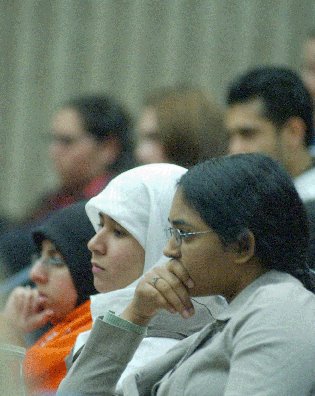
Filmmakers focus on Muslim college experience
By Kellie Bramlet
Tribune Staff

Milwaukee should get ready for its close-up — shooting for "Generation Jazba," an independent film about Muslim college students in Milwaukee, is tentatively scheduled to begin in May of 2007.
Writer and director Brooke Maroldi and producer Allyson Bahr said they plan to show the movie at prominent independent film festivals including Tribeca, Sundance and Toronto, among others. In order to help reach this goal they are a holding a fundraiser tonight, where promotional material for the movie will also be shot, according to a press release.
Based on a story by Qudsia Sethi, the film follows the lives of a group of Muslim college students living in Milwaukee as they struggle to find their place in a world between their Muslim roots and American society.
Their goal is "to portray a minority in a way that's realistic and fair and give people a lot to think about," Maroldi said.
Maroldi said they chose Milwaukee for the backdrop of this story for a number of reasons.
"We're here. We work here," she said.
Maroldi and Bahr said that through their film, they hope to present a new image of Milwaukee.
"Milwaukee has been kind of badly portrayed in the past. It's almost embarrassing," Maroldi said. "I think this is going to show a view of Milwaukee that a lot of people across the country have never seen."
Bahr said that the movie will give Milwaukee a "sexy and sophisticated look," because it shows college students gathering against a backdrop of nightclubs, coffee shops and the lakefront.
"We just want to make art in Milwaukee. We love the city," she said.
Both Bahr and Maroldi said the city plays a prominent role in the film, almost like a character.
"With such a small Muslim population here, the movie really is relevant to Milwaukee," Bahr said.
"In the city there's so much segregation," Maroldi said. "We're trying to show that (Muslims) are pretty much like everybody else."
Hammam Hasan, senior in the College of Engineering and leader of Marquette's Muslim Student Association, said he can definitely relate to the characters in this film after hearing a plot synopsis and some details concerning the movie.
Hasan was raised in Philadelphia, but moved to Palestine with his family when he was 8 years old because his parents wanted him to learn about his culture and roots, he said. Hasan said he moved to Milwaukee in 2001 to avoid violence and find better opportunities, attending high school and eventually Marquette.
"I hope that (the movie) justly describes the situation," he said. Hassan also said he hopes that the film focuses on the positive and avoids stereotypes, because the news media often fail to do so.
"There are a lot of things about Middle Eastern tradition that people in the U.S. do not understand," he said. "Having to put up with both ends of the world is not easy at all."
Although the film is about Muslim students, Bohr said its themes are really universal and that college students everywhere should be able to relate to it.
The movie is about "how you carve yourself into this world and become a person," she said. "And I think that all college students can relate to that."
Currently, Maroldi and Bahr, along with their newly-formed production company Jazba Productions, are working on fundraising for the film. They said they hope to raise $50,000 before asking for funds from investors and then moving on to the pre-production phase, which is tentatively scheduled for February. The fundraiser will be held this evening at the Hi-Hat Garage, 1709 N. Arlington Place, at 5 p.m. and admission is $7.

This article was published in The Marquette Tribune on Thursday, March 23, 2006.
Muslim camp lease signed
Published: 03/22/2006 5:34 PM

By: Frank Gluck - The Gazette


NORTH LIBERTY, IA - An organization planning a Muslim youth camp on the shores of Coralville Lake has signed a lease of up to 25 years with the federal government, the U.S. Army Corps of Engineers announced this afternoon.Muslim Youth Camps of America (MYCA) now has full rights to be on the land and, once it works out details with county and state regulators, can begin building at any time.The organization has up to five years to begin building before the Corps of Engineers would reconsider the lease. If, after five years, MYCA shows it is progressing in a "satisfactory" fashion, a 20-year lease would be offered.Plans for the $934,000 facility call for lodging up to 60 campers ages 10 to 17 -- 40 in cabins and 20 in tents -- plus staffers during summer, and up to 40 per night in the off-season.The proposal has been a controversial one. Many neighbors have complained that the development would overwhelm the rural Johnson County roads leading to the facility and that the proposed buildings would mar the scenic nature of the spot.A minority of other camp opponents have tried to block construction by evoking the specter of terrorism.The plans were downsized from the original proposal, which detailed a $2 million facility for 136 campers. The Corps asked Muslim Youth Camps of America in 2003 to cut that scale in half after concerns about safety that neighbors raised.The Johnson County Supervisors had given their informal approval, without needing to vote, in late December for the lease agreement.County planning officials said the camp's operators had adhered to restrictions the county imposed, dealing with the county's planning and zoning, building code, public health and engineering departments.

For more on this story check Thursday's Gazette and GazetteOnline.com

PM: Muslim world needs to develop entrepreneurial skills

KUALKA LUMPUR: Prime Minister Datuk Seri Abdullah Ahmad Badawi said on Thursday that the Muslim world must develop entrepreneurial skills and managerial expertise.
Speaking at the 'Third Islamic Development Bank (IDB) 1440H Vision Commission Meeting and launching the IDB 1440H Vision Document' here, he said, "The Muslim World is not lacking in assets.
"It possesses an abandunt supply of resources for wealth creation. In terms of numbers, the 1.3 billion Muslims represent at least 20% of the world's manpower."

Prime Minister Datuk Seri Abdullah Ahamd Badawi shaking hands with one of the delegates at the third Islamic Development Bank 1440H Vision Commission meeting on arrival at the welcoming dinner at Mandarin Oriental Hotel Wednesday night. Also present was IDB president Dr Ahmed Mohammed Ali (right). "Muslim countries occupy strategic gheographical positions, being located in the centgral region of the earth which are the most fertile and resource rich in the world.
"If there is any deficiency it is more in the area of entrepreneur skills and managerial expertise.
"These we must develop ...," the Prime Minister, who is also the Chairman of the Organisation of Islamic Conference (OIC) said.
For the full text of the speech, click
here.
Law lords back school over ban on Islamic gown
By Joshua Rozenberg,
Legal Editor(Filed: 23/03/2006)

A schoolgirl who was refused permission to wear a
full-length Islamic gown in class was not deprived of the right to manifest her religion, five law lords ruled yesterday.
The House of Lords
allowed an appeal by Denbigh High School, in Luton, against a unanimous ruling by the Court of Appeal last March in favour of Shabina Begum, 17.

Shabina Begum: 'Quite happy that it's all over'
Lord Bingham said it would be "irresponsible" for any court to overrule the school's judgment "on a matter as sensitive as this".
The power to devise a school uniform had been given to the school staff and governors for the "compelling reason" that they were best placed to exercise it, the senior law lord said, and he saw no reason to disturb their decision.
School rules permitted the shalwar kameez, loose trousers under a smock-like dress worn by some Muslim, Hindu and Sikh girls.
But Shabina was sent home when, aged 13, she arrived wearing a jilbab, a long coat-like garment that "concealed, to a greater extent than the shalwar kameez, the contours of the female body".
The school "had taken immense pains to devise a uniform policy that respected Muslim beliefs but did so in an inclusive, unthreatening and uncompetitive way," Lord Bingham continued. "The rules laid down were as far from being mindless as uniform rules could ever be. The school had enjoyed a period of harmony and success to which the uniform policy was thought to contribute."
Cherie Booth, QC, for Shabina, had argued that the school's actions had deprived the girl of the right to manifest her religion under Article Nine of the Human Rights Convention.
But, Lord Hoffmann said yesterday: "Article Nine does not require that one should be allowed to manifest one's religion at any time and place of one's own choosing. Common civility also has a place in the religious life."
Shabina could have changed schools when she discovered that the uniform she had worn for the past two years created a problem for her. "That might not have been entirely convenient for her, particularly when her sister was remaining at Denbigh High, but people sometimes have to suffer some inconvenience for their beliefs," Lord Hoffmann said.
"Instead, she and her brother decided that it was the school's problem. They sought a confrontation and claimed that she had a right to attend the school of her own choosing in the clothes she chose to wear."
Lady Hale pointed out that the school had respected cultural and religious diversity by allowing girls to wear a skirt, trousers, or the shalwar kameez, with or without a headscarf. This was a "thoughtful and proportionate response", as shown by the fact that girls were worried that they would come under pressure to wear the jilbab if it had been permitted.
The law lords also dismissed the second of Miss Booth's arguments - that Shabina had been denied the right to education, guaranteed by Article Two of the first protocol, or supplement, to the Human Rights Convention.
"That article confers no right to go to any particular school," said Lord Hoffmann. "It is infringed only if the claimant is unable to obtain education from the system as a whole."
The law lords agreed that the two-year interruption in Shabina's education was the result of "her failure to secure prompt admission to another school where her religious convictions could be accommodated".
And in a related case taken by Miss Booth on behalf of the Children's Legal Centre, the law lords decided that Abdul Ali, now 18, had not been deprived of his right to education either. As a 13-year-old he had been excluded from Lord Grey School in Bletchley after being questioned by the police about a suspected arson incident - although charges were later dropped.
Speaking in the House of Lords lobby immediately after the ruling, Shabina said: "I am upset about the judgment, but I'm quite glad that I can move on now, and that I did make a stand and speak out against this. I am quite happy that it's all over."
She said she felt that at least she had made a lot of people question the issues. The loss of schooling was not her fault, as there were no places available in alternative schools.
law@telegraph.co.uk

Tuesday, March 21, 2006

Islamic Televangelist Risks Popularity
By NADIA ABOU El-MAGD,
Associated Press Writer12:14 PM PST, March 20, 2006

CAIRO, Egypt -- Islamic televangelist Amr Khaled is young, smiling, teaches love and mercy, and is so popular he's credited with inspiring thousands of women to take the veil. Now he's putting his popularity on the line by trying a new role, as a bridge between Islam and the West at a time when many are talking about a clash of civilizations.
In the process, Khaled is telling the faithful something they're not used to hearing from clerics -- that Muslims aren't blameless in the tensions, that the West is not always bad and that dialogue is better than confrontation. "A young Muslim goes to Europe with a forged visa, takes unemployment insurance there, then goes on TV and says, 'We're going to expel you from Britain, take your land, money and women,'" Khaled said recently on his weekly program on the Saudi satellite TV channel Iqraa, trying to explain the mistrust of Muslims in Europe. "It's a rare example, but it exists." The 38-year-old Egyptian raised a storm of controversy when he attended a March 9 conference of European and Muslim leaders in Denmark, which has been the focus of anger across the Islamic world over cartoons of the Prophet Muhammad first published in a Danish paper. Some in the Arab world saw his attendance as a surrender and branded him a traitor and an opportunist. This week, Khaled is headed to a gathering of Islamic clerics in Bahrain that begins Wednesday, aimed at considering the next step in the response to the prophet cartoons. The conference is organized by one of Khaled's most vocal critics, hard-line Sheik Youssef el-Qaradawi. Many Muslims saw the caricatures -- one of which depicted Muhammad wearing a turban shaped like a bomb -- as an intentional insult and reacted with a wave of protests. In the West, the outrage was seen as an attack on freedom of speech and only deepened anti-Muslim sentiment. For Khaled, the controversy underlined the need for a new approach by Muslims, one of reform and dialogue with the rest of the world. "For the past three years, with youth across the Islamic world, we've been working for a faith-based renaissance in this region, which will not take place by clashes but by coexistence," he said in an interview with The Associated Press in Cairo. Khaled is not the only Muslim religious leader promoting dialogue. But he has become one of the most outspoken. And he brings the fan base of a pop star: young people, women and members of the middle and well-to-do classes. He built his popularity over more than 10 years of preaching in a style far from traditional clerics in their beards and robes, whose sermons often emphasize the demands of Islam and the threat of damnation and hellfire. By contrast, Khaled is known for his stylish suits and broad smile. In his sermons, he avoids politics and stresses God's mercy, seeking to show how one can be a good Muslim while still enjoying the activities of modern life. That message instantly appealed to the young -- particularly the well-off, looking for a version of Islam that suited their lifestyles. Educated as an accountant, not a cleric, Khaled began preaching as a hobby in social clubs, but then vaulted to television. Thousands packed mosques where he preached. "He is a very simple, moderate, humble man, easygoing. He makes you feel like you are his sister," said Zeinab el-Sherif, 32, a wealthy, veiled Egyptian businesswoman who has been a fan of Khaled's for a decade. "He is so tolerant and friendly, he makes you feel good about your religion and yourself," she said. The Egyptian government, apparently nervous over his popularity, pushed Khaled out in 2002, banning him from giving sermons at Egyptian mosques. He moved to London with his wife and son Ali to pursue a doctorate in Islamic studies. His thesis: "Islam and coexisting with the other." The time in London "has resulted in a mixture of maturity and seeing the other better and readiness to coexist," he told the AP. "It also made clear the common values as well as the differences that can't be overcome." Khaled's program on the Iqraa channel continued, and now Egypt -- perhaps seeking to encourage a moderate Islamic voice -- has been more welcoming, allowing him to hold a large conference in Cairo last month. He is back in Egypt for good. Many clerics criticized Khaled in the past, particularly for his lack of religious training. The controversy heated up with his campaign for dialogue, which represents a new foray into the realm of politics. Egyptian newspapers have been sharply divided over his visit to Copenhagen. But Khaled's supporters appear to be sticking by him. "I loved the idea of the Denmark conference, and I don't know any of Amr Khaled's admirers who don't," said Riham el-Demerdash, 35, a veiled mother of three in Cairo. "Those who are against the conference are those who don't like Amr in the first place -- or are clerics who are jealous."

Britain Wants Muslim Businesses?

Britain Aims to Become Europe's Most 'Islam-Friendly' Economy
By Kevin McCandlessCNSNews.com
Correspondent

March 20, 2006London (CNSNews.com) - As more and more British banks offer special services to Muslims, the government says its wants to make the United Kingdom the most Islam-friendly economy in Europe.Treasury officials said they wanted to create a "level playing field" for banks selling financial products that comply with Islamic law (shari'a.)In addition to providing for the 1.8 million Muslims who live in Britain, Treasury spokesman Tom Youldon said the government would continue to promote the country as a center of Islamic finance for Muslims based abroad.According to government estimates, global assets controlled by Islamic banks stand at around $500 billion and are growing at a rate of 10-15 percent a year."Shari'a-compliant" finance forbids any form of interest - called "usury" in the Koran. Although a Muslim cannot earn interest, Islamic institutions can pay investors a share of profits, as earning a profit is not prohibited.All partners in a business venture must share risk equally and Muslims cannot invest in businesses dealing in alcohol, gambling or pornography.To get around these restrictions when selling mortgages, for example, a bank will buy a property and then rent it back to its customer for a set number of years.Currently, the Islamic Bank of Britain is the only fully Islamic retail bank here, but several British banks have begun to offer a line of shari'a-compliant products in the last year or so.Humayon Dar, an economist specializing in Islamic finance, said most British Muslims wanted Islamic banking, but only if it came with the convenience they were used to getting from other banks.He said he personally favored Western banks offering shari'a-compliant services over the creation of small Islamic institutions.Ashraf Piranie, financial director at the Islamic Bank of Britain, said many laws relating to purchasing and leasing commercial property were unfair to Muslim business owners.They were either forced to pay a higher rate of tax when using shari'a-compliant business arrangements or to compromise their religion.Piranie said his bank had been in talks with the government and predicted tax rules would be adjusted once Chancellor Gordon Brown unveils the government's 2006 budget on Wednesday."Thankfully the Treasury has been very keen to understand the issues facing the development of Islamic financial products," he said.While analysts agree that the core of Islamic banking will probably remain in the Middle East, many argue that London is a natural magnet for such activity.Rodney Wilson, a professor of economics at the University of Durham, said that since the city is already a major financial center, many Middle Eastern bankers were already comfortable with doing business there.One problem Islamic financing in the West faced was the shortage of people knowledgeable in shari'a who were able to help structure complex deals, he said.Another was that while a particular scholar may be qualified in terms of religion, his English may not be good enough to understand complicated contracts.Hamid Yunis, a lawyer with the London firm of Taylor Wessing, said Islamic financing was flexible enough to tackle projects of almost any size.Last year, his firm helped an international consortium buy a $250 million office complex in the heart of London in a shari'a-compliant deal that used a form of Islamic bonds as equity."In Islam, there's a saying that in matters of [business] dealings, everything is possible - unless it's prohibited," he said.

What will the Afghan Government Do?

Afghan on trial for Christianity An Afghan man is being tried in a court in the capital, Kabul, for converting from Islam to Christianity.

Abdul Rahman is charged with rejecting Islam and could face the death sentence under Sharia law unless he recants.
He converted 16 years ago as an aid worker helping refugees in Pakistan. His estranged family denounced him in a custody dispute over his two children.
It is thought to be Afghanistan's first such trial, reflecting tensions between conservative clerics and reformists.
Conservatives still dominate the Afghan judiciary four years after the Taleban were overthrown.
The BBC's Mike Donkin in Kabul says reformists, like the government under President Hamid Karzai, want a more liberal, secular legal system but under the present constitution it is hard for them to intervene.
'Tolerance'
Afghanistan's post-Taleban constitution is based on Sharia law, and prosecutors in the case says this means Abdul Rahman, whose trial began last Thursday, should be put to death.
We will ask him if he has changed his mind. If so we will forgive him Trial judge Ansarullah Mawlazezadah
When he was arrested last month he was found to be carrying a bible and charged with rejecting Islam which is punishable by death in Afghanistan.
Trial judge Ansarullah Mawlazezadah told the BBC that Mr Rahman, 41, would be asked to reconsider his conversion, which he made while working for a Christian aid group in Pakistan.
"We will invite him again because the religion of Islam is one of tolerance. We will ask him if he has changed his mind. If so we will forgive him," the judge told the BBC on Monday.
But if he refused to reconvert, then his mental state would be considered first before he was dealt with under Sharia law, the judge added.
He said he expected the case to take about two months to be heard.
Precedent
The Afghan Human Rights Commission has called for a better balance in the judiciary, with fewer judges advocating Sharia law and more judges with a wider legal background.
Several journalists have been prosecuted under blasphemy laws in post-Taleban Afghanistan.
The editor of a women's rights magazine was convicted of insulting Islam and sentenced to death last year - but was later released after an apology and heavy international pressure.
Mr Karzai's office says the president will not intervene in the case.
Observers say executing a converted Christian would be a significant precedent as a conservative interpretation of Sharia law in Afghanistan.
But it would also outrage Western nations which put Mr Karzai in power and are pouring billions of dollars into supporting the country.


Story from BBC NEWS:http://news.bbc.co.uk/go/pr/fr/-/1/hi/world/south_asia/4823874.stmPublished: 2006/03/20 13:15:27 GMT© BBC MMVI

Islam Awareness Week at the University of Virginia


Inside Islam
As Islam Awareness Week begins, Muslim students reflect on life at the University
Jenna Wandres
Cavalier Daily Staff Writer


Sam Stollar Cavalier Daily
Students who attended the Islam Awareness Week kick-off event heard from Imam Siraj Wahajj, who spoke on the recent cartoon controversies depicting the Prophet Muhammad.
When most Americans hear the word "Islam," chances are good that they immediately think of several strong images and phrases. Perhaps they picture an arid desert village crawling with soldiers. Maybe they hear words like "jihad," "fundamentalist" or "terrorism." Maybe they see a replay of a plane crashing into a skyscraper in a plume of smoke and flames.
While the media has popularized these perceptions of Islam, the organizers of Islam Awareness Week feel these stereotypes couldn't be more untrue for the majority of Muslims. While the center of military conflict regarding these issues is in the Middle East, there is a different front of the conflict, some Muslim students feel, which is present right here at the University: the struggle of American Muslims to embrace their faith in the midst of a Western culture that misunderstands them.
­­­
Misunderstood
Islam is the third-largest religion in the United States, and its number of American adherents is growing faster than any other religion. This trend is evident in the University community as well, according to third-year College student Umair Javed, president of the Muslim Student Association. Javed estimates the number of Muslims at the University to be in the low hundreds.
"We're not a very large group, but we are growing every year," he said. "We work to build a support structure for Muslim students by doing things like trying to find rooms around Grounds where Muslims can do their five daily prayers and trying to bring Halaal food to dining halls."
The MSA also recently formed a Muslim Alumni Association, through which Islamic graduates ofthe University can network with present students to share resources, advice and fellowship. Some Muslims at the University, however, are also faced with issues that are not as tangible to solve.
Hassan Tahmir, a fourth-year Commerce student, discussed the difficulties of being a religious Muslim while immersed in a secular society that he feels misunderstands him.
"Islam is a very peaceful religion, based strongly on trust and community," he said. "A lot of times, people see and hear about terrorists and other Islamic groups and make the assumption that all Muslims believe the same thing. Just as Baptists, Methodists and Mormons are all considered Christians, there are different groups that hold different Islamic beliefs."
First-year College student Nazia Chowdhury expressed her frustration with the misconceptions surrounding jihad, an Arabic term literally translated as "striving in the way of God."
"Jihad can be anything from inwardly trying to become a better person to an [armed] struggle fought in defense of Islam," she said. "People, especially the American media, don't understand that in order for true armed jihad to be established, there is a long process with lots of different rules and standards that must apply."
According to a recent MSA project, misconceptions such as these about Islam are fairly common among University students. The project, a documentary, addressed the question, "what is the perception of Islam amongst U.Va. students?"
According to Javed, the results of the project were grim.
"Overall, we found that non-Muslim students don't have a basic knowledge of what Islam is," Javed said. "U.Va. students did have an impressive knowledge of the politics surrounding Islam and had strong opinions about what Muslim countries should be doing, but they had no knowledge of the religion itself."
Tahir said this lack of knowledge is usually the root of anti-Muslim sentiment.
"People don't understand Islam, and they can't understand the Islamic people without understanding their religion," he said.
Since the attacks of Sept. 11, Muslim communities in America have faced a diverse realm of reactions. Waves of hate crimes, harassment and assaults on Islamic people and businesses spiked drastically in late 2001 and have been intermittent since then around the United States.
However, the University community has generally responded in a calmer manner.
"After Sept. 11, people began asking a lot of questions about Islam, with a desire to learn and see it as a peaceful religion," Javed said. "More and more people are seeking to learn about our faith and practices, in order to understand what is going on in the world with an unbiased perspective."
To combat this general ignorance, the MSA has set March 20 through March 30 aside as "Islam Awareness Week," with a theme of "The Many Faces of Islam." This week is meant to show another side of Islam than is usually portrayed in the media and to let the Muslim voice be heard around Grounds.
"We want the student body to hear about controversial issues directly from Muslims," Javed explained. "We want everybody to realize that Islam is broader than what they hear in class and encompasses all areas of life."
Chowdhury said she thinks this week will be a good opportunity for the University community to learn about Islam but, mostly, to recognize that Muslims are a peaceful, God-centered group.
"Our God is the same God as the Christian God and the Jewish God," she said. "Many of us say, 'In'sh'Allah' almost every time we have a conversation, which means, 'If God wills it."
A tight-knit community
"Before I came to U.Va., I wasn't sure what to expect," Chowdhury said. "I wasn't sure if I would be able to fit in and find all the resources I would need. I was scared I would have to be stuck on a crazy vegetarian diet or something."
While the transition from home to college can be difficult for many Muslim students, it is made a lot easier by an extensive support network of both peers and the Charlottesville community.
"Once I got here and I realized how many resources are available to Muslims, I haven't had a very hard time adjusting at all," Chowdhury said.
Tahmir expressed similar sentiments about his experiences at the University, especially during the month of Ramadan.
"During Ramadan, [Muslims] fast during the daylight hours," he said. "It's a month that is intended for us to grow closer to God, but in the process, we are able to grow closer to each other, too."
During Ramadan, the MSA sponsors events such as community fast-breaking after sunset, as well as an IHOP breakfast at 4 a.m.
As a community, Javed said they strive to take advantage of available resources as much as possible. In addition to hosting events with religious studies professors Abdulaziz Sachedina and Timothy Gianotti as key speakers, the Muslim community also gives back to Charlottesville by participating in Habitat for Humanity builds and tutoring young Muslim students at local public schools.
"One of the things we're trying to do is integrate the Muslim identity into the University," Javed said. "And one of the best things about ... U.Va. is that we have the opportunity to work with and learn together with so many different groups."

Islam in Italian Public Schools

I believe that one of the signs of the end of time is that Rome will embrace Islam. I may be wrong ( If I am, please post the correct information so that we all may be properly informed), but this article sounds as though it could be the beginning.

Italian Schools Might Teach Islam
ROME, MARCH 21, 2006 (Zenit.org).- Cardinal Camillo Ruini, president of the Italian bishops' conference, acknowledged the possibility that Islam might be taught in this country's public schools. The cardinal made that point when he opened a session of a bishops' commission on Monday. After recalling that the Church has authority in "relations with the Italian state in regard to the teaching of Catholicism but not in regard to other religions," the cardinal noted that "the right to religious freedom is true for all and, in principle, the teaching of the Islamic religion does not seem impossible." "However, there must be some fundamental conditions, applicable to all teaching in Italian public schools: specifically, there must be no opposition to the contents of our Constitution, for example, in the matter of civil rights, beginning with religious liberty, the equality of man and woman, and marriage," stressed Cardinal Ruini. "To date, a representative entity of Islam has been lacking, empowered to establish an agreement in this regard with the Italian state," he said. "It is also necessary to ensure that the teaching of the Islamic religion does not give room in fact to a socially dangerous indoctrination."

Prince Charles Speaks on Islam

For a long time I have wondered if Prince Charles is a Muslim or not. He appears to be quite knowledgeable in the deen, even more so than some of us that openly profess adherence. You never know. He could be like John Esposito, knowledgeable about the deen but still a Christian. Nevertheless, may we all be guided on the straight path. Here is the article about his speech at Al Azhar University.


Charles mends fences over Islam cartoons
By Caroline Davies in Cairo(Filed: 22/03/2006)

For the Prince of Wales, whose passion for all things Islamic is firmly on record, there can be few greater accolades than the opportunity to address some of the Arab world's most eminent scholars.At Cairo's venerated Al-Azhar University - the oldest seat of religious and secular study in the world - he took full advantage yesterday, delivering a 30-minute speech on inter-faith tolerance entitled Unity in Faith.
Before an audience that included Egypt's top cleric the Grand Sheik of Al-Azhar, Mohammed Sayed Tantawi, and 800 students and teachers, he seized the opportunity to criticise the Danish cartoons that satirised the Prophet Mohammed and provoked violent protests across the Muslim world.
"The recent ghastly strife and anger over the Danish cartoons show the danger that comes of our failure to listen and to respect what is precious and sacred to others," said the prince.
"In my view, the true mark of a civilised society is the respect it pays to minorities and to strangers."
He continued: "I look forward to a world in which we share a vision that acknowledges our differences with respect and understanding, that recognises what others hold sacred, and to a world in which we see that we cannot and must not abuse our great traditions and their teachings as a weapon in the service of selfish worldly power."
It was a mammoth speech, running to eight typed pages. The Duchess of Cornwall perched a pair of wire-rimmed reading glasses on her nose, for the first time in public, to read the English version.
In respect of Islamic culture she had slipped off her duck-egg blue suede shoes to reveal pink-laquered toenails.
In the knowledge that the eyes of the Sunni Muslim world's most auspicious scholars would be upon her, she had chosen an ensemble of pale-blue silk and chiffon tunic top and white trousers, a Western interpretion of the shalwar kameez and designed by Robinson Valentine.
Earlier, the royal couple joined 30 students at a class in English on Islamic studies at the mosque adjoining the university.
The highlight of the visit was the presentation of an honorary doctorate to the prince in recognition of his conciliatory stance since the September 11 attacks.
Yesterday's visit coincided with the Duchess being named "Spouse of the Year" by The Oldie magazine for her "strength and conviction " in the public gaze, attributes which have undoubtedly helped her bear constant comparison to Diana, who was also famously photographed at the mosque.
Accepting the award long-distance and with good humour, she dispatched a tongue-in-cheek message via her friend, the author Jilly Cooper.
"Unfortunately, at the time this award launch takes place I shall be carrying out some overseas spousing duties," she said.

Friday, March 10, 2006

Community Development

I am only recently getting over the flu. That is why I have been remiss with posting new information. Nevertheless, Alhamdullah I'm back. As you will come to find out over time, I like to progress and to help others do the same. One thing that I feel is missing from the ummah here in North America is the unity of Muslims outside of the masjid. Our deen is a way of life that extends beyond salaat and the masjid.
I think that we need to insulate ourselves from the flucuation of public perceptions of Islam and Muslims. I believe that a good way to provide this insulation is to establish and support Muslim businesses. I realize that there are many Muslim owned businesses across this country, but we need more. It doesn't matter if you start the next Microsoft or Google, or if you transition a hobby that you are good at into a homebased business. Even if you are currently employed, you should still consider starting a business. The goal is to be as self-sufficient as possible.
We should focus on three things (business wise) . The first is to insure that it is a halal means of earn an income. The next is to employee other Muslims, particularly recent immigrants and high school/college students (This will give valuable experience to the next generation of Muslims in our community). We need to look to other Muslim businesses to do business with first (this will keep money within our ummah longer). We need to diversify the types of businesses that we open. Doing so will allow us as a community to adequately support our individual local communities. There are other professions than computer programmers, engineers, doctors, falafel shop owners, and car dealers. All of those professions are needed, but we also need more lawyers, nurses, teachers (not professors), cleaning services, dry cleaners, and etc. All the services and products that we consume from non-Muslims, we should work to provide for ourselves. With that said, Muslim businesses should not take the support of local Muslims for granted by charging above average prices.


I will step off of my soapbox now and provide you with some information to started.


www.sba.gov/starting_business

www.entrepreneur.com

www.inc.com/guides/start_biz/

For existing businesses, please send in your ummah can procure from your business. We have to be aware that your business exists before we can take advantage of your products or services.


INTERESTING VIDEO FOR THOSE NEW TO ISLAM OR WANTING INFORMATION ON ISLAM


Wednesday, March 01, 2006

First Day Extras

Here are more useful resources. I know that the links to the Home country webpages are not up yet. I made all of what you see in one night. This is defintely a work in progress. Inshallah, I will have all of the HCWP linked soon. I do some of the code by hand (old school) so it takes a little longer, but it looks the way that I want. What I would like from you is feedback. I intend to continueously add and improve this project. Please leave comments to let me know what you would like to see or how I may be able to improve this site.


FREE MUSLIM MARRIAGE SERVICE

QURAN TRANSLATION DOWNLOAD FOR FREE
Quran translation in zip format
Quran translation in exe format

FREE COLLEGE SCHOLARSHIPS FOR QUALIFYING MUSLIMS
List of Islamic institutes which may give free room and board for their foreign students(Al-Azhar is # 1 :-)

FREE ARABIC NETSCAPE BROWSER
Sinbad Arabic viewer

QURAN TRANSLATIONS VIEW ON LINE
http://www.geocities.com/Athens/Agora/4229/tQ.html

FREE COPY OF THE QURAN
http://convertstoislam.org/Free-Quran.htm

RECEIVE DAILY AYAT TRANSLATION FOR FREE
http://www.muslimsonline.com/~ayat

FREE MUSLIM E-MAIL
http://www.muslimsonline.com/webemail.html

FREE MUSLIM WEB PAGE SPACE
http://www.muslimsonline.com/freehosting.html
http://www.muslims.net/

FREE MUSLIM CLINICS
http://www.geocities.com/CapitolHill/Lobby/2294/
MUSLIM STUDENT ASSOCIATION FREE ITEMS
Basic Planning for Small Islamic Organizations
Quranic Ayahs of the Week (WithFonts) (Zip file, contains MS Word documents) file which has manybeautifully prepared bezels of Quranic Wisdom for you toprint, Xerox, and post around your campus.
How to Organize Your MSA Log BookDo you wish you could see exactly what other groups aredoing, and learn from them? Then download this file anddo a Project Log Book for your organization, and encourage othergroups to do them, too! (41K Zip file contains 3 MS Word documents)
Guidelines for Establishing Islamic Study Circles (Halaqas) Downloadthis 79K (Zip file, contains many MS Word documents)
Guidelines for Establishing an MSA Library (coming soon)
Summary Notes on a Time Management Workshop (Zip File )
How to Teach the Quran To Children (Zip File of 7 KB)
FREE MUSLIM YELLOW PAGES DIRECTORY
http://www.muslim-yellowpages.com/index.html
FREE MUSLIM GREETING CARDS
http://www.inminds.com/cardcentre.html
http://www.muslimdirectory.co.uk/
http://www.sakhrsoft.com/lpostcards/greeting.html
http://www.islamicart.com/vcards/
http://www.123greetings.com/events/miladudnabi/
FREE MUSLIM MARRIAGE SITE
to the Free Islamic Marriage Page
FREE ISLAMIC RADIO AND SPEECHES ON-LINE
Quran Al Kareem radio station
Hear Qur'an in Arabic
Hear Qur'an translation in English
Hear Qur'an translation in Urdu
Online Islamic audio lessons
Islamic Radio (what CNN hides, now Learn the Full Story)
Voice of Islam
Ahmed Dedaat (hear is great speeches)
Dr. Jamal Badawi (additional great speeches)
Tunisia Radio in French and Arabic
Egyptian Radio
Hear the News in (Arabic), (Urdu), (Hindi), (Persian) news broadcasts.
FREE ISLAMIC GATEWAY CD
http://ummah.net/igcd.html
FREE ISLAMIC PICTURES
http://members.xoom.com/Sumair/page22.html
http://users.aol.com/hineaf/files/free.htm
FREE ISLAMIC ARABIC FONTS
http://www.ummah.net/islamloads/apps3.htm
FREE ISLAMIC PRAYER TIME PROGRAMS
http://www.ummah.net/islamloads/apps1.htm
FREE ISLAMIC MOON CALCULATOR
http://www.ummah.net/islamloads/apps2.htm
FREE MUSLIM SCREEN SAVER
Beautiful Hajj screen saver here
Other Free Islamic Screen savers here
ISLAMIC / ARABIC NEWSPAPERS VIEW FOR FREE
Al Shaab in Egypt
The Truth in the USA
Al Ayyam: Online Arabic Newspaper from Bahrain.
Asharq Al Awsat: Middle East Newspaper (in Arabic)
Islamic Republic news agency in Iran
Harbinger Column
Islamic Voice (India)
Middle East Times
Renaissance Islamic Journal
DAWN, Karachi http://www.dawn.com/
The NATION, Lahore http://www.nation.com.pk/
The NEWS, Karachi & Islamabad http://www.jang.com.pk/thenews/
MUSLIM TELEVISION STATIONS AND VIDEOVIEW ON-LINE FOR FREE
Saudi TV
Free Islamic Video Library a great selection
Dawah in the Park from England
Al Ayam TV Broadcast
Bahrain Radio AND TV
Oman Radio AND TV Broadcast
Pakistan Television
Al-Manar Television
Jordan TV
More Arab TV stations online
ARABIC MP3 MUSIC
Om Kalthoum (one of the greatest Arabic Muslim singers)
non-ISLAMIC, but USEFUL and FREE
Free International Telephone links Call to most Countries Free (no more Phone Bills)
Free Internet Provider Links get online absolutely FREE (no more Internet Bills)
Submit url to All Search Engines Free Easy one step url submission to Top search engines (promote Islamic sites on the web) especially mine :-)
MORE FREE ISLAMIC RESOURCES PAGESSimilar sites offering a wide variety of resources to spread Islam:
http://www.al-sunnah.com/free.htm
http://www.beconvinced.com/downloads.htm
http://209.1.224.14/Athens/Olympus/1458/islam005.htm
http://www.sioindia.com/links/bazar/downloads.htm
http://www.dawatul-islam.org/links.html
http://islamicweb.com/free.htm
http://websolution.net/islamicweb/free.htm


Freestuff

Tuesday, February 28, 2006

Welcome

Salaam Wa Laikum Wa Ramatullah

Welcome to the inaugural edition of the Ummah News & Resources Online. Our purpose is to provide information about our deen to those who seek it and provide interesting information and resources that someone may benefit from. Remember, you should want for others what you want for yourself. I want everyone to grow in the deen and prosper in this world and the next. May Allah (SWT) guide us all to that end. Enjoy.