Wednesday, April 12, 2006


Muhammad's birthday opens dialogue on Islam
Muslims say the recent controversies have given them the opportunity to tell world of the prophet's greatness.
Gregg Krupa / The Detroit News

Daniel Mears / The Detroit News
Abbass
See full image

About the celebrationMany Muslims in Metro Detroit are marking April 12 as the birthday of the prophet Muhammad. Celebrations include banquets, lectures, discussions and poetry at local mosques.
Daniel Mears / The Detroit News
Dr. Hakim was the keynote speaker at the Islamic House of Wisdom in Dearborn Heights last week. People of other faiths joined in the prophet Muhammad's birthday celebration.

As Muslims across Metro Detroit commemorate the birthday of the prophet Muhammad this week, many are using the occasion to reaffirm their faith at a time when, some feel, Islam has come under attack.
In the wake of a recent Washington Post-ABC News poll that showed a sharply diminished appraisal of Islam among Americans, controversies over the publication of caricatures of Muhammad and the attempt to prosecute a Muslim who converted to Christianity in Afghanistan, many Muslims say the significance of the prophet's birthday is greatly increased this year.
"This has taken on an importance, particularly in these times when the prophet's character has been attacked," said Victor Ghalib Begg, chairman of the Council on Islamic Organizations of Michigan. "At our mosque, it has taken on this sort of meaning: Here is an opportunity to tell the world who the prophet is."
Many of Metro Detroit's estimated 125,000 to 200,000 Muslims will commemorate the birth of Muhammad on Wednesday. The prophet was born in Mecca, Saudi Arabia, in about 570 A.D., but Muslims in different parts of the world celebrate the day at different times of the year -- or don't celebrate it. The true significance of Muhammad is trumpeted not only by imams in local mosques and officials in charge of Islamic organizations, like the Council on American Islamic Affairs, but also by the faithful themselves. And some followers of other faiths are joining in.
Michael Hovey, assistant adviser for ecumenical and interfaith affairs for the Roman Catholic Archdiocese of Detroit, attended a birthday celebration at the Islamic House of Wisdom last week.
"I was excited to read about him," Hovey said. "He was a person who, in religious terms, seemed to respond very much to the presence of God in his life.
"It's very unfortunate that 9/11 is probably the main cause of an increase of interfaith discussion and relationships," he said. "But, in my opinion, that is probably the best thing to happen out of the whole catastrophe."
Zayd Allebban of Inkster thinks it is more important than ever to spread the word. "In a non-Muslim country, there is a stronger responsibility than just commemorating his birthday. And not by violent protests … but by conferences and lectures and really spreading the true and relevant information," said Allebban, 27, a Web site developer for the city of Detroit and a student.
Even some Muslims say they will mark the holiday this year by learning more about him.
"I consider myself to be a Muslim who needs to learn a little bit more," said Saba Ali of Romulus, who attended a celebration at the Islamic House of Wisdom last week. "Growing up, we focused on the two big Eids, the holidays after the fasting of Ramadan and after the Hajj. The birthday of the prophet is called an Eid, too."
Even some believers are sometimes divided about the faith. For example, not all Muslims mark Muhammad's birthday, which is called the Milad-un Nabi, or Mawlid.
"Primarily Muslims who are Sufis or Shi'a observe this," said Dawud Walid of the Council on American Islamic Relations. "Some Sunnis do observe the Mawlid. But to certain Sunnis, it is seen as a despicable religious invocation, because the prophet did not celebrate his birthday."
But for all Muslims, Muhammad symbolizes tolerance, forgiveness, purity and the transcendence of human desires in the quest of godliness.
"The Prophet Muhammad is the most inspiring personality for every Muslim … he is the best example of a moral, ethical man who lived by his ideals," said Imam Sayed Hassan Al-Qazwini, of the Islamic Center of America, who is considered a direct descendant of Muhammad.
Qazwini and other imams frequently preach about the life of Muhammad as an example of how to live. "He was a very caring man and he did not reciprocate hostility with his own," Qazwini said.
You can reach Gregg Krupa at (313) 222-2359 or
gkrupa@detnews.com.

Tuesday, April 11, 2006

African tribe leaders embrace Islam
2006-04-10


Tribe leaders from Nigeria, Northern Ghana, Northern Togo, and Southern Sudan have converted to Islam before the leader of the Revolution. The tribe leaders recited the Shahadtian, “ there is god but Allah, and Muhammad is his Messenger.” The Leader told them that Muhammad peace and pray of Allah be upon him, is the last prophet. “ If Jesus was here, he would have followed the prophet Muhammad,” the leader says.

First Muslim sorority hopes to form chapters across USA
Updated 4/9/2006 11:43 PM
E-mail Save Print
By Donna Leinwand, USA TODAY

CAMBRIDGE, Mass. — Christine Ortiz slips quietly from the Muslim prayer room on the campus of the Massachusetts Institute of Technology and into a group of squealing young women. Some of them are Ortiz's Muslim sisters, the undergraduate pals who embraced her when she converted to Islam from her family's Roman Catholicism.
Less than a year after she graduated from MIT, Ortiz, 23, has returned to campus on a chilly night to help introduce them to a new concept in Muslim sisterhood: the first Muslim-oriented sorority, Gamma Gamma Chi.
The sorority, which was formed last year, has no campus chapters but is trying to drum up interest with informational meetings across the nation. It aims to be a sorority unlike almost all others by adhering to principles of Islam: no alcohol and no casual mixing between men and women.
Ortiz is a member of Alpha Phi, one of five traditional sororities at MIT. She says she wants her Muslim girlfriends to have the sorority experience without having to compromise their religious values. In theory, the existing sororities' policies are in line with Muslim beliefs, but in reality, she says, the sorority culture at MIT and other campuses "unfortunately is based on men and alcohol."
Muslim women at MIT, the University of Kentucky, Rutgers, the University of Maryland-Baltimore and the University of Southern California have expressed interest in Gamma Gamma Chi, says founder and President Althia Collins, who owns an educational consulting business in Alexandria, Va.
Collins and her daughter Imani Abdul-Haqq, both Muslim converts, created the sorority in 2005.
The MIT gathering attracted 13 women — five in traditional Muslim head scarves and loose-fitting clothes but most with uncovered hair and typical campus attire of jeans and sweaters.
"I never felt attracted to sorority life," says Tania Ullah, 20, a junior from New York City. "Aside from the drinking and partying, which I don't do, I didn't feel comfortable with pledging loyalty to the principles."
'We're already a close-knit group'
Collins and Abdul-Haqq's idea for a Muslim sorority reflects both the increasing presence of the religion on U.S. campuses and the growth of multiculturalism, says Denise Pipersburgh, a lawyer in Newark, N.J., and president of the National Multicultural Greek Council.
The National Panhellenic Conference represents 26 historically Caucasian sororities and women's fraternities with 3.8 million members. The National Panhellenic Council, which represents four historically black sororities and five men's fraternities, has 1.5 million members. The first Latina sorority was formed in 1975, and Asian-American Greek organizations have existed since the 1920s.
At the MIT session, the Muslim women, whose majors include brain and cognitive sciences and chemical engineering, seem intrigued by the idea of their own sorority. But they also are skeptical.
"An Islamic sorority is almost an oxymoron, isn't it?" asks Tasneem Hussam, 20, a junior from Centreville, Va.
Muslims are active at MIT, where the Muslim Student Association on the 10,200-student campus regularly attracts 200 people to its dinners. All of the women at the presentation belong to the association.
"We're already a close-knit group," Hussam says. "I'm a little unsure about how necessary it is to have a sorority."
Tayyba Anwar, 18, a freshman from New York City, wonders how she'll explain the sorority concept to her parents and persuade them to let her join Gamma Gamma Chi.
"They'll say, 'What is this? Is it good or bad?' " Anwar says. "To me, it sounds like a respectable thing."
Ortiz notes that Greek life is a big part of MIT. "Once they are organized, it'll give Muslim women a face and voice on campus," she says.
Ultimately, none of the MIT students submitted applications to Gamma Gamma Chi.
'An American phenomenon'
The Muslim women at MIT say they rarely suffer from discrimination or isolation on campus. Panhellenic President Shannon Nees, 20, a junior from Hatfield, Penn., says they would be welcome in any of MIT's five sororities.
"MIT is a very diverse group of people," Nees says. "None of the sororities discriminate."
Abdul-Haqq says Gamma Gamma Chi, unlike traditional sororities, will allow Muslim women to feel more comfortable without compromising their Islamic beliefs.
Abdul-Haqq recalls trying to join a sorority at Bennett College in Greensboro and fearing she might be required to dress immodestly while pledging. "I don't wear short sleeves," she says. "I wear my hair covered. I felt put off from the beginning."
Collins and her daughter have sent e-mails to Muslim student groups and received enthusiastic responses, but no campus has signed up the 10 to 15 members needed for a chapter.
"We have to keep in mind that sororities are really an American phenomenon," Collins says. "A lot of Muslims come from Middle Eastern and South Asian backgrounds. This is not a part of their experience."
The sorority has collected the names of 200 women who have expressed interest in joining. The sorority, Collins says, would also welcome non-Muslim women who support its mission.
Xenia Tariq, 19, a freshman at Kentucky whose family moved to the USA from Pakistan, attended the sorority's recent seminar in Lexington and applied to join. She has been spreading the word among her Muslim girlfriends and hopes the university will have a chapter by fall. "I guess the appeal was that it is the first ever Muslim sorority," Tariq says. "I was thinking this is going to be really cool and groundbreaking, and I wanted to be a part of it."


Military needs more Muslims, Hillier says
Last Updated Mon, 10 Apr 2006 13:34:50 EDT
CBC News
Canada's top soldier is calling on Muslims to join the military, saying the makeup of the Canadian Forces doesn't reflect the country's ethnic diversity.
INDEPTH:
Canada's military

Gen. Rick Hillier says Canada's military does not 'reflect the demographics of our country to nearly the degree that we want.' (CBC)
Chief of Defence Staff Gen. Rick Hillier delivered the invitation Sunday night at a dinner hosted by Ottawa's Muslim Association.
Hillier had the highest praise for the military, but he said the force of 62,500 regular members and 20,000 reservists has a serious shortcoming.
"Those men and women do not, however, reflect the demographics of our country to nearly the degree that we want," said Hillier.
"And in short, let me just tell you quite frankly, they don't reflect your community in the numbers that we need, or that we want, or that are healthy for our country."
Hillier said Canadian soldiers are in Afghanistan to root out terrorists, to help stabilize the region and, mainly, to help ordinary Afghans.
"We simply help those who need help, and when they don't need that help any longer, we want to be coming out of those countries and coming home as quickly as possible," he said.
Some of the young Muslims whom Hillier wants to reach were skeptical.
Khaled Kaddoura says he needs a clearer idea of why Canada is in Afghanistan before he would consider a career in the military.
"First of all, I'm a Muslim, so I don't like to fight," said Kaddoura. "So unless there's a clear purpose for me to go there, to change it, then I wouldn't do it, you know what I mean?"

Monday, April 10, 2006


Official: U.S. Backing Somali Militants
By CHRIS TOMLINSON Associated Press Writer

© 2006 The Associated Press


NAIROBI, Kenya — The United States is backing a new coalition of Somali militants fighting Islamic extremists for control of the lawless nation's capital, a U.S. official said, as both sides prepared for a battle that could explode in widespread violence.
Clan leaders have put aside their traditional rivalries to take on the extremists, whom they describe as terrorists. The extremists, though, say they can offer unity and order after decades of chaos in Somalia.


Residents say both sides have recently received an infusion of cash and weapons as they face off for control of the country, which has had no central government since warlords divided it into clan-based fiefdoms in 1991.
The State Department said in March that the U.S. government was concerned about "al-Qaida fugitives responsible for the 1998 bombings of the U.S. Embassies in Nairobi and Dar es Salaam (in Tanzania) and the November 2002 bombing of a tourist hotel and attack on a civilian airliner in Kenya, who are believed to be operating in and around Somalia."
While there have been numerous reports of al-Qaida bombers hiding in the Horn of Africa nation, only recently have they been reportedly involved in fighting alongside Somali extremists.
A U.S. official, speaking to The Associated Press on condition of anonymity because he was not authorized to speak to the press, said prominent al-Qaida leaders with large cash bounties on their heads are under the protection of the extremist leaders in Mogadishu. He did not name them, but eight men wanted in the embassy bombings are on the FBI most wanted list.
The same official, who monitors the situation in Somalia, also repeated the long-standing U.S. policy of working with anyone who is ready to cooperate in the fight against al-Qaida, adding that U.S. officials had made contact with a wide range of Somalis. He declined to say what kind of support the U.S. was supplying.
Somali Prime Minister Ali Mohamed Gedi told AP that the alliance of clan leaders fighting the Islamic group was not acting on his authority, though he said his government was cooperating with the United States.
"As far as I know the U.S. government is leading the fight against terrorism and we are certainly a part of that process," he said. He declined to elaborate.
The U.S. has long worried about al-Qaida and other terrorist groups finding a haven in Somalia. For years, though, clan rivalries may have kept outsiders from gaining a foothold. The Islamic extremists appear to be capitalizing on the Somali people's frustration with disorder and instability.
Hassan Dahir Aweys, a religious leader and retired army officer whom the U.S. government says has connections to al-Qaida, has emerged within the last year as the leader of a new group, the Union of Islamic Courts. The group has recently acquired a large arsenal and a skilled militia.
"Islam is itself a policy which God created for the people to rule each other," Aweys told the AP. "We will have to liberate our people from these warlords who have been shedding our people's blood for the past 15 years."
Aweys does not deny past contacts with Osama bin Laden, but says he has no links now with bin Laden or al-Qaida.
A U.N. report on violations of the Somalia arms embargo said that Aweys has been receiving weapons from a nearby country, but did not identify it or the source of the money to pay for them.
Last month, the Islamic union's forces beat back militiamen loyal to warlords who have held power for most of the last 15 years and have joined the new government. The Islamic union's forces captured a small airport and a strategic road to the vital El-Ma'an port, through which almost all trade with Mogadishu passes.
The four days of fighting left more than 80 people dead and 200 injured.
Since then, hundreds of heavily armed Islamic fighters have been building defensive positions in Mogadishu, residents said. They have threatened to kill anyone who cooperates with non-Muslims and several high-profile intellectuals have been slain for their contacts with Westerners, so witnesses agreed to speak with the AP only on condition they were not named.
Residents also said that they were stockpiling food and water in anticipation of a major battle.
Aweys, who went into hiding following the Sept. 11 attacks and only re-emerged in August 2005, has condemned the new United Nations-backed transitional government. The top Cabinet members are a who's who of former warlords, but the transitional government has taken control only of a small portion of the nation of 7 million.
In an apparent response to the Islamic extremist challenge, several key warlords in the new government have formed the Alliance for the Restoration of Peace and Counterterrorism.
Hussein Gutaleh Ragheh, the alliance's spokesman, said the group's goal is to capture known al-Qaida members who have come to Somalia from Sudan, Yemen and other countries.
"We're not fighting against any tribe or clan, we're hunting down a few terrorists who are hiding among our people," he said.
"We know that these terrorists are using some Somalis after brainwashing them ... to kill the innocent, the intellectuals and the former military officials of the country under the pretext that they work for foreigners," he added.
In a few months, the alliance has gone from a disparate group of clan-based warriors to one of the most powerful militias in Somalia. Residents of alliance-held areas report trucks full of new weapons arriving from neighboring Ethiopia for the anti-extremist alliance. The source of the weapons was not clear.
Ali Garaare, an alliance commander, said hundreds of new fighters have joined the force.
"Our leaders used to pay us $60 dollars (a month), but after the formation of the new anti-terrorism alliance they increased our salary to $160," Garaare said.
Most Somalis live on less than $1 a day and the country has few natural resources, making it one of the poorest countries on earth.
Somalis with connections to the alliance have said that U.S. officials have frequently visited Mohamed Dhere, a governor in the new administration, and other alliance leaders.
Aweys said he believes they are CIA agents who have financed the alliance's sudden increase in cash, a rumor widely accepted among Somalis.
The CIA declined to comment on any matter concerning Somalia.
There have also been rumors of U.S. troops from neighboring Djibouti operating in Somalia. The U.S. official said the reports of military personnel in Somalia are untrue, but would not go any further.
The official did say that U.S. officials have met with many community leaders and provided them with information about al-Qaida suspects living in Somalia and have asked them to expel such people from the country.
Dhere, who along with other alliance leaders declined to speak to the AP, told his troops on Monday to prepare for battle.
"You must prepare yourselves for a real war against terrorism," local journalists quoted him as saying in the central town of Jowhar.
"When you cut a camel's neck, you know it struggles for its life as it kicks everywhere, and that's what these terrorists are doing ... get ready for your last blow against terrorism, we will have to eradicate them from our Somali soil."

Islamic Insurance May Be Worth $14 Billion by 2015, HSBC Says

April 9 (Bloomberg) -- The market for takaful, or Islamic insurance, may be worth $14 billion by 2015, a fivefold increase from now, according to HSBC Holdings Plc.
Insurance premiums paid in Muslim nations are equal to between 0.5 percent and 5 percent of gross domestic product, Ajmal Bhatty, global head of takaful for HSBC's Amanah Islamic finance unit, said in an interview today. That compares with between 10 percent and 15 percent in developed markets.
``There is huge potential out there,'' Bhatty said, a day before a presentation to the World Takaful Conference in Dubai, United Arab Emirates. ``Our first focus is on Muslims, but then we can promote takaful as an ethical and fair system to non- Muslims too.''
Takaful is a form of Islamic insurance based on the Koranic principle of mutual assistance. It is similar to mutual insurance in that members are the insurers as well as the insured. Conventional insurance is prohibited under Islamic law because it involves interest payments, which are forbidden.
According to HSBC, Europe's largest bank by market value, the global takaful industry comprises 79 companies offering products in 23 countries. The industry emerged as an alternative to conventional insurers in the 1980s in Malaysia.
``We are beginning to compete with conventional insurers, but our priority now is to sell to Muslims who would not otherwise buy conventional insurance,'' said Parvaiz Siddiq, general manager of Dubai-based Islamic Arab Insurance Co., known as Salama.
Qatar is the Muslim country with the highest spending on insurance, at $444 per person, Siddiq said. That compares with $5,716 in Switzerland, $4,508 in the U.K. and $3,755 in the U.S., he said.
``We do have tremendous growth potential, but to really become global we must focus on creating a platform to attract customers of all kinds, Muslims and non-Muslims,'' said Gautam Datta, deputy general manager of takaful for Bahrain-based Solidarity Co.


European imams aim to link Islamic, Western values

09 Apr 2006 12:48:05 GMTSource: ReutersBy Tom Heneghan, Religion Editor
VIENNA, April 9 (Reuters) - European imams meeting in Vienna have pledged to work harder to prove that Islam is compatible with democracy and that the majority of Muslims living in the West support human rights, free speech and pluralism.
More than 130 prayer leaders from across the continent, whose meeting was sponsored by Austria as current European Union president, agreed Islamic theologians in Europe must do more to establish that their faith does not clash with Western values.
Their declaration published on Sunday amounted to a catalogue of home-grown moderate views that Western politicians have been urging Muslim leaders to draw up as a bulwark against radical Islamist ideologies coming from the Middle East.
While declaring their loyalty to their new homes, the imams also complained that Europeans were increasingly suspicious of Muslims and often used what they called isolated problems as proof that Islamic and Western values clashed.
"Muslims in Europe are making history," said Mouddar Khouja, a senior official of the Islamic Community in Austria, which organised the two-day meeting where several speakers urged "new thinking" to develop a theological basis for Islam in Europe.
He said European imams were issuing fatwas (religious edicts) dealing with modern challenges, such as condemning terrorism, instead of leaving the field open to radical Middle Eastern preachers who glorify violence on the Internet.
"We have shown how to protect ourselves from fatwas from other countries," he said. "We have fatwas from imams living in Europe and they speak for themselves."
Imams, who lead Friday prayers in mosques, play an important role in Islam because the faithful often ask their advice on what the faith allows or forbids Muslims to do.
This is routine in Muslim majority countries, but Muslims in Europe face new challenges as minorities in non-Islamic societies. They also have fewer Islamic scholars and little or no tradition of Muslim life in the West to refer to.
THEOLOGY IS PART OF THE SOLUTION
This Conference of European Imams aimed to strengthen moderate voices sometimes drowned out in Muslim discussions by radical anti-Western preachers whose sermons and writings on the Internet inspire small groups of radical Muslims in Europe.
It stressed that Muslims might better adapt to Europe, which some of them see as corrupt and immoral, if imams stressed in their sermons that core Western values of democracy and freedom meshed with their own Islamic faith.
"Imams, as teachers and preachers, have a duty to emphasize to their congregations to play a positive role ... in addressing the plagues of Europe -- hate, bigotry, racism, extremism and terrorism," said British imam Abduljalil Sajid.
The declaration urged Muslim theologians in Europe to point out chapter and verse how Islam fits with Western values.
"Theological arguments have a good chance of leading to lasting changes in attitudes," it said. "These should be seen as part of the solution and fostered in public discussion."
Among practical steps they sought were Islamic arguments against immigrants isolating themselves in self-made ghettos, refusing to integrate or rejecting the separation of church and state in Western democracies.
Imams should also show that violations of women's rights -- through forced marriages, female circumcision and "honour killings" -- were rooted in traditions from outside Europe and not justified by Islam, they said.
"We need some new thinking," said Ayatollah Sayed Abbas Ghaemmagami, head of the Imam Ali Islamic Centre in Hamburg, a leading Shi'ite centre in Europe.
"Today we are in dire need of a social model that is just and realistic (and can) arrive at solutions to the problems that prevent integration and peaceful living together," he said.

Dutch to Muslims: Do you really want to settle here?


By Tom HundleyTribune foreign correspondentApril 9, 2006ROTTERDAM, Netherlands -- The new test for foreigners who want to apply for Dutch residency is, well, very Dutch.It features a DVD that illustrates various aspects of Dutch life, including, most notably, a topless woman frolicking in the surf and two men kissing warmly. The message couldn't be more explicit: This is who we are; if you don't accept it, don't come.Although the DVD doesn't single out any particular group, the intended target of the message is clear. Growing numbers of conservative Muslim immigrants are seen by many Dutch as posing a threat to the Netherlands' liberal consensus and easygoing lifestyle.The Dutch are not alone. Britain and Germany are toying with the idea of citizenship tests that would examine cultural values of Muslim immigrants. In the wake of Sept. 11, the attacks in London and Madrid, and the Danish cartoon controversy, Europeans are struggling to come to grips with a widening culture gap between themselves and an increasingly alienated Muslim immigrant community.For the Netherlands, with a Muslim population of 945,000, the tipping point was the murder of filmmaker Theo van Gogh, shot and stabbed while riding his bicycle along an Amsterdam street in November 2004. The attacker, a Dutch-born Muslim of Moroccan descent, was enraged by a van Gogh film about mistreatment of women in Islamic societies.The Dutch entrance exam, which became mandatory last month, has been praised by politicians who believe it is a good way of screening out people who are not suited to live in the Netherlands."It's like the warning label on the cigarette packs," said Marco Pastors, a Rotterdam city councilman whose Leefbaar Rotterdam Party has been labeled anti-Muslim for its support of strict immigration controls."It's not very subtle, but it prepares people for what they will find in this country," he said. "If you want to live here, you have to accept that girls are allowed to wear miniskirts and can stay out until 3 in the morning. You don't have to behave this way yourself, but you have to tolerate it."Not everyone sees it this way. Mesut Disli, a community activist who came to Rotterdam from Turkey, said that while he accepted the need for an entrance exam, he considered the scenes of nudity and homosexuality to be gratuitously offensive."They [Dutch officials] know that according to Islam, nudity and homosexuality are taboo. They know the feelings of Muslims on this subject. So, indirectly, they are saying that we are not welcome," he said.Han Entzinger, a sociologist at Erasmus University Rotterdam and an expert on immigration issues, said the entrance test and other recent measures to curb immigration are "symptoms of panic and anxiety" on the part of the government. He said they also reflect ordinary Dutch citizens' fear of change."It's part of the same trend as the `no' vote in last year's referendum [on the European constitution]. It's a psychological reaction to rapid change--you try to hold on to what you perceive the past was like," he said.Litany of disincentivesIn addition to the brief scenes of nudity and homosexuality, the 104-minute DVD warns prospective immigrants that the weather in the Netherlands is cold, housing is expensive and the country is flood-prone. It also informs them that honor killing, wife-beating and female circumcision are crimes.The exam preparation packet and DVD cost about $80. The materials are available in 14 languages, including Rif Berber, Kurdish, Indonesian and Thai. The fee to take the exam is $425, which also could discourage some candidates.The test, based on information found on the DVD, will be administered at Dutch embassies. In addition to answering questions about the history and lifestyle of the Netherlands, applicants will have to demonstrate a basic competence in the Dutch language.After complaints from Muslim groups, the government produced an "expurgated" version of the DVD--minus the bare breasts and male kissers--for some Islamic countries where possession of pornography is a crime.But people in other Islamic countries still are given the original DVD, and even in the expurgated version, there are women in bikinis and men who appear to be lovers.U.S. citizens and residents of EU countries do not have to take the exam, fueling Muslim suspicions that the test is mainly meant to exclude them.Rotterdam City Council member Leonard Geluk is not enthused about the exam or the attention it has drawn from the international media."It's not a correct image of our society," he said. "We are a tolerant society, and we will stay tolerant. But we also want people from other cultures to understand that when you come here, you are not obliged to sunbathe topless."The Rotterdam codeIn February, Geluk helped draft guidelines for multicultural living that have become known as the Rotterdam code. It calls for respectful treatment of women, homosexuals and people of different religions, but the main provision requires that the Dutch language be spoken in all public places."Dutch people feel excluded when they go into a shop and no one is speaking Dutch," Geluk explained. "They are not racists, but sometimes they feel frightened and a bit alone in their own city when they can't talk to their neighbors."Nearly 40 percent of Rotterdam's population is foreign-born, and projections suggest it will have a non-native-Dutch majority by 2017. In the city's schools, the children of immigrants already make up more than 50 percent of enrollment.Pastors, the councilman, says the code is a step in the right direction but that tougher measures will be needed to compel immigrants to integrate."We used to think: Give people time and they will integrate. It's a nice theory, but it didn't work," he said.He laid blame on some Muslim leaders who "cultivate the differences between their religious group and others."Dutch Muslims say attempts to legislate cultural norms only widen the gap between them and the native Dutch."The Netherlands has always been known for tolerance, for freedom of religion and respect for human rights," said Ahmet Akgunduz, rector of the Islamic University of Rotterdam. "Unfortunately, politicians are starting to discuss ways of changing that."Karim Khaoiri, a 23-year-old media student, tried to lead a discussion of the subject on a blog he hosts and found himself under attack by both sides.The son of Moroccan immigrants, Khaoiri was born in the Netherlands. "Ninety percent of my friends are Dutch; I only speak Dutch; I'm a proud Dutchman," he said.But as the culture gap widens, he finds himself in a no-man's land."Even when we are born here, we are allochtoon," said Khaoiri, using the Dutch word for immigrants. "You see it when they look at you: You are not one of us."----------thundley@tribune.com
Copyright © 2006, Chicago Tribune

Sunday, April 09, 2006


Woman Robbed By Two People Dressed As Muslims
Police Said Woman Knew Attackers
POSTED: 2:47 pm EDT April 7, 2006


Email This Story Print This Story
PHILADELPHIA -- Two people who police believe were men dressed in garments often worn by Muslim women forced a woman entering a Philadelphia International Airport terminal into a car Thursday and robbed her of her jewelry.
Police said the robbers also made off with than $1,000 in cash.
The 22-year-old woman, whose name wasn't released, told police she was forced into the car at gunpoint at about 1:30 in the afternoon. Police say the woman told them she was pushed into the back seat and, after being robbed, was released uninjured at the edge of Fairmount Park.
Police said the robbers also took the battery from the woman's cell phone.
Police Capt. Benjamin Naish says the men knew the woman, but the motive for kidnapping her is still under investigation.

Crackdown on Muslims Reported in South Russia
Created: 07.04.2006 13:14 MSK (GMT +3), Updated: 13:14 MSK


Developments in Russia’s North Caucasian province of Adygeya caught media attention this week, as it transpired that dozens of Muslims had been detained there on Friday, March 31, as they were going to a local mosque for Friday prayers. Regnum news agency said in a report on April 7 that a week earlier dozens of Muslims were detained in Adygeya. Local residents informed the Regnum correspondent that before the prayer began all roads in the village of Novaya Adygeya were blocked by police commandoes who carried out a joint security sweep in the area with the republic’s organized crime department and FSB (internal security service) forces. A source in the Muslim community of Adygeya has reported that security services registered all believers who regularly attended prayers at the local mosque, their names, passport numbers and car license plates being included in a special list. “Two buses with SOBR (special rapid-reaction) troops were parked at the approach to the village. They only stopped the cars of Muslims who were heading to the mosque, searching them with sniffer dogs. Nobody made it to the mosque that day,” a witness told Regnum. All the believers going to the mosque that day were detained and taken to a police station in the village of Yablonovskoye. “There we were told they would break our legs if we went on attending the mosque, then they let us go,” he continued. “They made a list of our names. I can’t imagine what’s going to happen to those who are on that list.” Witnesses and detainees are convinced that the raid was aimed at intimidating local residents. Believers were arrested in the presence of a large crowd. Armed troops wearing camouflage are rare in those parts, they say. One of the believers detained last week suggested that the government was seeking to prevent locals from sending their children to the mosque. The Chechen rebel website Kavkaz-Tsentr this week linked the unexpected resignation of Adygeya leader Khazret Sovmen to the persecution of Muslims in the southern Russian republic.Officials from the FSB central office are currently in Adygeya carrying out searches and questioning people. There is concern about a possible crackdown on Muslims, Kavkaz-Tsentr said.Meanwhile, thousands of people gathered Thursday in Maikop, the capital of Adygeya, to protest Kremlin-backed plans to merge the republic with Krasnodar, as well as to protest against xenophobia, The Associated Press reported. “People have come together to show their strong disagreement with Moscow’s treatment of Adygeya as an independent subject of the [Russian] Federation,” regional presidential spokesman Abreg Chich said from Maikop. He said Adygeya’s residents were also concerned about the possible resignation of the regional president, Khazret Sovmen, who has fiercely opposed unification with Krasnodar. Chich estimated that close to 10,000 people were rallying in Maikop, but police put the number closer to 5,000.

Malaysia producing first high-tech TV animation series on Islamic hero Saladin
By EILEEN NG Associated Press Writer

The Associated Press

Muslim-majority Malaysia unveiled plans Friday to produce its first high-tech television animation series for the global market on the life of Saladin, the 12th century Islamic warrior who drove the Crusaders from Jerusalem.The 13-episode show, "Saladin," is part of efforts to accelerate growth in Malaysia's decade-old information technology industry hub in the Multimedia Super Corridor -- renamed MSC Malaysia on Friday.Officials also hope that the animated series will spur growth in Malaysia's digital content industry and help it tap into a global animation market expected to be worth US$644 billion (euro541 billion) by 2009.The project is being undertaken by MDeC, the agency that runs MSC Malaysia, a 750 square kilometer (300 square mile) zone shaped after California's Silicon Valley that offers tax breaks and grants to information technology companies and researchers.
"Once completed, 'Saladin' will employ more than 400 creative minds to produce a world-class 3-D series that will put Malaysian talents on the radar screen of the animation industry," MDeC vice president Kamil Othman told reporters.The project, expected to be completed by late 2007 or by mid-2008, could cost up to 10 million ringgit (US$2.7 million; euro2.25 million) in production and marketing, he said.MDeC will market the television series in the Middle East, China and the West once the first two episodes are completed by the year-end, he said. It will also entice companies to develop merchandizing, comics, computer games and mobile content based on the Saladin characters.Saladin, born into a Kurdish family in present day Iraq, is one of the greatest Islamic heroes, hailed as a chivalrous and valiant caliph. He united the Muslim world and drove the Christian armies out of Jerusalem in 1187 after 88 years of Crusader rule.Kamil said two companies from China and the Middle East have expressed interest in funding the project."This project is not about making millions. It's a showcase of Malaysian talents. It's about opening doors for us to break into the global animation market," he said.Malaysia produces some 2,000 graduates in this industry each year, and such projects will help retain local talent, he added.An eight-minute trailer of the series was shown to Prime Minister Abdullah Ahmad Badawi and some 500 guests at a ceremony Friday to mark MSC's 10th anniversary.Abdullah pledged to redouble efforts to woo major content companies to invest in the MSC, noting that Disney, Sony, Nintendo, Gameboy, Channel V and some Hollywood studios had outsourced parts of their work to Malaysian firms."We are not short of ideas but we are short of implementation. Along the way, others have overtaken us. We seem to have lost the staying power," he said. "We must act fast. We need to take the MSC to greater heights."
BREAKING NEWS: Islamic group offers $5,000 reward in attack
Friday, April 07, 2006
From staff reports
A prominent national Islamic civil rights and advocacy group today announced a $5,000 reward for information leading to the arrest and conviction of the perpetrator of last weekend’s reported assault on a female Muslim student at Baylor University.
The Dallas-Fort Worth office of the Washington-based Council on American-Islamic Relations made the announcement at a news conference held this morning in Waco. The reward, CAIR officials said, was to bolster “the call for increased efforts to promote racial and religious tolerance following the Saturday night assault.”
In that incident, a Baylor University senior of South Asian heritage says she was attacked while walking through the university’s campus. The perpetrator of the attack reportedly used racist and anti-Muslim slurs, which has resulted in the FBI’s joining Baylor police in investigating the matter.
More than 250 people from all corners of Baylor University — students, faculty and staff — as well as members of the Waco area’s two mosques came together Thursday night for a candlelight ceremony, “Solidarity Against Hate.” Student government leaders were involved in setting up the rally.

Texas Muslim Group To Call For Tolerance After Attack On BU Student


(April 7, 2006)—The Dallas-Fort Worth Office of the Council on American-Islamic Relations scheduled a news conference Friday in Waco to call for “increased efforts to promote racial and religious tolerance” in the aftermath of an attack on a Muslim coed on the Baylor University Campus.

The group earlier called on the FBI to investigate the attack as a hate crime.
document. The FBI joined the Baylor Department of Public Safety Wednesday as authorities tried to track down the man responsible for the attack.
The student told News Ten the man grabbed her headscarf Saturday night as she walked back to her campus dorm and threw her to the ground, yelling profane ethnic and anti-Muslim slurs while threatening to kill her if she made any noise.
The man pinned her to the ground, she said, and dug his nails into her chest until she screamed.
When she screamed, she said the man slapped her in the face and kicked her twice in the ribs before he fled.
She required emergency room treatment for a dislocated shoulder and contusions.
She has left Baylor to return to her family’s home in a neighboring state to recuperate.
Baylor student leaders and members of various campus organizations planned a candlelight vigil Thursday night on campus for the coed.
The students observed a moment of silence for their victim of the attack and signed a book, which will be given to her, the University said.
“When we learn of incidents such as this, it is essential for us to unite and show our indignation toward all forms of hatred and cruelty,” the student leaders said in an e-mail sent to the student body.
“We have an opportunity to make a difference by standing as a community and publicly announcing our intolerance for violent actions, especially those motivated by race or religion.”
The victim said she did not think her attacker was a student.
Muslim school already expanding
MERRILLVILLE: Plans in place for 7,000-square-foot addition
BY DEBORAH LAVERTYdlaverty@nwitimes.com219.662.5324
This story ran on nwitimes.com on Friday, April 7, 2006 12:48 AM CDT


MERRILLVILLE Less than two years after its opening, a school attuned to the religious and academic needs of the area's Muslim community is expanding.The 7,000-square-foot addition to Avicenna Academy, 9803 Colorado St., will include space for at least three more classrooms, a conference room, a library/book store, administration office and storage areas.
The school is located next to the Northwest Indiana Islamic Center and mosque, where the youngsters can go for daily prayers and religious services.It is the only school in the area offering Islamic instruction and the Arabic language to its students. Emphasis is placed on a high standard of excellence in academics, Assistant Director Nuha Rifai said.When the school opened in the fall of 2004, there were 19 students enrolled in preschool through second grade.Now there are 41 students from throughout Lake and Porter counties who attend.Third and fourth grades were added this year, and plans are to continue adding a grade each year until the school includes eight grades, Rifai said.Fifth-grade classes will be added this fall, when at least a portion of the expanded area will be completed, she said.If additional space is needed in the future, there is acreage to the east for building or there is the possibility of adding a second level, she said.The general contractor is Ali Rashad and the architect of record is Tom Kuhn, of Carras-Szany-Kuhn & Associates in Schererville.The emphasis will be on fundraising to pay for the new addition at the prayer service and groundbreaking today, and the annual gala dinner dance at 6 p.m. Saturday, Rifai said."We're hoping to motivate people to donate for the school expansion," she said. "We want to collect at least half of the $900,000."There are a number of ways members of the mosque, parents, grandparents and members of the community can support the school, she said.Engraved bricks, with the donor's name printed on them, can be purchased for a price ranging from $500 for a smaller version to $1,000 for a larger one.


ISLAM: EUROPEAN IMAMS MEET IN VIENNA


Vienna, 7 April (AKI) - A conference of 150 Muslim leaders and imams from more than 40 European countries opened on Friday in the Austrian capital, Vienna. The three-day gathering will focus on issues affecting the Muslim communities in Europe, such as the creation of new jobs and the role of women. A key goal will be to hammer out an identity for European Muslims that preserves their traditions while integrating with Western political and social values.The gathering comes at a critical moment for the faith, under pressure from anti-terror probes and a perceived clash with Western values - highlighted by the recent Prophet cartoons crisis. The Second Conference of European Imams will be attended by clerics from Turkey to the United Kingdom, as well as Austria's president, Heinz Fischer, Chancellor Wolfgang Schuessel, European Commission president Jose Manuel Barroso, EU external relations commissioner Benita Ferrero Waldner, and EU Racism and Xenophobia Observatory chief, Beate Winkler, as well as the Islamic Scientific, Education and Cultural Organisation (ISESCO) director general Abdul-Aziz al-Tuweijiry. The meeting is being organised by Vienna's Islamic Religious Authority (IRA).Axel Byybu Koehler, president of Germany's Central Muslim Council, and representatives of Europe's main Muslim organisations will address the conference, where issues such as Islamic education, political participation, integration, the role of family, employment, the environment and ainmal rights will also be discussed.An estimated 15 million Muslims live in the European Union's 25 member states, forming approximately 3.3 percent of the bloc's population. There are 400,000 Muslims in Austria, some 4 percent of the population. Islam, which was officially acknowledged in Austria in 1912, is considered the country's second religion after Catholicism.

Friday, April 07, 2006


Muslim and Middle Eastern communities watch immigration debate from sidelines

DETROIT Hispanic immigrants have been at center stage as Congress debates whether to legalize undocumented immigrants or make it a felony to be one.They, their relatives and their supporters have taken to the streets for rallies in Michigan and across the country.
However, Michigan's large Muslim and Middle Eastern communities have been mostly quiet during the debate. But many of their members could be deeply impacted by the legislation.
Community leaders say immigrants from Muslim countries fear speaking out in a post-Nine-Eleven climate. But despite the lack of public demonstrations, they're watching the developments closely, with a mixture of hope and anxiety.
Copyright 2006 Associated Press. All rights reserved.

NBC Plants Muslims at NASCAR
April 06, 2006 09:31 AM EST


By Sher Zieve – NBC’s Dateline is reported to have planted Muslims at a NASCAR event, in order to uncover anti-Muslim sentiment. The NBC action is said to have been a “sting operation”.
NASCAR, who confirmed with NBC that it had purposefully sent “Muslim-looking men” and a camera crew to the race in an attempt to see if there would be ‘racist’ activities, said it is “outraged” at this attempt by NBC to create the news. NASCAR spokesman Ramsey Poston said Wednesday: "It is outrageous that a news organization of NBC's stature would stoop to the level of going out to create news instead of reporting news." There are no reports that anyone bothered the Muslim-looking men.


Algeria bans converting Muslims to other religions

Thu Apr 6, 2006 8:31 AM GMT
ALGIERS (Reuters) - Algeria, determined to keep religion and politics separate after years of Islamist violence, has passed a law forbidding non-Muslims from seeking to convert Muslims to another religion, an official said on Wednesday.
Mohamed Aissa, director of the ministry of religious affairs, told state radio the measure passed on March 20 was prompted by the activities of Christian evangelical sects, particularly in the restive ethnic Berber Kabylie region.
"We found out that in addition to Islam, Christianity has also been used as a tool to destabilise the country during the last bloody decade," said Aissa.
"Ten (Christian) sects are active in Algeria. They do not respect our laws. And some of these sects called for revolt in the Kabylie region," he said.
Algeria plunged into conflict when militants unleashed a holy war or jihad after the military cancelled legislative elections in 1992 that the radical Islamic Salvation Front was poised to win.
Authorities at the time feared an Iranian-style revolution, and an estimated 200,000 people were killed during the uprising.
The new law lays down sentences of five years in prison and a fine of between 5,000 and 10,000 dinars for non-Muslims who try to convert Muslims to another religion.
"Never forget that the use of Islam as a political tool produced more than 10 years of terrorism. We want to be immunised against the use of religion, all religions, in Algeria as political tools to destabilise the country," said Aissa.
SUBVERSIVE
Before the measure was passed, there was no legal barrier to the conversion of Muslims to other religions, although state officials generally viewed the practice as subversive.
Berbers, original inhabitants of North Africa before the Arab invasion in the 7th century and who make up a fifth of oil-producing Algeria's 33 million people, have campaigned for more language and cultural rights.
The Berber region was hit by unrest fuelled by the death of a schoolboy in police custody in 2001.
Algeria is almost totally Muslim. According to officials, no more than 5,000 Christians, including expatriates, live in the country of 33 million.
The Roman Catholic, Protestant and Seventh Day Adventist churches were the only non-Muslim faiths authorised to operate in the country, the U.S. State Department has said in a report on human rights in Algeria.
"We are inviting representatives from the three churches in Algeria for dialogue and an exchange of views so that we can prevent the use of religion for purposes that have nothing to do with religion," said Aissa.
Algiers' archbishopric representatives were not immediately available for comment. But one of its officials, Gilles Nicolas, said recently the law "is not very reassuring".

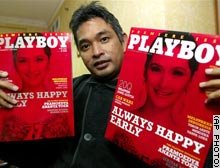
Tamer Playboy hits Jakarta newsstands
Islamic leaders denounce magazine, despite lack of nude women


Thursday, April 6, 2006; Posted: 11:00 p.m. EDT (03:00 GMT)

Publisher-director of Playboy Indonesia Erwin Arnada shows copies of the magazine's first edition.

JAKARTA, Indonesia (AP) -- A toned-down edition of Playboy magazine went on sale Friday in Indonesia, defying threats of protests by Islamic hardliners who called the publication a form of moral terrorism in the world's most populous Muslim nation.
The magazine does not feature nude women, and its photos of female models in underwear are no more risque than those in other magazines already for sale in the country. More explicit photos appear daily in local tabloids.
Protesters hit the streets in towns across Indonesia when the magazine announced in January it was planning a local version, but it remains to be seen whether demonstrations will pick up again after people have read it.
One hardline group, the Islamic Defenders Front, pledged to forcefully remove the magazines from shops.
"The first edition might be tame, but it will get more vulgar," said group spokesman Tubagus Muhamad Sidik. "Even if it had no pictures of women in it, we would still protest it because of the name."
Muslim leader Yusuf Hasyim said the magazine posed more of a threat to Indonesia than the terrorism from al Qaeda-linked militants that has killed more than 240 people in the sprawling country in recent years.
"This is a kind of moral terrorism that destroys the way of the life of the nation in a systematic and long-term way," state news agency Antara quoted Yusuf Hasyim as saying, calling on Muslim youth not to attack shops selling the magazine.
Playboy, which already has 17 international editions with content tailored to local tastes, played down the protest threats.
"Let the people look at it and see what they think. Hopefully they will accept it," said promotion manager Avianto Nugroho. "If there are demonstrations, we will try to meet their demands."
The magazine is unlikely to worry too much because if protests remain largely peaceful they will only boost sales. Nugroho denied speculation that by choosing to launch the magazine on Friday, the Islamic day of prayer, it was actively trying to trigger protests.
Most Indonesians practice a moderate form of Islam, and many women shun standard Middle Eastern forms of dress associated with Muslims. Many Indonesian women do not cover their heads and often dress in tight-fitting jeans and sleeveless tops.
Indonesian versions of Western magazines FHM and Maxim, which also contain photos of women in underwear, are already on sale.
Pornographic video compact discs, though illegal, are sold more or less openly at markets all over the country.
The magazine costs around $5 (€3.5), more than twice the minimum daily wage in Jakarta, but affordable to many middle- and upper-class city dwellers.
As well as two photo spreads of partially clothed women, the first edition includes an interview with internationally renowned Indonesian author Pramoedya Ananta Toer, and articles on East Timor after its break from Jakarta rule in 1999 and the development of Indonesian cartoons.

Copyright 2006 The Associated Press. All rights reserved.

Thursday, April 06, 2006

Bridges TV Cable Station

My family was probably the first family in Arizona, easily the first in southern Arizona to start subscribing to Bridges TV. In a little over a year, I have noticed the quality of the programming increase by leaps and bounds. Like anything else the first cable station dedicated to Muslim Americans appears to be a growth process that is in constant revolution. This is a good thing. I particularly enjoy the prominent scholar series every weekday morning. It is nice to have channel that the entire family can watch without the craziness that can be found on network TV or other pay TV channels. Not bad for $15 a month. It is also good because we need Muslim journalists and outlets for them, but that is another topic for another day. I'm glad that they are growing in viewership. Inshallah, more will benefit from this first step.


Muslim network expands to more than 1 million homes
April 5, 2006 - 4:57PM

BUFFALO, N.Y. (AP) - It was a premium pay-TV channel reaching ten-thousand households a year ago. Today, "Bridges TV" is a basic-cable offering on several cable and satellite systems, viewed in more than a million U.S. homes. "Bridges TV" features Muslim-American lifestyle and cultural programming. It can be seen in markets including Detroit, Chicago, Boston and Washington. The cable channel produces a daily, hour-long newscast at its studio in suburban Buffalo, New York. Broadcasts also include children's educational programming, current affairs, cooking and travel shows, soccer and cricket matches, documentaries and sitcoms. Ford Motor Company is a major sponsor. Bridgestv.com
Church packed for Islam talk
By Citizen reporter
A talk by an Islamic leader on ten things Christians should know about Muslims was attended by more than 100 people at a village church.
Moulana Faruk Ali delivered the talk which was hosted by Rev Doug Smith at Hillside Methodist Church in Brinscall.
Among the subjects discussed were aspects of Muslim prayer, the fact that Jesus is seen as a prophet under Islam, fasting during Ramadan and the pilgrimages expected of all Muslims.
Rev Smith said: "Everyone present found out more of what it is like for Muslims in modern day Britain."

11:48am Wednesday 5th April 2006
Islamic curtain
A curtain that once veiled the Kaaba in Mecca, the holiest place in Islam, may fetch $700,000 when it's auctioned Wednesday in London, said Sotheby's Holdings Inc. Embroidered with gold and silver threads, the door curtain dates from 1909 and is being sold by a family that received it then from the sultan, Sotheby's said.
montrealgazette.com
The CW greenlights Muslim comedy pilot
Tuesday, April 4 2006, 21:27 BST - by Neil Wilkes
New US network The CW has greenlit production on the pilot for a potentially controversial new comedy, Variety reported on Tuesday.Aliens In America, written by Moses Port and David Guarascio (Just Shoot Me), follows a family who send their 16-year-old son on a foreign exchange program.Things "don't go as planned", however, when the exchange student turns out to be a Pakistani Muslim who "wears a kufi on his head and a shalwar kameez over his body".If it gets the greenlight for next season, the show is being tipped as a partner for freshman hit Everybody Hates Chris.
Muslim Student Attacked On Baylor Campus
Muslim Student Attacked On Baylor Campus (Video)

(April 4, 2006)—The Washington-based Council on American-Islamic relations is calling on the FBI to probe at attack on a female Muslim student on the Baylor University campus as a hate crime.
The coed was attacked from behind Saturday evening as she walked to her dorm from the Student Union Building.

She told News Ten that her attacker was a white male who appeared to be in his 30s. She said she didn’t think the man was a Baylor student.
She said the man grabbed her headscarf and threw her to the ground, yelling profane ethnic and anti-Muslim slurs while threatening to kill her if she made any noise.
The man pinned her to the ground, she said, and dug his nails into her chest until she screamed.
When she screamed, she said the man slapped her in the face and kicked her twice in the ribs before he fled.
She required emergency room treatment for a dislocated shoulder and contusions.
She has left Baylor to return to her family’s home in a neighboring state to recuperate, the organization said.
She said she didn’t hear from university officials until Tuesday, three days after the attack.
She said she’s not sure whether she will return to Baylor.
CAIR says the attack should be taken seriously.
"Law enforcement authorities and university officials need to treat this disturbing incident with the seriousness it deserves," said CAIR Communications Director Ibrahim Hooper.
"Local, state and national leaders also need to speak out against the rising level of Islamophobic hate in our society that can lead to such attacks."
Baylor didn’t have an immediate comment on the incident, but did release a statement Tuesday evening saying the university is treating the incident “very seriously and is in the process of investigating the matter in cooperation with law enforcement agencies.”
“As a faith-based institution, Baylor is sensitive to, and very concerned about, the report of an assault involving ethnic or religious intolerance,” the statement said.
NSW Muslim Council 'not dumping mufti'
Tuesday Apr 4 13:31 AEST


The chairman of the NSW Muslim Council has rejected reports he wants to dump outspoken mufti Sheikh Taj Aldin Alhilali, describing him as a "good friend".
The Australian newspaper reported that a proposal by the NSW Muslim Council to redraw the constitution of the Australian Federation of Islamic Councils (AFIC) is aimed at deposing Sheikh Alhilali from his position as mufti of Australia.
Sheikh Alhilali has been the high-profile spiritual leader of the nation's 300,000 Muslims since 1989.
But NSW council chairman, Neil Kedomi, said the wide-ranging proposal, which will be put to a meeting of Islamic leaders later this month, is not a personal attack on Sheikh Alhilali.
"I have never had a problem with him, he's a good friend of mine," Mr Kedomi told AAP.
"He's the one who has helped me many times. He has the respect of 99.9 (per cent) of the committee and all the people ... who have positions in AFIC."
AFIC's chief executive, Amjad Mehboob, said the position of mufti is currently appointed in an "ad hoc manner", and the NSW Muslim Council's proposal looks to consolidate the position within AFIC's structure.
"The core purpose of the proposal is to formalise the position of the mufti within the structure of AFIC," Mr Mehboob said.
"As far as the mufti is concerned, that is, Sheikh Taj Aldin Alhilali, he is the mufti. This proposal is only going to consolidate his position," Mr Mehboob said.
Mr Kedomi said the proposal will act as an endorsement for Sheikh Alhilali.
"We (drew up) the proposal to make Sheikh Taj (Alhilali) attend the meetings and have a say in AFIC. The mufti ... is more wise than anybody else."
©AAP 2006
April 4, 2006
religion
Islam week delves into politics, perceptions
By Elizabeth Giorgi


Muslims are not terrorists.
The Muslim Student Association and Al-Madinah Cultural Center have collaborated for the week to address issues and stereotypes that portray the Islamic faith in a negative light.
Islam Awareness Week is not only a campus event, but also is recognized nationally. “Unpatriotic Religion” is the groups’ theme on campus describing what they call unfair treatment of Muslim Americans as a result of the Patriot Act.
This week is important because students have the opportunity to learn and get beyond the Muslim stereotypes depicted in the media, said Muslim Student Association President Mus’ab Husaini.
“Islam is the religion of peace, and we would like to present that idea and (that Muslims) are peaceful Americans,” he said. “We are as peaceful and democratic and peace-loving as any other people.”
Awareness is essential for people to learn and understand the misrepresentation of Muslims that stereotypes cause, Husaini said.
Students are known for pursuing knowledge, and University students have the opportunity to seek knowledge about Islam firsthand during a week such as this, he said.
One of the common stereotypes about Muslim women is that they are oppressed because of how they dress, but that is not the case, said Muslim Student Association Vice President Ayan Ali.
Also, the portrayal of a few Muslims in the media makes it seem as though all Muslims are terrorists, but that is not true, she said.
Ali said focusing on a larger picture of the Islamic faith can help students understand it.
“People need to open their eyes and be more objective when they want to learn about Islam, and TV is not the only place to look for their knowledge,” she said.
Augsburg College studio art senior Kim Jurek decided to attend the event after she heard the evening’s speaker, Imam Johari Abdul-Malik on Minnesota Public Radio on Monday morning.
Jurek said the topic of the Patriot Act sounded really interesting, and because she wasn’t Muslim, she thought it would be a good opportunity to learn something different.
Imam Johari Abdul-Malik is well-known for his work serving as the Muslim chaplain at Howard University in
Washington and was the first Muslim officially installed as a chaplain in higher education at Howard. He is the head of the National Association of Muslim Chaplains in Higher Education.
Abdul-Malik opened Monday evening’s speech by enforcing that he denounced all terrorism and explained the Patriot Act’s unfair targeting of Muslims.
“Terrorism knows no religion,” he said. “It is not part of any of our traditions.”
The Patriot Act was enacted after Sept. 11, 2001, to help counteract possible terrorist attacks on the United States.
There are many examples of people who have been denied their rights in this country through wiretapping and unwarranted searches of homes as part of the act’s measures to identify terrorists, Abdul-Malik said.
Problems with the act make it difficult to fight terrorism fairly, he said.
Islam Awareness Week is not the only time people should be trying to learn about the Islamic faith, how the Patriot Act affects it and trying to examine the truth behind the stereotypes, Ali said.
Rather, people should try to learn about Islam anytime they are able to, Ali said.
“With Islam you don’t need to go read a book about it, you need to experience it,” she said.
© Copyright 2006 The Minnesota Daily

April 2, 2006
Rice Finds British Muslims Want to Give Her an Earful
By
JOEL BRINKLEY
Correction Appended

BLACKBURN, England, April 1 — Secretary of State Condoleezza Rice faced more protests and public embarrassment here on Saturday that have turned a trip meant to be a friendly follow-up to an American trip by Foreign Secretary Jack Straw into a two-day run through a raucous, mishap-ridden gantlet.
She was heckled by protesters and faced criticism from Muslim leaders hand-selected to meet with her by the Foreign Office during a visit here, the district Mr. Straw represents in Parliament. He visited Ms. Rice's hometown, Birmingham, Ala., in October.
About 250 protesters ringing Blackburn's City Hall shouted "Shame on you" as the two arrived. Through the din, Ms. Rice looked off into the distance and spotted a handful of people, many holding shopping bags, who had stopped to gawk.
She pointed them out to Mr. Straw, and the two of them waved enthusiastically. Later, Mr. Straw said this gathering of "people who agree with the visit" was "at least as large as the protesters."
In a news conference, Ms. Rice said she was "enjoying this visit very much." She described the meeting with the Muslim leaders as "immensely stimulating and interesting."
Although the names of the 21 Muslim leaders had been made public, several of them requested that their names not be published or broadcast, for fear of repercussions. Five who agreed to be interviewed clearly feared they might be viewed as traitors.
"We are here to represent the views of the thousands of protesters out there," said Kamrudden Kotha, the leader of a business federation. "We talked to them about the perceived double standard of American foreign policy. But I am not naïve enough to think we will change American foreign policy."
Whenever asked, Mr. Straw said the protesters were a small minority, and he even belittled them, saying at one point that he "could have done better" during his youthful days as a peace advocate. He added, "I can't say I am embarrassed in the least" by the reception his hometown gave to Ms. Rice. "If you did an opinion poll, you'd find that the vast majority of people in Blackburn agree with this trip."
On Friday, Ms. Rice had to content herself with a visit to the Liverpool school where Paul McCartney studied instead of meeting him — and had to face a short line of students wearing T-shirts that said: "No torture. No compromise." During a visit to a school in Blackburn, she was greeted with chants of "Condi Rice go home!"
Mr. Straw had advised Ms. Rice that she would probably be greeted by protesters on the trip, officials said, and she told him that such confrontations would not bother her. She gave several interviews to the British press, and almost every one was dominated by questions about her rough reception.
"People can say whatever they wish," she told The Lancashire Evening Telegraph. "I know where I stand. We made the right decision" in Iraq. "I was fully supportive of the decision."
During the news conference in Blackburn on Saturday, the boos and jeers rose to greet the secretaries as they spoke. Referring to the protesters at one point, Ms. Rice said, "They make my point. A democracy is the only system of government that allows people to be heard peacefully."
In front of City Hall a little earlier, Mayor Yusef Janvirmani, a native of Uganda, stood on the steps, resplendent in his ceremonial red robes, the heavy gold mayor's medallion suspended from his neck. He seemed unsure what to do as he prepared to welcome Blackburn's most prominent foreign visitor in decades. He decided to shake hands with the protesters behind the barricades as if he were working a rope line. "I'm delighted they are here," he told reporters. "I am against the war and will tell her that."
"But," he added, "having the secretary of state here is good for the economy."
Correction: April 6, 2006
Because of editing errors, articles on Saturday and Sunday about Secretary of State Condoleezza Rice's visit to England misstated Foreign Secretary Jack Straw's relationship to Blackburn, England. It is a town in the district he represents, not his hometown.

Tuesday, April 04, 2006

Mufti to be ousted by Muslim leaders
Richard KerbajApril 04, 2006

A POWERFUL group of Muslim leaders has moved to depose the contentious Sheik Taj Din al-Hilali as Mufti of Australia - the nation's most senior Islamic cleric.The Australian understands the high-profile but controversial spiritual leader of Australia's 300,000 Muslims will be challenged for his position at a meeting of Islamic leaders within weeks.
Under the plan to oust Sheik Hilali, the NSW Muslim Council proposes to call for the position to be made vacant as part of a plan to set up a national board of imams identified by the executive of the umbrella body, the Australian Federation of Islamic Councils.
The NSW Muslim Council proposes redrawing AFIC's constitution so that the mufti position would be decided by a vote of Islamic council representatives from around Australia.
The proposed new rules for AFIC - which represents the nation's nine leading Muslim organisations - obtained by The Australian, states: "The AFIC executive committee in conjunction with the federal council and the AFIC state board of imams shall set up a national council of imams under a mufti of Australia who shall be appointed by the congress of AFIC at the recommendation of the executive committee."
The Australian understands the push to depose the Egyptian-born Sheik Hilali from the position he has held since 1989 follows criticism levelled at him by the federal Government and Islamic leaders over his outspoken opposition to John Howard's hand-picked Muslim advisory board.

The chairman of the NSW Muslim Council, Neil Kadomi, said yesterday the plan would give "specific" members of the community the opportunity to choose their mufti. "So many ... say that he (Hilali) is not our mufti," he told The Australian yesterday.
Mr Kadomi said the proposal would make official the position of mufti and be included in the AFIC's constitution.
The outspoken Sheik Hilali, head of Lakemba Mosque in Sydney's southwest, has divided the Muslim community since he was named Mufti by AFIC in 1989. He is paid by the federation but the position has no formal grounding in the body's constitution.
Sheik Hilali, who is considered a moderate leader but has regularly shaken relations with the Howard Government, still has a strong powerbase, particularly within the Lebanese community.
The Mufti, a member of the Prime Minister's Muslim Community Reference Group, told The Australian last month the 14-member body was "stillborn" and had been set up to disseminate Howard Government "propaganda".
He made an extraordinary dash to Iraq last year in an effort to help the Howard Government secure the freedom of kidnapped Australian Douglas Wood.
Mr Kadomi said the proposed process of appointing a new mufti would be more democratic and would be a great test to see rate Sheik Hilali's popularity.
He said the vote to appoint a mufti "would have to be a majority decision".
But the vote would not be determined by the nation's 300,000-strong Muslim population, but by the nine state- and territory-based AFIC-member organisations, including on Christmas Island.
Afghan convert sheds his Muslim name
Monday April 03, 2006 (1147 PST)


ROME: The exiled Afghan convert, Abdul Rahman, now reportedly wants to be identified as Joel -- his baptism name – and has expressed his thanks to people of Italy for their efforts to secure his release.
According to Assist News Service Joel (formerly known as Abdul Rahman) also extended thanks to Pope Benedict XVI for the same.
He was charged with death sentence since Afghanistan’s Sharia law interprets a Muslim’s conversion from Islam to any other religion as crime.
Mounting international pressure prompted Afghan President Hamid Karzai to intervene to save the Afghan convert from possible death sentence.
Italy granted asylum to 41-year old convert following his appeal for sanctuary in the west. He made to Italy on March 30.
Almost all Afghan parliamentarians have reportedly flayed the government’s decision to allow the convert to fly to Italy. Voicing their displeasure they said the trial should have continued against Joel in Afghanistan.
Rahman is said to have converted to Christianity some 16 years ago in Germany while working with an international Christian organization. He was charged with death sentence after he was seen holding Bible in Afghanistan.

Sunday, April 02, 2006

Muslim cemetery in Charlotte running out of room
Associated Press

CHARLOTTE, N.C. - Muslims in the Charlotte area are concerned their cemetery is running out of room. Cemetery treasurer Hossam Shoukry expects the remaining 100 plots will be gone in the next several years. Expansion options are limited, as buying and clearing additional land will probably be too expensive, he said.
The cemetery in east Gastonia serves Muslims from Gaston, Lincoln, Cleveland and Mecklenburg counties, as well as areas near the South Carolina border.
Burying Muslims in other types of cemeteries means certain burial traditions can't be followed, said Khalil Akbar, imam of the Ash-Shahad Islamic Center in Charlotte.
"Some cemeteries have regulations that don't accommodate us," Akbar said. "We want our own cemeteries so we don't have to compromise."
Traditional Muslim burial calls for the body to be wrapped in a shroud and buried in a two-level grave, lying on its side and facing Mecca. Some Muslims approve of coffins, but only if they're made of natural materials.
North Carolina law does not require that a body be buried in a coffin, but many local ordinances do, said Claud Whitener, administrator and general counsel for the North Carolina Cemetery Commission. Charlotte's six city-owned graveyards require the use of coffins.
Whitener said the best option for Muslim cemeteries is to buy new land. But in the South, that's often been a frustrating process due to local laws and suspicion.
Two years ago, Muslims in Lawrenceville, Ga., and Somerville, Tenn. petitioned for new cemeteries. But residents objected over fears that the unenclosed bodies could contaminate underground water or spread disease, despite experts' reassurances.
In Somerville, a mosque was built and a cemetery is being prepared. Muslims in Lawrenceville compromised, agreeing to use plywood boxes with plastic caps for coffins.
Louay Safi, executive director of the leadership development training center at the Islamic Society of North America, said the issue will continue to pose a challenge as Muslims move to smaller cities and seek to be buried there.
Safi said most Muslim cemeteries in the United States are near large cities. An Atlanta cemetery with room for 2,000 graves contains the remains of about 300 Muslims from around the country, according to Al-Farooq Masjid mosque.
About 90 percent of Muslims who have died in the Charlotte region are buried in the Gastonia graveyard since it was founded in the early 1990s, said Jibril Hough, spokesman for Charlotte's Islamic Center.
About 12,000 Muslims live in the city.
Shoukry said searches for new cemetery land in Charlotte and surrounding areas are only in the preliminary stages.
Fateen Hakeem of Charlotte is already looking elsewhere. He has bought plots for himself and his wife in York Memorial Cemetery in southwest Charlotte, where managers have set aside an area with about 100 sites for Muslims. Fifteen have been claimed.
"I've been here all my life," he said. "It's more convenient. It'd have to be almost a special trip to go to Gastonia."


Information from: The Charlotte Observer, http://www.charlotte.com
Islam recruited to help Egyptians fight HIV
02 Apr 2006 01:02:16 GMTSource: Reuters
By Mohammed Abbas

CAIRO, April 2 (Reuters) - In Egypt HIV and AIDS happen to other people; namely foreigners, the promiscuous, drug addicts and generally the morally corrupt, who should be avoided in case they infect you with a handshake, cough or unwashed cup.
Which is why Ahmed Turky's Friday sermon at a small Cairo mosque was unusual. In a Muslim country where hard drugs are relatively rare, gays are imprisoned and sex before or outside marriage is furtive, Turky's talk of compassion turned heads.
"The sermons had three points, first what AIDS is, secondly how it is spread and thirdly that if someone has AIDS it is an obligation of us all not to ostracise them," Turky said.
The majority of Egypt's health workers believe those with HIV should be removed from society, while most university students think "lewd" people, or those "who have neither values nor principles" are likeliest to get AIDS, a 2004 study found.
Turky started preaching about HIV and AIDS after attending a workshop organised by the U.N. Development Programme (UNDP), which in a new initiative aims to spread awareness about the disease by training religious leaders at a local level.
Although senior Arab religious leaders publicly backed efforts to combat the spread of HIV and discrimination against carriers of the virus in a declaration in 2004, spreading the message to local religious leaders has proved more difficult.
"You can always do good advocacy on top...But then trickling down is a completely different story," said Maha Aon of U.N. AIDS body UNAIDS.
Workshop information packs illustrate Islam's willingness to tackle sexual topics, and call for Koranic verses and sayings of the Prophet Mohammad that urge compassion and care for the welfare of others to be applied to those affected by HIV.
RAPID SPREAD
According to 2003 figures, fewer than 0.1 percent of Egyptian adults carry the HIV virus, but conditions exist for the disease to spread rapidly.
With about 73 million inhabitants, Egypt is the most populous Arab state. About 56 percent are aged under 25. Despite cultural prohibitions against pre-marital sex, experts say the young are particularly vulnerable to HIV.
Furthermore, chronic youth unemployment means fewer people can afford to marry, increasing the risk of HIV spreading as men turn to temporary marriage, prostitutes or sex with other men.
Illiteracy, especially among women, is high, making AIDS awareness more difficult. The social standing of most women in Egypt is such that they have little control over their sex lives. Many with HIV contracted the disease from their husbands.
Combined with widespread poverty, low levels of condom use, public discomfort with discussing sexual issues and the fear and ignorance surrounding AIDS, activists fear the disease could be more prevalent and spreading faster than once believed.
"There are two things that make us worry. If you plot the number of cases reported to the Ministry of Health it's quite a steep rise. The other thing is that we don't know what the situation is among the most vulnerable groups," Aon said.
Generally, men who have sex with men, injecting drug users and prostitutes are hardest hit by HIV epidemics. Each of these groups is strongly condemned in Islamic societies and consequently difficult for activists to reach.
Turky's sermons did not address these groups directly, or mention the use of condoms, which are mainly considered in Egypt as contraception for married couples. However, he said even those who contracted HIV in "vulgar" ways should not be shunned.
"When a man told the Prophet he was addicted to forbidden sex, the Prophet's companions were angered. But the Prophet listened, and by appealing to his mind and heart, not through anger, the Prophet persuaded him to stop," Turky preached.
FOREIGN DISEASE
Gay and bisexual men fear that, if they come forward for HIV testing, police will use their medical records to find and arrest them, and doubted that religious preaching would change state or public attitudes towards them or HIV.
In a high-profile crackdown in 2001 a number of men were arrested when police stormed a Cairo gay haunt, and later in sting operations arranged through Internet chat sites.
"It won't change a thing. The government wants to pretend gays don't exist, not help them. People like to believe that this is an Islamic society, so there are no gays," said one man.
Like many young men, he said, he was bisexual and would eventually marry. Although he himself tested regularly for HIV, he said most of his friends did not, and described a sub-culture in which rumour and ignorance discouraged condom use.
"Some think that if you only see Egyptians you won't get AIDS, or that if the whites of their eyes are very clear, they don't have HIV," he said, adding that female prostitutes he knew considered clients from strictly Islamic countries HIV-free.
Despite these attitudes, Aon said Egypt had made progress in combating the spread of HIV. Since 2004 HIV testing for Egyptian nationals has been anonymous, and from 2005 the Health Ministry made the costly drugs to treat HIV available free of charge.
Earlier this year, activists founded a drop-in health centre for commercial sex workers, and although practical AIDS advocacy through religious leaders is limited, they have great influence over Egypt's increasingly religious society.
"We don't have a visible or very prevalent epidemic. It's very much a silent epidemic...Of course if you sit back and think logically, the time to act is now, before it becomes much more difficult to control and much more expensive," Aon said.

French Muslims Get Grand Mosque
The mosque accommodates some 1,000 worshipers.
By Hadi Yahmid, IOL Correspondent


PARIS, April 1, 2006 (IslamOnline.net) - French Muslims in the southeastern city of Villeurbanne will no longer be crammed into vault prayer rooms or perform the weekly Friday prayer in the open as a grand mosque, accommodating 1,000 worshipers, opens its doors on Sunday, April 2.
"Villeurbanne now has a mosque in the true, literal sense of the word," Azzedin Gaci, the imam of the new mosque and the chairman of the French Council for Muslim Faith (CFCM) chapter in the Rhone Alpes province, told IslamOnline.net.
"A handful of Muslim places of worship in France can be called mosques," Gaci said.
"French Muslims are entitled to establish grand mosques to be a source of pride for both Muslims and Islam."
The three-storey Othman Mosque is built on 1,200 square meters with a huge library, school and a parking lot.
Dalil Boubakeur, the chairman of the umbrella CFCM, and Minister of Transport Dominique Perben will inaugurate the mosque Saturday, April 1, accompanied by a host of local religious leaders in the city.
Construction of the mosque, named after third Muslim Caliph Othman Ibn Affan, began in July 2003.
France is home to around six million Muslims, the largest Muslim minority in Europe.
Independent
The mosque building also features a school and a huge library.
Gaci said what is unique about the new mosque is its absolute financial independence.
"It is 100 percent funded by French Muslims and has received no foreign aid," he added.
The Islamic Cultural League in France, which supervised the construction of the Othman Mosque, raised one million euros for the project from French Muslims.
"This financial independence will consequently make the mosque politically independent from any foreign influences," said Gaci.
"It is open for all Muslims irrespective of their ethnic or communal backgrounds. It is, in fact, a stepping stone towards a 'French Islam' as the problems facing Muslims here are purely French."
Many mosques in France are affiliated either to the different Muslim communities in the European country or their countries of origin.
Paris Mosque, for instance, has indirect links to the Algerian government, while others are known for their affiliations with Morocco or Gulf states.
In March last year, France's major Islamic groups and then Interior Minister Dominique de Villepin gave the go-ahead for establishing the Foundation for Islamic Works with the aim of financing the construction of mosques and development of other Islamic activities in France.
A French book published in 2004 highlighted the history of mosques in France, particularly in the northern Alsace area.
Titled "Histoires de Mosquees,"
the book takes the readers back to the early stage of construction of mosques in France in 1960s.